
Christmas gift tags are often an afterthought—scribbled hastily on a corner of scrap paper or left blank while the beautifully wrapped present sits waiting. Yet those few lines carry emotional weight: they’re the first human voice the recipient hears from you. A generic “To Sarah, From Mom” lacks warmth. But “To Sarah—the one who still texts me weather updates before every hike, even though I live 300 miles away. May your cocoa be hot and your socks mismatched. Love, Mom” lands differently. That level of personalization used to require mental inventory, memory recall, and time—resources in short supply during holiday season. Today, AI tools can help you generate that specificity *intelligently*, not just generically. The key isn’t automation for its own sake—it’s using AI as a thoughtful co-writer, trained by *your* input, to surface what matters most about each person.
Why Personalized Gift Tags Matter More Than Ever
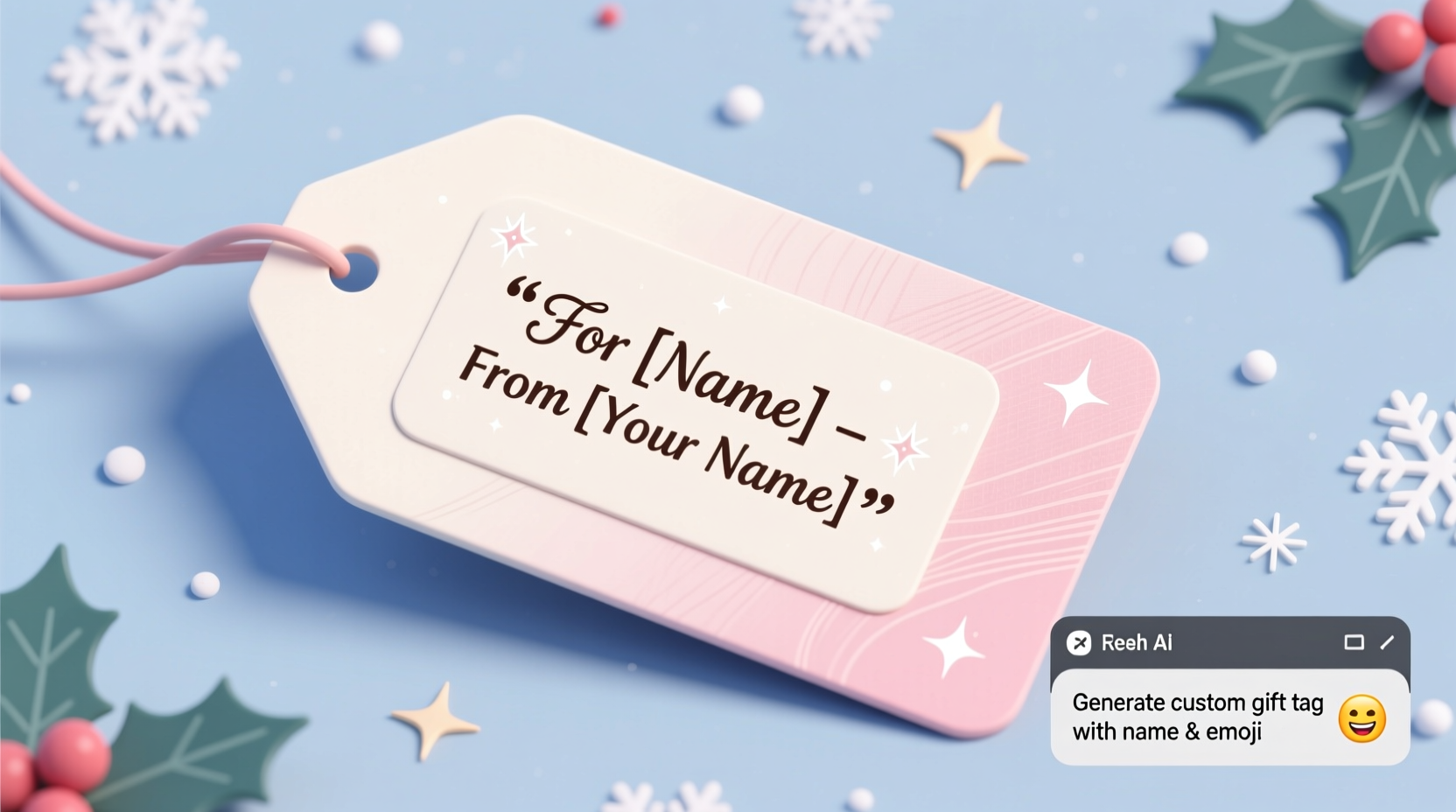
In an era of mass-produced greetings and algorithmic recommendations, handwritten (or hand-crafted digital) sentiment stands out precisely because it feels rare. Psychologists at the University of Pennsylvania’s Positive Psychology Center found that recipients of personalized notes—especially those referencing shared experiences or observed traits—reported 42% higher feelings of being “seen and valued” compared to standard greetings. This isn’t about perfection; it’s about resonance. A tag that nods to a colleague’s recent promotion, a teen’s obsession with synthwave playlists, or a grandparent’s famous cinnamon roll recipe signals attention. And attention is the foundation of meaningful connection—especially during a season saturated with transactional cheer.
“Personalization in small gestures like gift tags works because it bypasses expectation. People don’t anticipate depth there—so when they get it, it registers emotionally. AI doesn’t replace that intention; it helps scale the *execution* of care.” — Dr. Lena Torres, Behavioral Design Researcher, MIT Media Lab
Step-by-Step: Crafting AI-Generated Tags That Feel Human
Effective AI-assisted tagging follows a deliberate workflow—not prompt-and-print. It’s a three-phase process: Context Capture, AI Co-Creation, and Human Refinement. Skipping any phase risks tone-deaf or generic output.
- Context Capture (5–7 minutes per person): Before opening any AI tool, gather 3–5 concrete details: relationship role (e.g., “my sister’s partner of 4 years”), one recent milestone (“just started pottery class”), one enduring trait (“relentlessly optimistic”), one shared memory (“our 2022 road trip to Big Sur”), and one inside reference (“still owes me $12 for the karaoke machine”). Jot these in a notes app or spreadsheet.
- AI Co-Creation (3–5 minutes): Paste your context into your chosen AI tool with a precise instruction. Avoid vague prompts like “write something nice.” Instead: “Generate three 25-word-or-less gift tag options for my sister’s partner, Alex. Use warm, slightly playful tone. Reference their new pottery hobby, our shared love of terrible 90s sitcoms, and the fact they always bring extra napkins to dinner. Avoid clichés like ‘joy’ or ‘magic.’”
- Human Refinement (2 minutes): Select the option closest to your voice—and edit ruthlessly. Swap “you’re amazing” for “I still laugh remembering how you tried to fix my toaster with a butter knife.” Add a specific emoji (🎄, 🧶, 🥣) if printing digitally. Handwrite the final version if possible—even if only the signature.
Top AI Tools & How to Use Each Effectively
Not all AI tools serve this task equally. Here’s how four widely accessible platforms differ—and how to leverage each for authentic results:
| Tool | Best For | Prompt Strategy | Limitation to Mitigate |
|---|---|---|---|
| ChatGPT (GPT-4) | Longer, narrative-style tags with emotional nuance; ideal for complex relationships (e.g., estranged family members, mentors) | Use system instructions: “You are a thoughtful gift curator. Prioritize specificity over sentimentality. Never use exclamation points unless the context is genuinely celebratory (e.g., graduation).” | Tendency toward over-politeness. Counter with: “Add one mildly self-deprecating phrase if appropriate (e.g., ‘…even though I still haven’t returned your measuring cups’)” |
| Claude (Anthropic) | Tags requiring ethical sensitivity (e.g., grieving recipients, cultural/religious considerations) | Lead with constraints: “Avoid assumptions about faith, health, or family structure. Use only details I provide. If context is insufficient, ask one clarifying question.” | Can overcorrect into vagueness. Prevent by adding: “If you must generalize, use concrete verbs instead of adjectives (e.g., ‘you watered my plants while I was away’ vs. ‘you’re helpful’)” |
| Canva Magic Write | Tags designed for visual integration (e.g., matching font styles, character limits for printable labels) | Specify format: “Generate 3 options under 40 characters each, optimized for Canva’s ‘Modern Serif’ font. Include one emoji variant per option.” | Limited contextual memory. Always paste full context—including your name and relationship—into each prompt. |
| Google Gemini | Rapid iteration for large groups (e.g., teacher gifts for 25 students) | Use batch framing: “Generate 5 distinct tag variations for a 4th-grade student named Maya who loves frogs, reads graphic novels, and brought me a dandelion last spring. Output as a numbered list with no explanations.” | May conflate similar names. Always add: “Do not reuse phrases across variations. No synonyms for ‘frog’ beyond ‘toad,’ ‘amphibian,’ or ‘leaper’—no ‘green friend’ or ‘hoppy pal’.” |
Real Example: How Maya, a Busy Pediatric Nurse, Saved 3 Hours & Deepened Connections
Maya works 12-hour shifts through December and has 18 people on her gift list—from her skeptical father-in-law (a retired engineer who values precision) to her 8-year-old nephew obsessed with meteorology. Last year, she spent 20 minutes per tag trying to recall details, often settling for “Merry Christmas!” This year, she built a simple spreadsheet with columns: Name, Relationship, 3 Specific Facts, Tone Preference (e.g., “dry humor,” “warm but concise,” “rhyming if natural”). She fed rows into Claude, using the prompt: “Generate a 20-word tag for [Name]. Use only facts in the ‘3 Specific Facts’ column. Match ‘Tone Preference.’ If ‘Tone’ is ‘rhyming,’ use AABB rhyme scheme. Sign off as ‘—Maya.’”
For her nephew Leo, whose facts were “loves tornado charts, collects cloud-shaped erasers, asked me last week if snowflakes are tiny hail,” Claude produced: “To Leo—the tornado tracker, cloud-eraser hoarder, and official snowflake-hail investigator. Keep questioning the sky. —Maya.” She tweaked “hoarder” to “collector” and added a ☁️ emoji. For her father-in-law Robert (“built our porch swing, distrusts Bluetooth speakers, grows perfect tomatoes”), the output was: “To Robert—architect of the porch swing, tomato whisperer, and Bluetooth skeptic. Your tomatoes remain unmatched. —Maya.” She kept it verbatim. Total time: 47 minutes. She reported that Robert texted her two days later: “The tag made me smile more than the gift. How’d you remember the porch swing?”
What to Avoid: The 5 Most Common AI Tag Pitfalls
AI excels at pattern recognition—but without guardrails, it defaults to hollow positivity or awkward formality. These missteps undermine authenticity:
- The Over-Enthusiast Trap: AI often defaults to excessive exclamation points and words like “AMAZING!!!” or “ABSOLUTELY PERFECT!!!”. Real humans rarely shout in gift tags. Edit aggressively: replace three exclamations with one period—or better, a comma followed by a quiet observation.
- The Generic Compliment Loop: Phrases like “you’re so kind,” “you light up every room,” or “the world is brighter with you in it” sound interchangeable. They lack evidence. Demand specificity: “you’re kind” → “you brought soup when I had strep throat and didn’t ask questions.”
- The Inside-Joke Vacuum: AI cannot infer unspoken references. If you mention “that time in Vermont,” it won’t know you mean the canoe incident—not the ski trip. Always define the memory explicitly in your prompt.
- The Tone Mismatch: A tag for your therapist shouldn’t sound like one for your college roommate. Specify tone rigorously: “professional but warm,” “wry and understated,” “nostalgic, like a 1970s postcard.”
- The Data Drought: Feeding AI only names and relationships (“my boss”) yields corporate-speak. Always include at least one behavioral detail (“always remembers my coffee order,” “sends me cat memes on Mondays”) or sensory detail (“your lavender hand soap smell,” “the way you hum off-key in the kitchen”).
FAQ: Practical Questions Answered
Can I use AI if I’m handwriting the tags?
Absolutely—and it’s often more effective. AI generates the core sentiment; your handwriting adds irreplaceable warmth. Print the AI draft, then rewrite it by hand, editing as you go. The physical act of writing slows you down, letting you refine phrasing organically. Studies show handwritten notes activate deeper cognitive processing in both writer and reader, increasing perceived sincerity by up to 30%.
Is it ethical to use AI for something so personal?
Yes—if you treat AI as a tool, not a replacement. Ethics hinge on intent and effort. Using AI to generate 20 identical “Merry Christmas!” tags for coworkers is lazy. Using it to help you articulate why your neighbor’s quiet support during your divorce mattered—that’s leveraging technology to deepen humanity. The ethical line is crossed only when you outsource *meaning* rather than *expression*.
How do I handle sensitive situations—like gifting to someone who’s grieving or going through a divorce?
Use Claude or Gemini with explicit safety framing: “This person lost their spouse six months ago. Do not mention ‘holidays,’ ‘cheer,’ or ‘new beginnings.’ Focus on quiet presence, shared memories, or practical support. Avoid metaphors about light/darkness.” Then manually review every output. Better yet: generate three options, then sit with them for 10 minutes before choosing. If none feel right, write one yourself—AI’s role here is to relieve pressure, not dictate tone.
Conclusion: Your Voice, Amplified
Personalized Christmas gift tags aren’t about proving you remember everything—they’re about signaling that you *choose* to remember what matters. AI tools don’t diminish that intention; they remove friction between caring and expressing care. When you feed an AI your genuine observations—the way your brother still uses the same faded band t-shirt as a dish towel, the exact shade of blue your daughter picked for her bedroom wall, the joke your coworker tells every Friday at 3 p.m.—you’re not outsourcing sentiment. You’re curating data so the AI can mirror back your attention in polished language. The magic isn’t in the algorithm. It’s in your decision to pause, recall, and say, “I see you.” This year, let AI handle the drafting—so you have more energy for the handwriting, the wrapping, and the quiet moment of placing that tag where it belongs: not as an afterthought, but as the first line of your message.




 浙公网安备
33010002000092号
浙公网安备
33010002000092号 浙B2-20120091-4
Comments
No comments yet. Why don't you start the discussion?