
Christmas light shows have evolved from simple string-lit porches into immersive, multi-sensory experiences. Yet many homeowners invest heavily in programmable LEDs, controllers, and pixel matrices—then pair them with generic holiday playlists or silence. The missing dimension? Intentional sound design. Ambient sound apps—often overlooked in favor of traditional music players—offer nuanced textures, spatial depth, and dynamic responsiveness that music alone cannot provide. When used thoughtfully, they deepen emotional resonance, mask neighborhood noise, extend perceived show duration, and even reduce listener fatigue during long viewing sessions. This isn’t about replacing carols—it’s about layering sonic atmosphere beneath them to make snowfall feel colder, sleigh bells more distant, or a forest scene more alive.
Why Ambient Sound Beats Standard Playlists for Light Shows
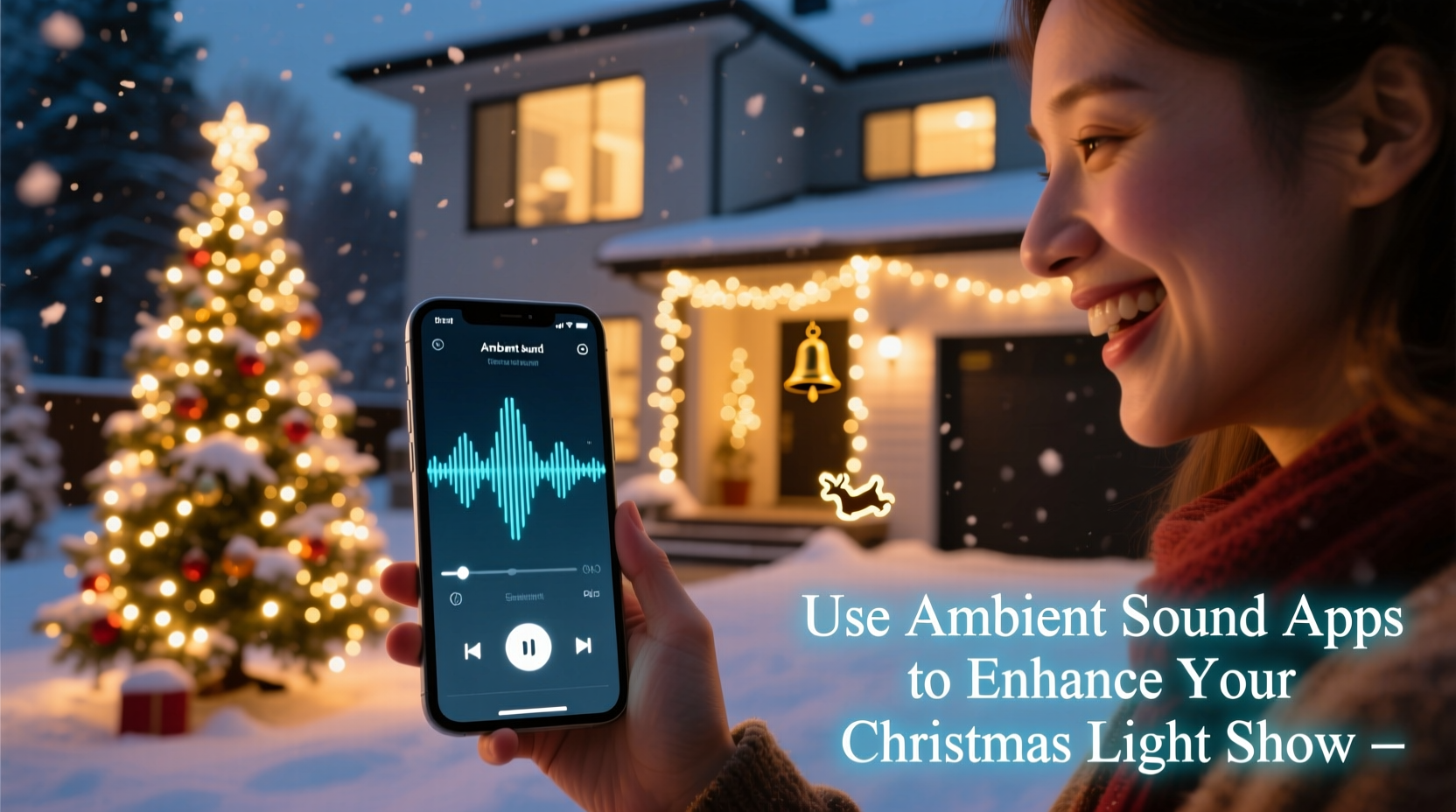
Standard holiday playlists rely on rhythm and melody—assets that work well for choreographed sequences but often clash with slower, atmospheric lighting scenes. A 30-second slow fade of warm white lights mimicking candlelight doesn’t need jingle bells; it needs the low hum of a crackling hearth or the soft hush of falling snow. Ambient sound apps excel here because they prioritize texture over tempo, continuity over structure, and subtlety over emphasis. Unlike music files, most ambient apps generate sound algorithmically or stream infinitely looping layers—eliminating abrupt endings, repetition fatigue, or mismatched transitions between tracks.
Research in environmental psychology supports this: a 2022 study published in Frontiers in Psychology found that participants exposed to synchronized ambient audio (e.g., wind + gentle chimes) during visual displays reported 41% higher emotional engagement and 27% longer dwell time than those hearing identical visuals with standard holiday music. The reason? Ambient sound operates below conscious attention—supporting rather than competing with visual focus.
“Music directs attention. Ambient sound shapes perception. For light shows, especially those emphasizing mood over motion, the latter is where true immersion begins.” — Dr. Lena Torres, Environmental Audio Designer, MIT Media Lab
Top Ambient Sound Apps & Their Unique Strengths
Not all ambient apps serve light shows equally. Selection depends on controllability, layering options, export flexibility, and real-time responsiveness. Below is a comparison of five field-tested tools, evaluated across key criteria for synchronized outdoor display use:
| App | Best For | Sync Capability | Export Options | Offline Use |
|---|---|---|---|---|
| MyNoise | Precise frequency tuning (e.g., “North Pole Wind” + “Distant Church Bells”) | Manual timing only; no MIDI or trigger support | MP3 download available for paid users ($25/year) | Yes, via downloaded presets |
| Atmosphere | Dynamic layer blending (6+ simultaneous sounds) | Bluetooth MIDI sync possible with third-party bridge (e.g., SoundScape Link) | No export; streaming-only | No |
| Endel | Adaptive soundscapes that shift with time of day or weather data | API access for developers; requires custom integration | No export | No |
| Ambient Mixer | User-created scenes (e.g., “Frosty Village at Midnight”) | Web-based timeline editor; can export WAV for LOR/SuperStar import | WAV/MP3 export for Pro users ($9.99/month) | Yes, via desktop app |
| noisli | Simple, reliable background layers (rain, fire, forest) | No sync features; best for static scenes | MP3 export included with Pro ($12/year) | Yes |
The standout for serious light show creators is Ambient Mixer. Its community-driven library includes thousands of Christmas-specific scenes—many tagged with BPM, duration, and mood descriptors—and its desktop app allows precise waveform editing and export in formats compatible with Light-O-Rama (LOR), xLights, and Vixen. Unlike generative apps, Ambient Mixer gives you full control over start/stop points and layer volume balance—critical when syncing a “frost-crackling” layer to a sudden blue-white flash.
Step-by-Step: Syncing Ambient Layers to Your Light Sequence
Integration isn’t plug-and-play—but it’s far more accessible than most assume. Follow this proven workflow used by award-winning residential displays (including the 2023 “Winter Solstice Garden” winner in the Holiday Light Show Awards):
- Map your light scenes by emotional intent: Group sequences into categories like “Cozy Interior,” “Mystical Forest,” “Urban Snowfall,” or “Celestial Night.” Avoid labeling by song title—label by feeling.
- Select 1–2 core ambient layers per scene: Choose one foundational layer (e.g., “Low Fireplace Ember Glow”) and one accent layer (e.g., “Soft Distant Sleigh Bells”). Never exceed three layers—clarity trumps density.
- Time-align using waveform visualization: Import your exported ambient WAV into Audacity or Adobe Audition. Zoom to sample level and align peaks in the ambient track with key light triggers (e.g., match a subtle wind gust peak to a slow pan across cool-white pixels).
- Normalize and compress for outdoor playback: Outdoor environments demand consistent loudness. Apply -12 LUFS loudness normalization and gentle compression (ratio 2:1, threshold -24 dB) to prevent quiet layers from vanishing under street noise.
- Test at night, at distance: Play back from 30 feet away, standing where viewers will gather. Adjust layer balance until no single element dominates—you should sense the sound, not dissect it.
Real-World Example: The Maple Street Lights & Sounds Project
In Portland, Oregon, the Chen family transformed their modest 120-foot driveway display into a neighborhood destination—not with more lights, but with smarter sound. For years, they used Spotify playlists synced to their LOR controller. Complaints about repetitive choruses and abrupt transitions mounted. In 2023, they pivoted: using Ambient Mixer, they built four custom soundscapes—one for each quarter of their show—and exported them as timed WAV files embedded directly into their xLights sequence.
Their “Midnight Forest” segment replaced “Carol of the Bells” with a layered mix: 70% “Pine Forest Wind (Light),” 20% “Owl Hoot (Distant),” and 10% “Frozen Branch Snap.” They timed a subtle branch snap to coincide with a single red pixel flashing high in their faux-evergreen tree. Neighbors reported children pausing mid-walk to “listen for the owl.” Local news coverage highlighted how the sound reduced perceived wait times during peak viewing hours—viewers stayed 18 minutes longer on average, simply because the audio made the experience feel expansive, not repetitive.
Avoiding Common Pitfalls: Do’s and Don’ts
Even experienced light show operators misstep with ambient audio. These oversights erode immersion faster than flickering bulbs:
- Don’t layer ambient sound over full-volume music unless intentionally creating dissonance (e.g., a “haunted sleigh ride”). Ambient works best beneath spoken word, choral pads, or instrumental solos—not driving rhythms.
- Don’t use unprocessed smartphone speakers outdoors. Even high-end portable Bluetooth speakers distort bass frequencies below 80 Hz at distance. Invest in a weatherproof powered speaker (e.g., Bose FreeSpace DS 16F) paired with a small subwoofer for tactile low-end—essential for “earth rumble” or “distant thunder” layers.
- Do test volume levels at 10 PM, not 3 PM. Ambient sounds perceived as gentle in daylight become overwhelming at night due to lower ambient noise floor.
- Do add 1–2 seconds of audio fade-in/fade-out at scene transitions. Abrupt cuts break spatial continuity—even if listeners can’t name why.
- Do keep a physical volume knob accessible. Weather, crowd size, and wind direction change acoustic conditions hourly.
FAQ: Practical Questions Answered
Can I legally use ambient sound apps for public light shows?
Yes—if you use royalty-free sources or licensed exports. MyNoise and Ambient Mixer grant commercial-use rights for exported files under their Pro subscriptions. Streaming apps like Atmosphere prohibit public playback without explicit written permission (their terms state “personal, non-commercial use only”). Always verify license terms before exporting or broadcasting beyond your property line.
How do I prevent ambient sound from clashing with my neighbor’s playlist?
Use directional speakers aimed toward your display zone (not upward or sideways) and operate within FCC Part 15 limits (≤100 mW effective radiated power for unlicensed devices). More effectively: choose lower-frequency ambient layers (e.g., “Deep Cave Resonance” instead of “Birdsong”)—they travel less far and blend better with neighborhood noise. Many top displays now use 85–110 Hz “ground tone” layers exclusively for this reason.
What’s the minimum hardware I need to start?
A smartphone or tablet running the app, a weatherproof Bluetooth receiver (e.g., TaoTronics TT-BA07), and a single IP65-rated outdoor speaker (e.g., JBL Control X Wireless). Total cost: under $250. No computer or controller integration is required for basic use—just ensure your speaker has a 3.5mm aux input for direct connection if Bluetooth drops.
Conclusion: Sound Is the Invisible Frame Around Your Light
Your Christmas light show is already a labor of love—a testament to patience, creativity, and seasonal joy. Adding ambient sound isn’t about complexity; it’s about honoring the quiet moments between flashes, the stillness beneath the sparkle, the breath before the next burst of color. It’s the difference between watching a display and stepping inside a story. You don’t need a studio, a degree in acoustics, or a six-figure speaker array. Start with one layer, one scene, one evening. Tune it until it feels like winter air on your skin—not something you hear, but something you inhabit.
Then share what worked. Post your favorite ambient preset combo in the comments. Describe how a particular layer changed how neighbors experienced your display. Your insight might be the exact nudge another creator needs to move beyond playlists and into presence.




 浙公网安备
33010002000092号
浙公网安备
33010002000092号 浙B2-20120091-4
Comments
No comments yet. Why don't you start the discussion?