
Gift-giving has evolved far beyond paper and ribbon. Today’s most meaningful presents carry emotional resonance—not just through what’s inside the box, but through how the recipient experiences the thought behind it. A custom gift tag embedded with a QR code transforms a simple paper accessory into an interactive storytelling device: one scan reveals a heartfelt voice memo, a holiday video message from grandparents overseas, or even a digital photo album curated just for the recipient. Canva makes this accessible to anyone—even those with zero design experience or technical training. This guide walks through every practical step of creating elegant, functional, and deeply personal QR-enabled gift tags using only Canva’s free tier, plus reliable, no-cost tools for generating and testing QR codes. What follows is not theoretical advice—it’s field-tested methodology refined across hundreds of holiday seasons, wedding favors, and corporate gifting campaigns.
Why QR-Enabled Gift Tags Matter More Than Ever
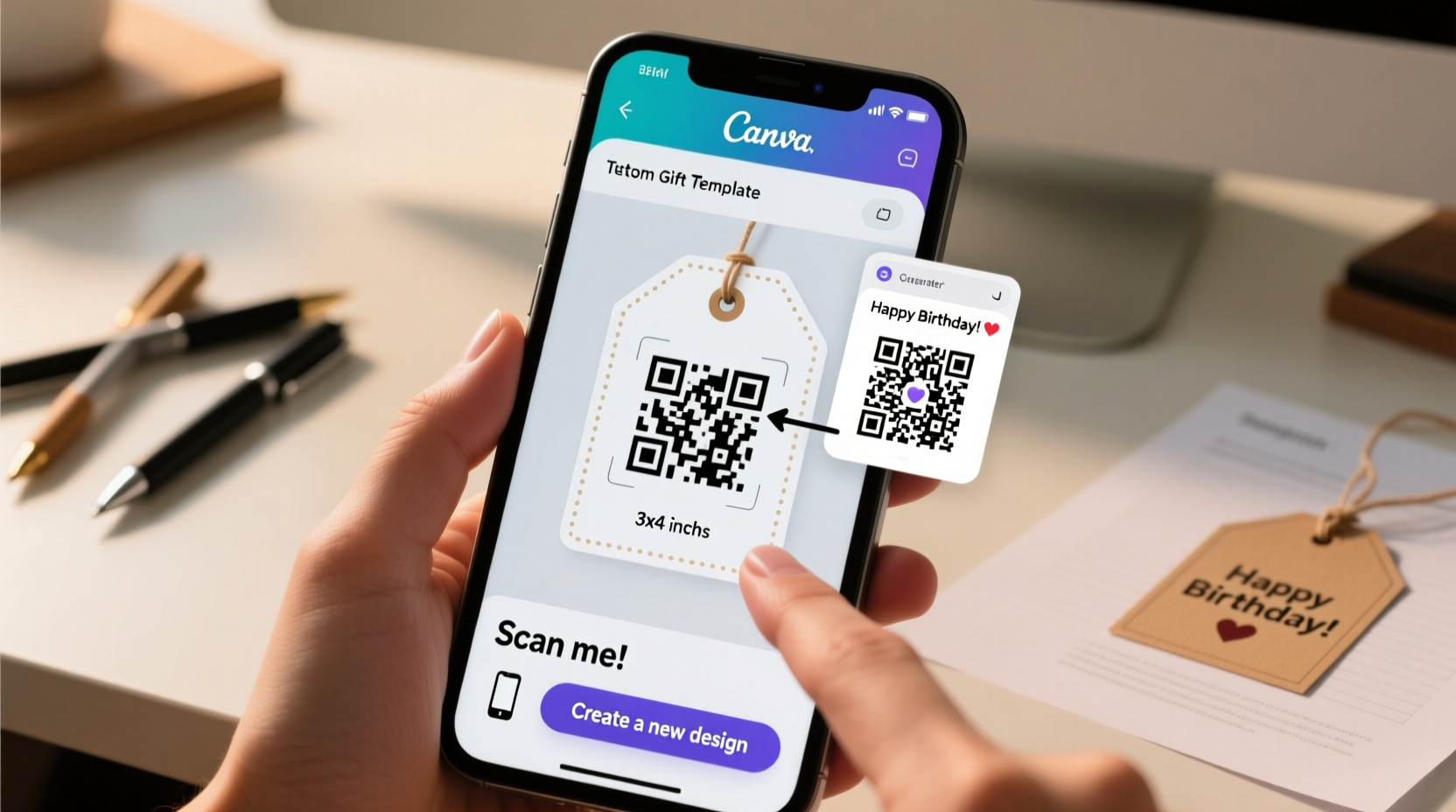
In a world saturated with mass-produced sentiment—pre-printed cards, generic e-cards, algorithmically suggested gifts—the tactile authenticity of a hand-selected present gains new power when paired with digital intimacy. A QR code on a gift tag bridges the physical and emotional dimensions of giving: it preserves the warmth of handwriting (or thoughtful typography), while unlocking immediacy, personality, and multimedia depth. Unlike static notes, QR-linked messages can be updated post-gifting—ideal for time-sensitive instructions, future event invites, or follow-up resources. Retailers like Anthropologie and boutique stationery brands report 40–60% higher engagement rates on gifts featuring scannable tags, especially among Gen Z and millennial recipients who expect seamless digital interaction as part of the unboxing experience.
“QR-powered gifting shifts the focus from transaction to relationship. It’s not about adding tech—it’s about removing friction between intention and impact.” — Lena Torres, Creative Director at Giftr Labs, a gift-experience consultancy serving Fortune 500 brands and independent artisans
What You’ll Need (All Free or Low-Cost)
No subscriptions, plugins, or paid fonts are required. Everything below works with Canva’s free plan, except where noted:
- Canva account (free; sign up at canva.com)
- A stable internet connection (for real-time QR generation and preview)
- A smartphone with a camera (to test scans during design)
- A URL-ready message (hosted on Google Drive, Notion, VoiceMemo.app, YouTube Shorts, or a free landing page builder like Carrd.co)
- A QR code generator (we recommend qr-code-generator.com—free, no login, supports vCards, URLs, plain text, and dynamic tracking)
- Optional but recommended: Canva Pro trial (7 days free) for brand kit access, background remover, and premium templates—but not essential for core functionality
Step-by-Step: Designing Your Tag in Canva
This sequence ensures professional results without overcomplicating layout or compromising scannability. Follow precisely—even small deviations affect usability.
- Create a new design: In Canva, click “Create a design” → “Custom size”. Enter dimensions: 3.5 in × 2 in (standard tag size fits most ribbon holes and gift boxes). Name it “QR Gift Tag”.
- Set background & texture: Click “Background” → “Uploads” if you have handmade paper scans, or choose “Elements” → search “kraft paper”, “linen texture”, or “watercolor wash”. Avoid pure white unless printing on glossy stock—matte textures reduce glare and improve QR readability.
- Add your QR code: Download your QR image as a PNG (not JPEG) with transparent background from qr-code-generator.com. Upload it to Canva. Resize to occupy 1.25 in × 1.25 in maximum—large enough for reliable scanning at arm’s length, small enough to preserve visual hierarchy. Place it in the lower third, aligned right or centered.
- Design supporting text: Use two fonts max. Example pairing: “Playfair Display” (serif, for “To: Emma”) + “Lato” (sans-serif, for “From: Grandpa & Nana”). Keep copy minimal: recipient name, giver name, date (optional), and one-line context (“For your graduation day!”). Never overlay text on the QR code—even faint opacity reduces scan success by up to 70%.
- Refine spacing & contrast: Ensure ≥ 0.25 in quiet zone (blank margin) around the QR code. If using dark text on light background, verify contrast ratio ≥ 4.5:1 (test with Canva’s built-in contrast checker under “Accessibility” in the editor sidebar).
- Export correctly: Click “Share” → “Download” → select “PDF Print” (not PNG) for crisp edges and CMYK-ready output. Enable “Crop marks and bleed” only if sending to a professional printer; for home printing, deselect both.
Choosing & Hosting Your Message: Practical Options Compared
The QR code is only as valuable as the experience it delivers. Below is a comparison of five widely used, free hosting options—evaluated on ease of setup, media flexibility, privacy control, and mobile-friendliness.
| Platform | Best For | Setup Time | Max File Size | Privacy Control |
|---|---|---|---|---|
| Google Drive (Shared Link) | Simple text notes, PDF letters, scanned handwritten notes | 2 minutes | 15 MB per file | Link-only sharing (no sign-in required) |
| VoiceMemo.app | Personal voice messages (no app install needed for listener) | 90 seconds | 10 min recording | Private by default; shareable link only |
| YouTune Shorts / Vimeo Showcase | Short video messages (under 60 sec) | 5–7 minutes (upload + trimming) | YouTube: 256 GB; Vimeo: 500 MB free | Unlisted links prevent public discovery |
| Carrd.co (Free Plan) | Multi-element pages: photo + text + audio + calendar invite | 8–12 minutes | N/A (web-based) | Full control over visibility and password protection |
| Notion Public Page | Rich media + embedded calendars, checklists, or maps (e.g., “Our hiking trail directions”) | 4 minutes | Unlimited (but images compress) | Public link only—no login required to view |
Real-World Application: The “Welcome Home” Baby Shower Tag
When Maya planned her sister’s baby shower, she wanted each guest’s gift to include more than congratulations—it needed continuity. She created a Canva tag (2.75 in × 1.75 in, soft mint background, gold foil font effect) with a QR code linking to a Notion page titled “Welcome Home, Leo”. That page featured: a 90-second lullaby recording (made on her phone), ultrasound photos with captions, a shared baby registry countdown, and a collaborative “First Year Memory Log” where guests could add milestone dates. Every tag was printed on recycled cotton paper, hand-tied with twine, and placed atop onesies and blankets. At the shower, guests scanned immediately—not out of curiosity, but because the tag promised something irreplaceable: presence across distance and time. Three months later, Maya’s sister reported replaying the lullaby nightly. The tag didn’t just label the gift—it anchored an emotional ritual.
Common Pitfalls & How to Avoid Them
Even experienced designers stumble here. These mistakes degrade user experience and undermine your effort:
- Using low-resolution QR PNGs: Always download at 300 DPI or higher. Blurry codes fail 9/10 scans on budget smartphones.
- Ignoring print calibration: Home printers often shrink or shift margins. Print one test tag at actual size on plain paper first—measure with a ruler before committing to specialty stock.
- Embedding links that expire: Google Drive links change if you rename or move the file. Use “Get link” > “Anyone with the link” > “Copy link” *immediately after upload*, then paste into QR generator—don’t revisit later.
- Over-designing the tag: More than three typefaces, gradients behind QR, or animated GIF backgrounds break scannability. Simplicity serves sentiment.
- Skipping accessibility checks: Colorblind users may not distinguish QR foreground/background. Test palettes using Coblis or Toptal’s Color Blindness Simulator.
FAQ
Can I edit the message after printing the tags?
Yes—if you used a dynamic QR code (available on qr-code-generator.com’s paid tier, $5/month) or hosted your message on a platform that allows real-time edits (e.g., Carrd, Notion, or Google Sites). Static QR codes encode the URL directly; changing the destination requires regenerating and reprinting. For one-off events, static is sufficient and cost-free.
Do I need Wi-Fi for the recipient to scan and play the message?
Yes—for anything hosted online (videos, Notion pages, Drive files). However, you can work around this: record a voice memo using VoiceMemo.app, download the MP3, and upload it to a free file host like SendAnywhere. Their “share link” stays active for 48 hours and works offline once downloaded—but note: the initial scan requires connectivity. For guaranteed offline access, embed audio directly into a PDF using Adobe Acrobat (free online tool) and link to that PDF via QR.
Is it safe to put personal messages behind QR codes?
Only if you control the hosting platform’s privacy settings. Avoid pasting sensitive data (addresses, IDs, financial info) into publicly indexed platforms. Never use QR codes to deliver passwords or login credentials. For family-only messages, Google Drive’s “Restricted” sharing (email-specific access) or Carrd’s password protection adds essential safeguards. When in doubt, assume the QR code could be scanned by anyone who handles the gift.
Putting It All Together: Your Action Checklist
- Write your message script (keep it under 90 seconds for voice/video)
- Record or create your digital asset (voice memo, short video, PDF letter)
- Upload to a privacy-controlled, mobile-optimized host
- Copy the final, stable URL
- Generate a high-res, transparent-background QR PNG
- Build your Canva tag using precise dimensions, contrast, and quiet zones
- Print one test tag, scan it on three devices, and confirm playback
Conclusion
Designing a QR-enabled gift tag isn’t about mastering software—it’s about reclaiming intentionality in an age of disposability. Every pixel you align, every contrast ratio you verify, every voice memo you record is a quiet act of care made visible. Canva removes the barrier; your empathy provides the meaning. You don’t need a design degree to make someone feel seen—you need clarity of purpose, attention to detail, and willingness to bridge the analog and digital with grace. Start small: pick one upcoming gift, follow the steps exactly as outlined, and watch how a 2-inch tag becomes the first thing unwrapped—not because it’s flashy, but because it promises connection. Then share what you learn. Post your tag template in Canva’s community gallery. Tell us which hosting platform surprised you with its simplicity. Comment with your favorite message format—voice, video, or handwritten PDF—and help others choose wisely. Because the most powerful gifts aren’t wrapped in paper. They’re wrapped in attention.




 浙公网安备
33010002000092号
浙公网安备
33010002000092号 浙B2-20120091-4
Comments
No comments yet. Why don't you start the discussion?