
Christmas lighting transcends seasonal decoration—it’s an opportunity to reinterpret your home’s structure with light, shadow, and rhythm. When applied thoughtfully, string lights can reveal the quiet elegance of a gabled roofline, underscore the symmetry of Georgian windows, or draw attention to hand-carved porch columns that might otherwise go unnoticed in daylight. This isn’t about covering surfaces with brightness; it’s about selective illumination—using light as a design tool to emphasize proportion, texture, and intentionality in your home’s architecture. Done well, it elevates curb appeal year after year and communicates care, craftsmanship, and visual literacy.
Understanding Your Home’s Architectural Language
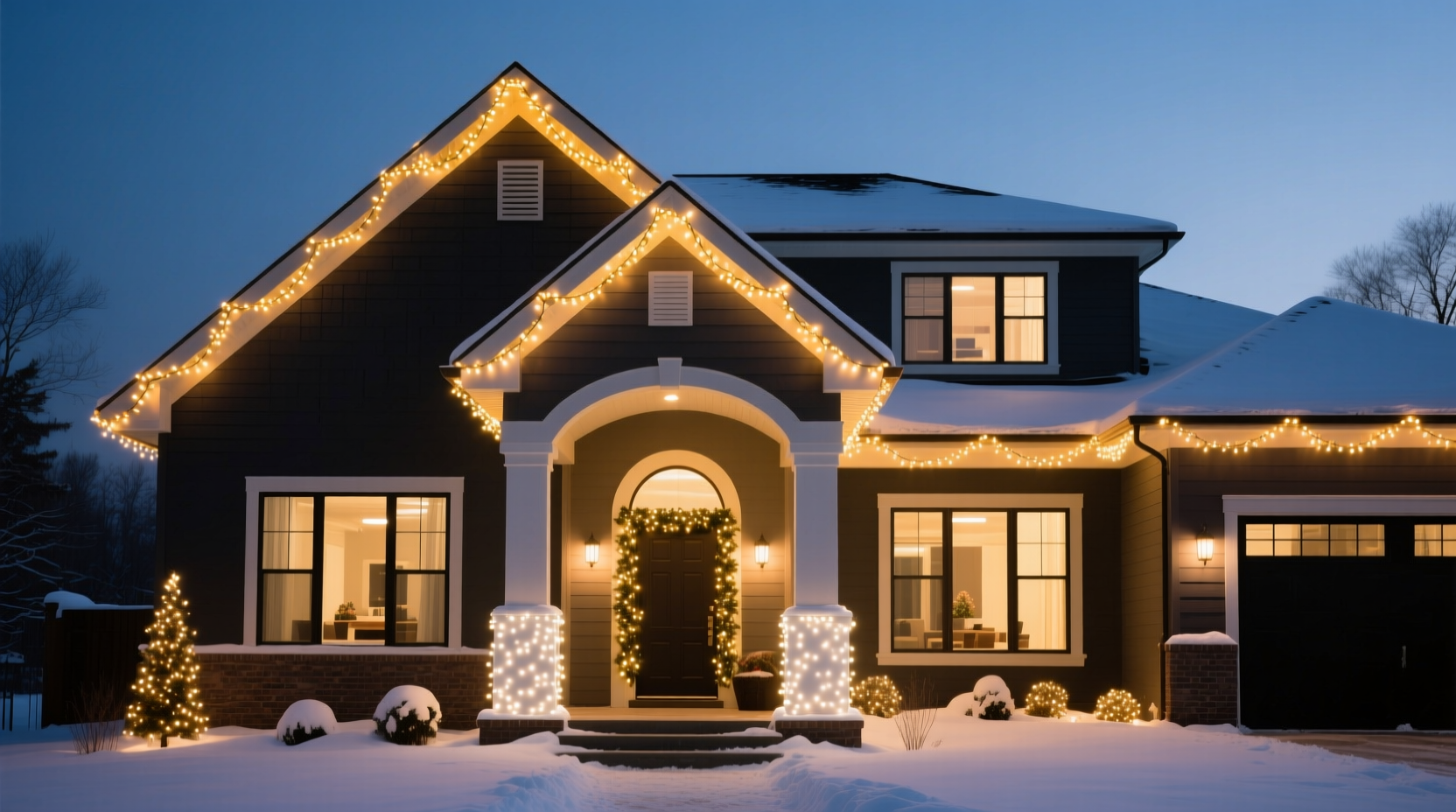
Before selecting a single bulb, step back—literally. Walk around your property at dusk with a notebook and observe how natural light recedes from different façades. Identify dominant features: Is your home defined by verticality (turrets, tall windows, pilasters) or horizontality (wide eaves, belt courses, ribbon windows)? Does it have rhythm (repeating bays, evenly spaced columns) or contrast (a stone foundation beneath clapboard siding, a dormer piercing a steep roof)? These aren’t just aesthetic details—they’re cues for where light will have maximum impact.
Traditional styles offer clear lighting opportunities: Colonial homes benefit from crisp perimeter lighting along cornices and window frames; Craftsman bungalows shine when exposed rafter tails and tapered porch posts are outlined; Tudor revivals gain drama when half-timbering is traced with warm white micro-lights; and Mid-Century Modern homes respond beautifully to subtle linear accents along clean roof overhangs and floor-to-ceiling glazing.
Choosing the Right Lights for Architectural Clarity
Not all Christmas lights serve architectural intent equally. Miniature incandescent or LED C7/C9 bulbs, while festive, scatter light diffusely and blur edges—making them ideal for trees or bushes but poor for defining lines. For feature highlighting, prioritize precision and control:
- Micro LED strings (2.5–3.5mm): Tight spacing (2–3 inches), low-profile bulbs, and directional output make them ideal for tracing fine details like window mullions, crown molding, or brick corbels.
- Linear LED tape (with 3M backing): Seamless, flexible, and available in color temperatures from 2200K (candlelight warmth) to 3000K (soft white). Best for recessed soffits, under-eave runs, or behind fascia boards where discrete illumination is required.
- Net lights: Only appropriate for textured surfaces like stonework or shingle roofs—never for smooth walls or glass, where they create visual noise instead of definition.
- Commercial-grade C9 or G12 bulbs on heavy-gauge wire: Reserved for bold outlines—roof peaks, column perimeters, or entry arches—where scale demands presence without sacrificing sharpness.
Color temperature matters more than hue. Warm white (2200–2700K) enhances wood grain, stone texture, and traditional materials without washing out detail. Cool white (4000K+) can flatten depth perception and make brick or stucco appear flat or clinical. Avoid multicolor strings for architectural work—they compete with form rather than supporting it.
Strategic Placement: Where Light Meets Structure
Architectural lighting succeeds not by quantity, but by alignment. Each placement decision should answer: *What structural element am I revealing—and how does this line reinforce its inherent geometry?*
Rooflines and Eaves
The roof defines silhouette. Run micro-LED strings precisely along the outer edge of the fascia board—not the gutter—to trace the roof’s true profile. For gables, continue the line up the raking edge and across the peak, avoiding the temptation to “fill” the triangle—empty space preserves hierarchy. On homes with deep overhangs, install linear tape inside the soffit, aimed downward to graze the fascia and cast a soft, consistent ledge of light.
Windows and Doors
Frame—not outline. Install lights 1/2 inch inside the exterior casing, following the inner edge of the trim. This creates a luminous “halo” effect that draws the eye inward, emphasizing glazing and craftsmanship. For multi-light windows, treat each sash as a unit: run lights vertically beside mullions, then horizontally across transoms. Never wrap lights around the entire window frame—this flattens depth and reads as decorative clutter.
Columns and Pilasters
Vertical elements demand vertical light. Wrap micro-LED strings in tight, even spirals (3–4 inches between wraps) from base to capital. Avoid horizontal bands—they segment height and contradict structural logic. For square columns, place lights in the center of each face, not the corners, to preserve mass and proportion.
Foundations and Water Tables
A subtle 12-inch band of warm linear tape installed just above grade level visually anchors the home, reinforcing its relationship to the ground. This is especially effective on homes with stone, brick, or textured concrete foundations—light grazing the surface reveals texture without glare.
| Feature | Recommended Light Type | Placement Precision Tip | Avoid |
|---|---|---|---|
| Raking Gable Edge | Micro-LED string (36–50 ft) | Secure every 12 inches with stainless steel clips—not staples—to prevent sagging | Running lights along gutter lip (creates inconsistent line) |
| Front Door Archway | C9 bulbs on commercial wire | Use adjustable conduit hangers to maintain exact radius match | Stringing lights loosely in a “garland” shape (distorts curve) |
| Exposed Rafter Tails | Linear LED tape (24V) | Mount tape flush to underside of tail, aimed downward at 15° angle | Clipping lights to top surface (creates harsh top-down glare) |
| Brick Corbel Course | Micro-LED with directional lens | Angle bulbs upward at 30° to graze brick joints and highlight relief | Evenly spacing lights regardless of corbel position (breaks rhythm) |
A Step-by-Step Installation Framework
Successful architectural lighting follows a deliberate sequence—not a rush to plug in. Follow these phases to ensure structural fidelity and electrical safety:
- Measure & Map (Day 1): Sketch each façade. Note dimensions of every feature you intend to light. Calculate total linear feet needed—then add 15% for slack, corners, and errors. Label circuits: “North Eave,” “West Windows,” etc.
- Select & Test (Day 2): Purchase lights matching your plan. Test every strand indoors at full length. Discard any with dead sections or inconsistent color temp.
- Mount Hardware (Day 3): Install permanent, non-damaging clips (e.g., S-shaped copper hooks for wood, adhesive-backed aluminum channels for vinyl). Do not drill into historic brick or mortar—use removable masonry anchors rated for outdoor load.
- Install Lights (Day 4): Begin at structural anchors—corners, column bases, window jambs—and work outward. Keep tension consistent. Use a laser level for long horizontal runs. Check alignment against a plumb line for verticals.
- Test & Refine (Day 5): Power on at dusk. Observe from multiple distances and angles. Adjust any misaligned sections. Document settings for next year—note which outlets power which zones and their amperage draw.
Real-World Application: The Henderson Residence, Portland, OR
The Hendersons live in a 1927 Tudor Revival with prominent half-timbering, steep gables, and leaded casement windows. For years, their holiday lighting consisted of tangled white strings draped over gutters—a visual distraction that obscured the home’s most distinctive features. Working with a local lighting designer, they shifted strategy: micro-LEDs were hand-soldered into custom lengths to follow every timber line, with directional bulbs angled to graze the plaster infill and emphasize depth. Gable edges received precise C9 outlining, while windows were framed with warm linear tape set into recessed trim grooves. The result? A neighborhood award for “Most Architecturally Respectful Lighting.” Neighbors reported noticing details—the carved oak capitals, the diamond-patterned brickwork—for the first time. As homeowner Clara Henderson noted: “We didn’t add light—we revealed what was already there.”
“Great architectural lighting doesn’t shout ‘look at me’—it whispers ‘look closer.’ It honors the builder’s intent and invites people to read the house as a composition, not just a backdrop.” — Daniel Ruiz, FAIA, Lighting Designer & Historic Preservation Consultant
FAQ: Common Architectural Lighting Questions
How many lights do I really need for clean lines?
It’s not about density—it’s about continuity. For crisp outlines, aim for 100–150 micro-LEDs per 25 linear feet (4–6 bulbs per foot). Overcrowding causes glare and obscures form. A 30-foot roofline needs ~360 bulbs—not 1,000. Less is legible; more is chaotic.
Can I use solar-powered lights for architectural work?
Generally no. Solar strings lack the consistent voltage, color stability, and directional control required for precise feature highlighting. Their output drops significantly after dusk and varies with weather. Reserve them for pathway markers or garden accents—not structural definition.
What’s the safest way to light a two-story façade?
Never drape or toss lights from above. Use a sturdy, OSHA-rated extension ladder with standoff arms to keep rails clear of siding. Hire a professional for heights above 16 feet—or invest in a telescoping pole with magnetic light holders designed for micro-LED installation. Prioritize UL-listed, wet-location-rated fixtures and GFCI-protected circuits.
Conclusion: Light as Stewardship
Using Christmas lights to highlight architectural features is an act of stewardship—of your home, its history, and its place in the streetscape. It asks you to look closely, measure deliberately, and illuminate with restraint. This approach transforms seasonal decoration into a quiet dialogue between past craftsmanship and present intention. You’re not just adding sparkle; you’re participating in the ongoing life of your home’s design story. Whether your house is a century-old Craftsman or a thoughtfully detailed new build, the principles remain the same: align light with structure, choose tools for clarity over coverage, and let the architecture speak first—with light as its thoughtful interpreter.




 浙公网安备
33010002000092号
浙公网安备
33010002000092号 浙B2-20120091-4
Comments
No comments yet. Why don't you start the discussion?