
Every November, millions of homeowners face the same seasonal dilemma: untangling dozens of extension cords while balancing ladders, wrestling with brittle wires, and tripping over loose coils on the driveway. The frustration isn’t just logistical—it’s electrical. According to the U.S. Consumer Product Safety Commission, over 3,000 home fires each year are linked to faulty or misused extension cords during the holiday season. Yet most people treat cord management as an afterthought—not a safety-critical system. Extension cord reels, when selected and used correctly, transform this annual chore into a streamlined, repeatable process. They reduce physical strain, minimize wear on insulation, prevent voltage drop through proper cord length control, and eliminate the risk of accidental overextension. This isn’t about convenience alone; it’s about reducing fire hazards, extending equipment life, and reclaiming hours of your December.
Why Standard Cord Handling Fails During Holiday Setup
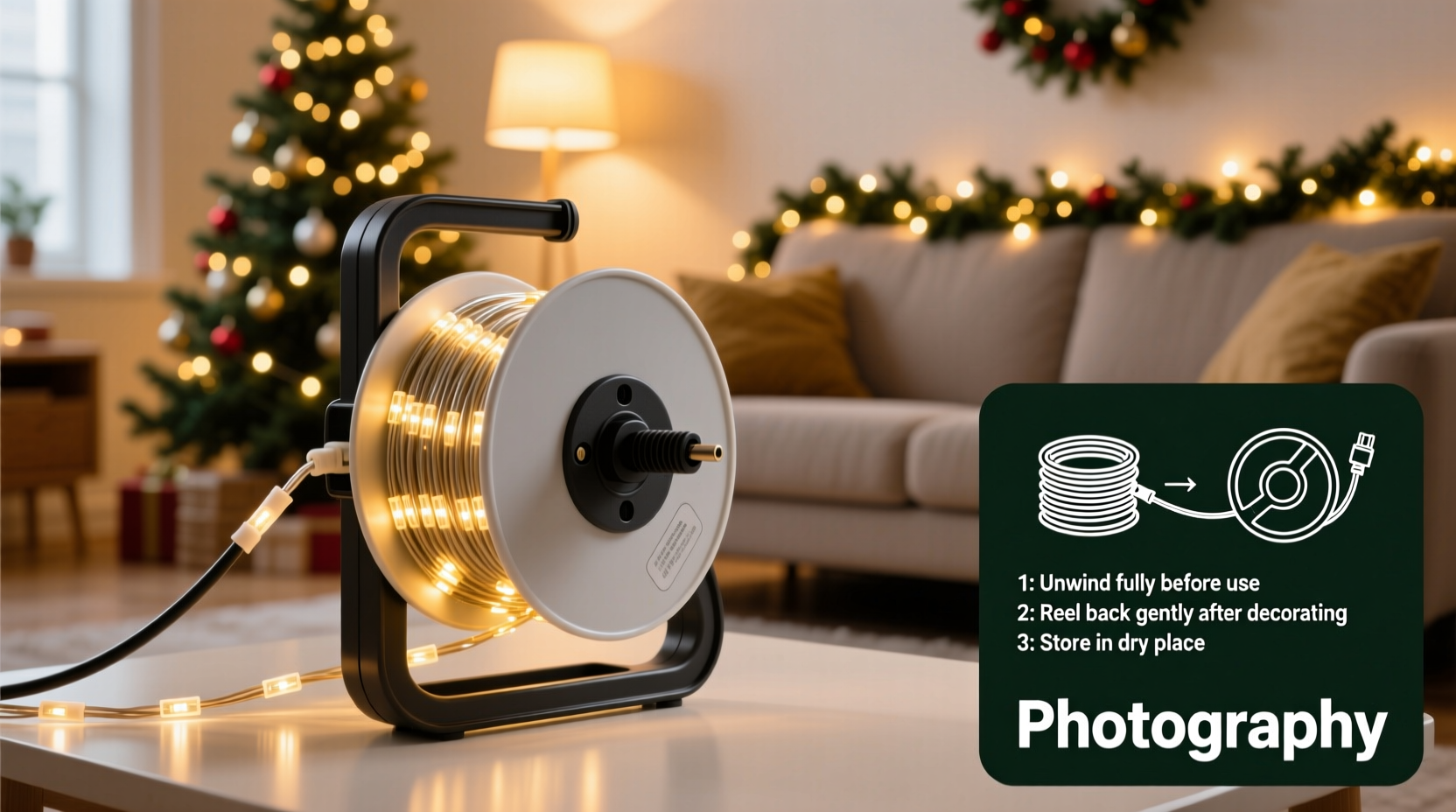
Traditional methods—winding cords by hand around elbows, stuffing them into plastic bins, or leaving them coiled loosely on garage floors—introduce three persistent problems. First, inconsistent winding creates kinks that degrade internal copper conductors and crack PVC insulation over time. Second, uncoiling long cords manually often results in “overpull,” where users yank beyond the reel’s designed capacity, straining internal springs and damaging locking mechanisms. Third, mixing multiple cord types (e.g., 16-gauge indoor vs. 12-gauge outdoor) without labeling leads to under-rated usage—plugging high-wattage light strings into undersized cords causes overheating. A 2022 National Fire Protection Association analysis found that 68% of holiday-related cord failures occurred not at the plug or outlet, but at stress points created by improper storage and repeated tight bending.
Selecting the Right Reel: Voltage, Gauge, and Build Quality
Not all cord reels are interchangeable. Choosing one requires matching specifications to your actual lighting load—not just “what fits in the garage.” Start with amperage: add up the wattage of every light string you’ll power simultaneously, then divide by 120 volts to determine required amps. For example, ten 75-watt incandescent strings draw 6.25 amps; LED equivalents (typically 5–7 watts each) draw less than 0.6 amps. Then select cord gauge accordingly: 16 AWG handles up to 13 amps (ideal for small porches), 14 AWG up to 15 amps (standard for most residential use), and 12 AWG up to 20 amps (required for large displays with animatronics or commercial-grade lighting). Reels must also be rated for outdoor use—look for UL listing “W-A” (weather-resistant, abrasion-resistant) and IP65 or higher for dust/water ingress protection.
| Reel Type | Max Load (Watts) | Best For | Avoid If |
|---|---|---|---|
| 16 AWG, 50-ft Indoor Reel | 1,560 W | Small entryway or window displays | You plan outdoor use or have >5 light strings |
| 14 AWG, 100-ft Outdoor Reel | 1,800 W | Front-yard trees, rooflines, fence wraps | You’re powering blower motors, fog machines, or heated elements |
| 12 AWG, 150-ft Heavy-Duty Reel | 2,400 W | Multi-tree installations, driveway arches, animated displays | Your outlet is more than 100 ft from the nearest GFCI-protected source |
| Retractable Wall-Mounted Reel | Depends on cord spec | Permanent porch or patio setups | You need portability between locations or lack wall-mounting options |
A Step-by-Step Holiday Setup & Storage Workflow
Adopting a consistent sequence eliminates decision fatigue and builds muscle memory. Follow this proven 7-step workflow each season:
- Pre-Season Audit (Late October): Unspool each reel fully. Inspect for cracked insulation, bent prongs, or stiff sections. Test GFCI reset functionality. Label reels with permanent marker: “Front Yard – 14 AWG” or “Garage – 12 AWG.”
- Load Planning (Early November): Sketch your display zones and assign circuits. Group lights by voltage draw—not location. Use a single 14 AWG reel per zone drawing ≤1,500 watts.
- Outlet Prioritization: Plug reels only into GFCI-protected outlets. Never daisy-chain reels. If using multiple reels, run them from separate outlets—not one power strip.
- Controlled Unspooling: Stand beside the reel, not behind it. Pull cord smoothly until you reach the needed length—then lock the mechanism. Avoid jerking or stepping on the cord mid-unwind.
- Light String Integration: Plug lights directly into the reel’s outlet (not into a secondary power strip attached to the reel). Keep connections elevated off wet grass or concrete using cord clips or insulated hooks.
- Post-Holiday Coiling: After unplugging everything, walk the full length of the cord. Straighten kinks by gently pulling taut—not twisting. Then rewind slowly, guiding the cord evenly across the spool with one hand while turning the crank with the other.
- Off-Season Storage: Store reels indoors at room temperature. Loosen tension on spring-loaded models per manufacturer instructions (usually 1–2 full turns backward). Place silica gel packets inside storage bins to inhibit moisture buildup.
Real-World Application: The Henderson Family’s 3-Year Transformation
The Hendersons in Portland, Oregon, managed a modest but growing display: six mature evergreens, a 20-foot pergola, and motion-activated path lighting. For years, they used five separate 50-ft cords stored in a laundry basket. Setup took 4.5 hours; tangles caused two blown fuses and one melted plug end. In 2021, they invested in three UL-listed 14 AWG outdoor reels (two 100-ft, one 75-ft) with manual crank and auto-lock. They labeled each by zone, installed dedicated GFCI outlets near key anchor points, and committed to the step-by-step workflow above. By 2023, their setup time dropped to 1 hour 20 minutes. More importantly, their cord replacement cycle extended from annually to every 3.5 years—and they’ve had zero electrical incidents. “It wasn’t the reels alone,” says Sarah Henderson. “It was treating the cord like part of the lighting system—not just something we plugged into.” Their biggest insight? Using shorter reels for high-traffic zones (like the front walk) eliminated tripping hazards entirely.
Expert Guidance: What Electricians Wish You Knew
Licensed master electrician Marcus Delgado, who inspects holiday displays for Portland General Electric, emphasizes proactive habits over reactive fixes. With over 27 years in residential electrical safety, he’s seen patterns most homeowners miss:
“People focus on ‘how many lights can I plug in’—but the real failure point is thermal cycling. Every time you coil a warm cord, you bake micro-fractures into the insulation. Let cords cool for 20 minutes after use before rewinding. And never store reels in attics or sheds where temperatures exceed 104°F or dip below 14°F—that accelerates polymer breakdown in both cord jackets and internal springs.” — Marcus Delgado, Master Electrician & NFPA 70E Certified Trainer
Delgado also debunks two widespread myths: First, “heavy-duty” doesn’t mean “unlimited duty”—even 12 AWG reels should not supply continuous loads above 80% of rated capacity (i.e., 16 amps max for a 20-amp reel). Second, weather resistance isn’t permanent: UV exposure degrades PVC jackets within 2–3 seasons unless reels are stored shaded or covered.
Do’s and Don’ts of Cord Reel Maintenance
- Do clean reel housings quarterly with a damp microfiber cloth—never solvents or abrasive cleaners.
- Do lubricate metal crank gears annually with silicone-based grease (not WD-40, which attracts dust).
- Do test GFCI buttons monthly during active use—press TEST, verify power cuts, then press RESET.
- Don’t wrap cords tightly around the reel’s outer edge—this stresses the jacket at the bend radius.
- Don’t use indoor reels outdoors, even under cover—their components aren’t sealed against humidity ingress.
- Don’t ignore audible cues: grinding during cranking signals gear wear; sluggish retraction means spring fatigue.
Frequently Asked Questions
Can I use a cord reel with smart plugs or timers?
Yes—but only if the smart device is rated for outdoor use and installed upstream of the reel (i.e., the timer plugs into the wall outlet, and the reel plugs into the timer). Never attach smart plugs downstream of the reel’s outlet, as heat buildup inside enclosures can compromise Wi-Fi connectivity and thermal safety cutoffs.
My reel won’t retract fully anymore. Is it broken?
Not necessarily. First, check for obstructions: debris caught in the guide slot, or a cord pinched between spool layers. Next, verify tension: manually turn the crank backward 3–4 full rotations to relieve spring pressure, then try retraction. If it still binds, internal gear teeth may be stripped—contact the manufacturer before attempting DIY repairs.
How many light strings can I safely plug into one reel?
Calculate total wattage, not string count. A 14 AWG reel rated for 15 amps supports 1,800 watts at 120V. Subtract 20% for safety margin (1,440 watts usable). Then sum your strings: twenty 60-watt incandescents = 1,200W (safe); forty 7-watt LEDs = 280W (well within limit). Always verify individual string labels—some “LED” sets include inefficient transformers that draw disproportionately high wattage.
Conclusion: Turn Seasonal Stress Into Systematic Success
Extension cord reels are not passive accessories—they’re active components of your holiday electrical infrastructure. When chosen with intention, deployed with discipline, and maintained with awareness, they convert what was once a frustrating, hazardous ritual into a predictable, safe, and even satisfying part of your December rhythm. You gain back hours—not just during setup, but in reduced troubleshooting, fewer replacements, and peace of mind knowing your family and home are protected. This season, don’t just hang lights. Engineer your power delivery. Choose one reel to upgrade first. Follow the workflow. Inspect, label, and store deliberately. Small changes compound: by next year, you’ll wonder how you ever managed without it. Your future self—standing on that ladder in 15° weather, cord feeding smoothly, lights glowing without a flicker—will thank you.




 浙公网安备
33010002000092号
浙公网安备
33010002000092号 浙B2-20120091-4
Comments
No comments yet. Why don't you start the discussion?