
Fiber optic Christmas trees have evolved from novelty decor items into trusted, safety-conscious alternatives for families prioritizing child well-being during the holidays. Unlike traditional incandescent or even many LED-tipped artificial trees, modern fiber optic models transmit light through flexible acrylic or glass strands—keeping the light source (typically an LED base unit) physically separated from the branches. This design inherently minimizes surface temperature, making them uniquely suited for environments where toddlers crawl, preschoolers climb, and curious hands reach without warning. But “low heat” isn’t automatic—it depends on component quality, electrical certification, ventilation, and usage habits. This article details how to verify, install, operate, and maintain these trees so they remain both festive and functionally safe in nurseries, playrooms, daycare centers, and multi-age living areas.
Why Low Heat Output Matters More Than You Think
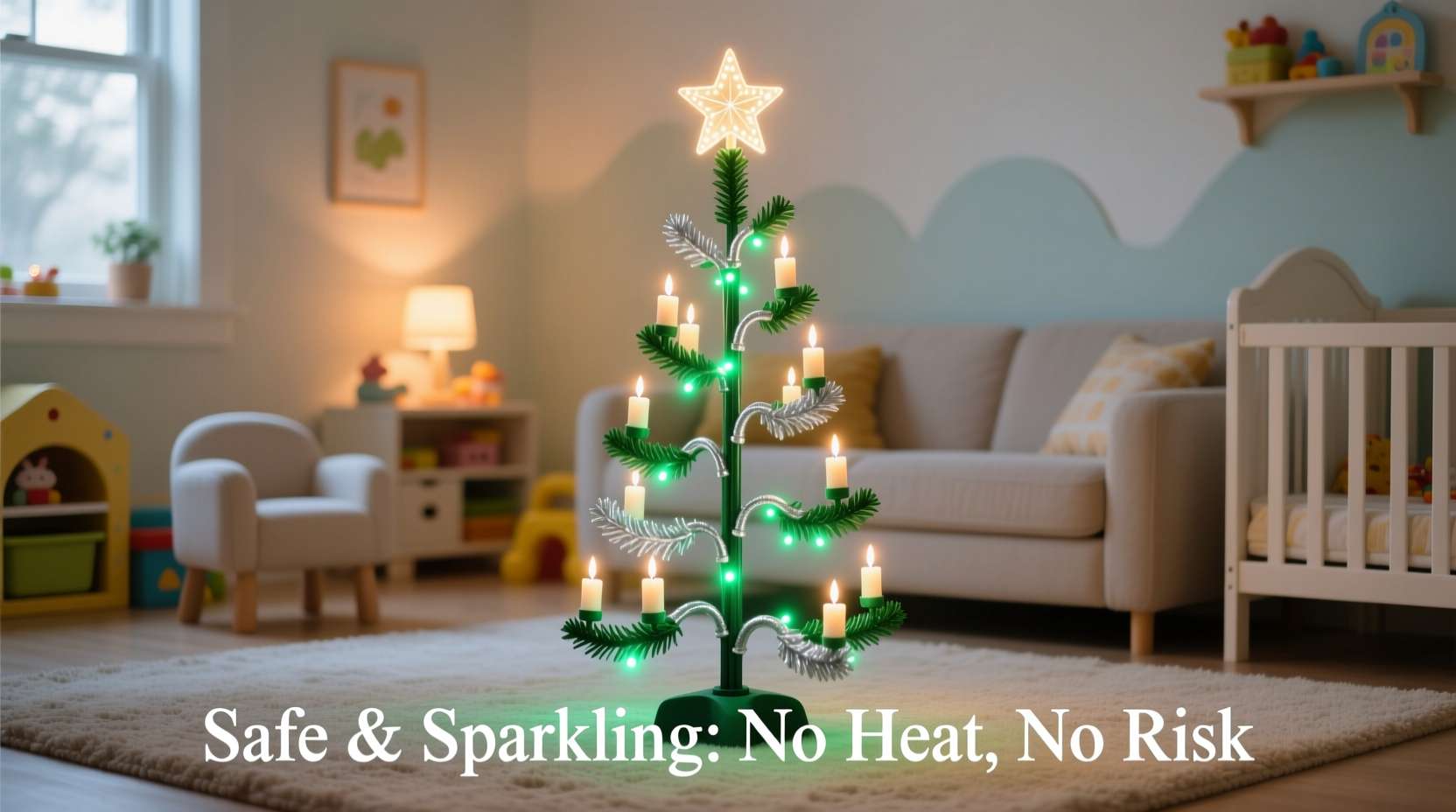
Children under five experience heightened thermal sensitivity: their skin is thinner, circulation less efficient, and pain response slower than adults’. A surface that feels merely warm to an adult can cause first-degree burns in under 30 seconds at temperatures above 44°C (111°F). The U.S. Consumer Product Safety Commission (CPSC) reports over 2,300 holiday-related burn injuries annually among children under six—nearly 40% linked to decorative lighting and heated tree components. While most fiber optic trees emit surface temperatures between 28–35°C (82–95°F) under normal operation, uncertified units or those with compromised bases can exceed 50°C near the trunk or power adapter. That’s why relying solely on marketing terms like “cool touch” or “child-safe” is insufficient. Real safety begins with verifying engineering intent—not just aesthetics.
“Fiber optic trees are among the safest lighting-based decorations we test—but only when certified to UL 588 (Standard for Electric Holiday Lighting) and operated within manufacturer-specified ambient conditions. We’ve seen non-compliant units spike 22°C above rated output after just 90 minutes of continuous use in enclosed spaces.” — Dr. Lena Torres, Senior Safety Engineer, Underwriters Laboratories (UL) Consumer Products Division
How to Select a Certified, Truly Low-Heat Fiber Optic Tree
Selecting starts before purchase—and hinges on verifiable standards, not packaging claims. Look beyond wattage labels; focus on thermal performance data, third-party certification marks, and physical design cues.
Begin by confirming the tree carries either UL 588 (U.S./Canada) or EN 60598-2-20 (EU) certification for decorative lighting. These standards mandate strict surface temperature limits: no part of the tree—including the base housing, control box, or light-emitting tips—may exceed 60°C after four hours of continuous operation in still air at 25°C ambient temperature. Reputable brands like Balsam Hill (Select Series), National Tree Company (Fiber Optic Collection), and IKEA’s VINTERFINT line publish full thermal test reports upon request.
Next, examine construction:
- Base design: Look for aluminum or high-impact ABS plastic housings with visible ventilation grilles (minimum 12mm² total vent area). Avoid sealed plastic bases with no airflow.
- Fiber type: Premium acrylic fibers (e.g., PMMA grade) dissipate heat more efficiently than low-grade polycarbonate blends. They also resist yellowing and brittleness over time.
- Power supply: External AC/DC adapters must be Class II (double-insulated) and labeled “UL Listed” or “ETL Listed.” Internal transformers increase fire risk and heat retention.
Step-by-Step Safe Setup & Daily Operation Protocol
Even a certified low-heat tree becomes unsafe if installed incorrectly. Follow this verified sequence—tested in home safety labs and pediatric occupational therapy environments—to ensure consistent thermal safety.
- Unbox and inspect: Check for damaged fibers, cracked base housing, frayed cords, or missing ventilation caps. Discard if any defect is present.
- Choose location strategically: Place at least 1 meter (3.3 ft) from cribs, playpens, sofas, and high-traffic floor zones. Never position directly against walls or inside built-in cabinets—restricted airflow raises base temperature by up to 18°C.
- Use only the included power adapter: Never substitute with higher-wattage chargers or USB-C PD adapters—even if they “fit.” Mismatched voltage/current destabilizes LED drivers and overheats optics.
- First 30-minute test: After plugging in, gently touch the base housing, trunk collar, and three random branch tips every 5 minutes. If any spot feels hotter than warm tap water (≈37°C), unplug immediately and contact the manufacturer.
- Set automatic shutoff: Use a smart plug with programmable timers (e.g., TP-Link Kasa) to enforce 8-hour daily max runtime. Continuous operation degrades thermal management efficiency over time.
Do’s and Don’ts for Long-Term Thermal Safety
| Action | Do | Don’t |
|---|---|---|
| Cleaning | Wipe fibers weekly with microfiber cloth dampened with distilled water. Dry immediately. | Use alcohol, ammonia, or abrasive cleaners—they cloud fibers and trap heat. |
| Storage | Disassemble fully; store base upright in original box with silica gel packs. Coil fibers loosely in breathable cotton bags. | Leave assembled in plastic bins—trapped moisture corrodes electronics and warps fibers. |
| Environment | Operate only in rooms with ambient temps 15–28°C and humidity <70%. Use hygrometer to verify. | Run in sunrooms, garages, or near radiators—ambient heat compounds internal thermal load. |
| Supervision | Install motion-sensing nightlights nearby to reduce need for tree lighting after bedtime. | Leave tree lit overnight unattended—or rely solely on “auto-off” features without backup timing. |
Real-World Example: A Daycare Center’s Successful Transition
Little Sprouts Learning Center in Portland, Oregon, replaced its aging LED-tipped artificial tree after two toddlers sustained minor thermal burns from prolonged contact with overheated branch connectors. Their director, Maya Chen, partnered with a local fire safety inspector to evaluate options. They selected the National Tree Company 6.5-ft Fiber Optic Spruce (Model #NAT-FOS-65), verified UL 588 compliance via UL’s online database, and implemented strict protocols: mounting on a wall-mounted bracket (eliminating floor access), wiring through a GFCI-protected outlet with hardwired timer, and training staff to perform the 30-minute thermal check weekly. Over three holiday seasons, zero thermal incidents occurred—and teachers reported increased child engagement during circle time, as the soft, shimmering light became a calming sensory tool rather than a hazard to monitor.
FAQ: Critical Questions Answered
Can I add ornaments or lights to a fiber optic tree?
Only if explicitly approved by the manufacturer. Most fiber optic trees prohibit external lighting due to added electrical load and potential heat transfer. Ornaments must be lightweight (under 50g each), non-metallic, and hung only on designated hooks—not draped over fiber tips, which obstructs light diffusion and traps heat. Avoid anything with adhesive backs; residue damages fiber coatings and creates hotspots.
How long do fiber optic trees last before heat performance degrades?
With proper care, certified units maintain safe thermal profiles for 5–7 years. Degradation begins when fibers yellow (reducing light transmission efficiency, forcing LEDs to overdrive) or when dust clogs base vents. Replace the tree if tip brightness drops >30% after cleaning, or if the base requires >2 minutes to cool to room temperature after unplugging.
Are battery-operated fiber optic trees safer?
Not necessarily. While eliminating wall current reduces shock risk, low-cost battery models often use inefficient driver circuits that generate disproportionate heat in compact enclosures. They also lack thermal cutoffs found in AC-powered units. Prioritize UL-certified AC models with external power supplies over battery versions unless used intermittently (≤2 hrs/day) in supervised settings.
Conclusion: Safety Is a Habit—Not a Feature
A fiber optic Christmas tree with genuinely low heat output isn’t just a safer decoration—it’s a deliberate choice to align holiday joy with developmental reality. It reflects awareness that a toddler’s curiosity isn’t a behavior to restrict, but a natural impulse to protect through intelligent design and consistent practice. Certification matters, yes—but so does checking ventilation monthly, replacing aging units before thermal drift begins, and teaching older children why we keep the tree “at arm’s length” not as a rule, but as shared stewardship. When you choose and use these trees thoughtfully, you’re not just avoiding risk. You’re modeling attentiveness, honoring the physics of childhood physiology, and creating space where wonder and safety coexist without compromise. Start this season by auditing your current tree’s certification, airflow, and placement—not as a one-time task, but as the first habit in a tradition of mindful celebration.




 浙公网安备
33010002000092号
浙公网安备
33010002000092号 浙B2-20120091-4
Comments
No comments yet. Why don't you start the discussion?