
Christmas displays have evolved far beyond strings of lights and inflatable snowmen. Today’s holiday setups often feature synchronized music, moving props, color-shifting LEDs, and motion-activated effects. What many don’t realize is that the technology inside a common gaming console—like the PlayStation, Xbox, or even a Nintendo Switch—can be repurposed to orchestrate these dazzling spectacles. With built-in processing power, network capabilities, and input/output flexibility, gaming consoles offer an accessible and powerful platform for controlling smart lighting, audio systems, and animatronics in seasonal displays.
This isn’t about playing games near the tree—it’s about leveraging existing hardware to create immersive, responsive holiday experiences. Whether you're managing a backyard light show synced to Mariah Carey or triggering Santa’s sleigh animation when kids approach, your console can act as the central brain behind it all.
The Hidden Potential of Gaming Consoles
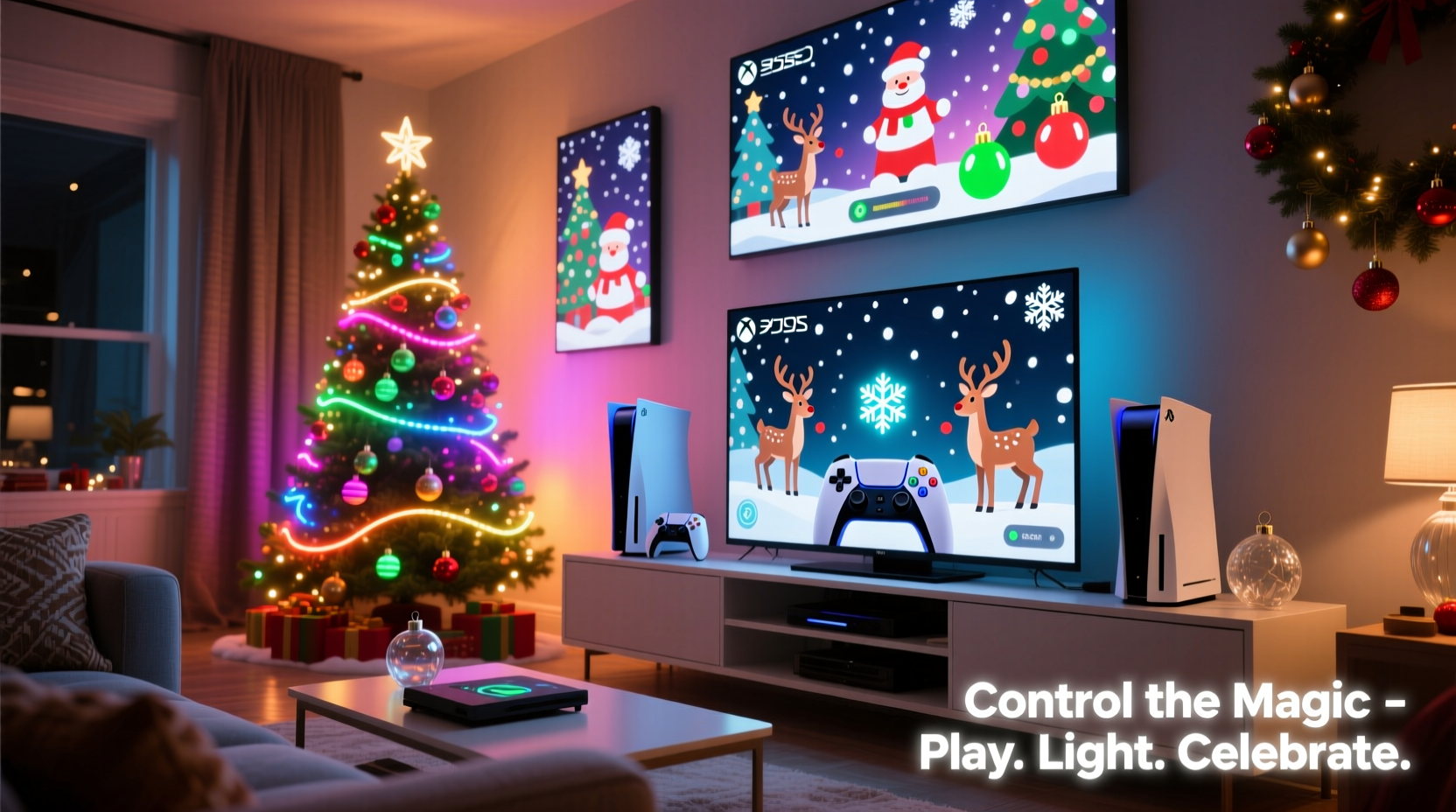
Gaming consoles are essentially compact computers optimized for real-time performance. They come equipped with HDMI outputs, USB ports, Bluetooth, Wi-Fi, and increasingly, support for third-party applications and homebrew software. These features make them surprisingly capable controllers for external devices when paired with the right tools.
Modern displays often rely on platforms like Raspberry Pi or Arduino microcontrollers to manage sequences. But not everyone has experience coding on embedded systems. Gaming consoles, already present in most households, offer a more familiar interface. By using custom scripts, media center apps, or even game development environments, users can route commands from the console to smart home ecosystems that power their decorations.
For example, an Xbox Series X running a Python-based automation script via Windows Subsystem for Linux (WSL) can send signals over MQTT to control Philips Hue bulbs arranged across a rooftop. Or a PlayStation 5, connected to a home network with IFTTT integrations, could trigger a motorized reindeer display when a specific playlist starts.
Connecting Your Console to Smart Holiday Devices
To begin, you’ll need to establish communication between your gaming console and the devices in your display. This typically involves bridging the console into your home automation network. Here's how:
- Ensure Network Integration: Connect both your console and smart devices (lights, speakers, sensors) to the same Wi-Fi network. Assign static IP addresses where possible to prevent connection drops during shows.
- Enable Developer Mode (if available): Some consoles, like certain models of PlayStation or jailbroken Xbox units, allow developer access. This opens up command-line tools and scripting environments essential for automation.
- Use Automation Platforms: Integrate services like IFTTT (If This Then That), Home Assistant, or Node-RED. These can listen for triggers initiated by the console—such as launching a video or starting a game—and respond by activating holiday devices.
- Leverage Media Triggers: Since consoles excel at media playback, synchronize light patterns with audio files or videos. For instance, start a holiday movie on your PS5, and let a companion app detect the playback event to activate corresponding outdoor animations.
One practical method involves using Kodi—a media center application supported on some consoles or compatible streaming boxes controlled via console remotes. You can program Kodi playlists so that when a festive track plays, it sends HTTP requests to an ESP32 microcontroller managing RGB LED strips, changing colors in rhythm with the music.
Real Example: The Xbox-Powered Drive-Thru Display
In suburban Ohio, a local family transformed their front yard into a full-scale interactive Christmas village powered entirely through an older Xbox One. Using a combination of open-source tools and smart plugs, they programmed the console to run a timed sequence every evening from 5–9 PM.
The setup worked as follows: A custom dashboard app on the Xbox monitored time and weather data. When conditions were favorable, it activated a series of actions—turning on pathway lights, starting a looped soundtrack through outdoor speakers, and sending pulses to servo motors that made animated elves wave. Motion sensors detected approaching cars, prompting the Xbox to switch to a high-energy musical number with strobe-like light bursts across the roofline.
The entire system was managed through a Node.js server hosted on a secondary device but triggered remotely via the Xbox’s web browser using saved bookmarks linked to API calls. Residents loved the responsiveness, and the family reduced manual effort significantly compared to previous years.
“We didn’t buy any new gear—we just used what we had. The Xbox was sitting there doing nothing half the year. Now it runs our whole show.” — Daniel Reyes, DIY Holiday Enthusiast
Step-by-Step Guide: Setting Up Console-Controlled Lighting
Follow this timeline to build your own console-driven display:
- Week 1: Inventory & Planning
- List all decorative elements: lights, figures, speakers, etc.
- Determine which are smart-enabled (Wi-Fi/Zigbee) or require relay modules.
- Schedule desired show times and themes (e.g., “Classics Night,” “Pop Hits Hour”).
- Week 2: Network Setup
- Connect all smart devices to a stable 2.4 GHz Wi-Fi band.
- Install a hub if needed (e.g., Samsung SmartThings, Hubitat).
- Test individual device control via smartphone app.
- Week 3: Console Configuration
- On your console, install a compatible browser or media app.
- If supported, enable developer mode or side-load automation software.
- Create bookmarks or shortcuts that link to webhooks (e.g.,
http://homeassistant.local:8123/api/services/light/turn_on).
- Week 4: Integration & Testing
- Set up automation rules in IFTTT or Home Assistant based on console activity.
- Run dry tests: Start a video game → verify porch lights flash blue.
- Refine timing and brightness levels for smooth transitions.
- Week 5: Go Live & Monitor
- Launch the display during off-peak hours to observe performance.
- Keep a log of glitches (e.g., delayed responses, dropped signals).
- Adjust firewall settings or upgrade router firmware if necessary.
Do’s and Don’ts: Best Practices Table
| Do’s | Don’ts |
|---|---|
| Use wired Ethernet adapters for consoles when possible to reduce latency. | Overload your Wi-Fi network with too many simultaneous devices. |
| Back up automation scripts and configurations regularly. | Rely solely on proprietary apps that may discontinue service. |
| Test emergency shutoff procedures before public viewing hours. | Place electronics outdoors without weatherproof enclosures. |
| Leverage voice assistants (Alexa/Google) as fallback triggers. | Ignore power consumption—calculate total draw to avoid circuit overload. |
| Start small—automate one element first, then expand. | Attempt complex mods without understanding electrical safety basics. |
Expanding Beyond Lights: Audio, Motion, and Interactivity
While lighting is the most visible component, true interactivity comes from combining multiple sensory layers. Gaming consoles are particularly strong in audio processing, making them ideal for syncing soundtracks with visual effects.
For instance, you can use a PlayStation 5’s ultra-fast SSD to load high-bitrate audio files seamlessly, ensuring zero lag between beats and light flashes. Pair this with a Sonos speaker array or powered outdoor PA system, and you’ve got a professional-grade synchronized show.
Adding motion interaction takes it further. Connect a low-cost radar sensor or infrared detector to a Raspberry Pi, then have it signal the console when movement is detected. The console can then switch to a special “welcome” sequence—playing “Jingle Bell Rock” while turning on path lights and animating a talking snowman.
Some advanced users have even created mini-games within actual titles. One modder programmed a custom level in Minecraft on Xbox that mirrored their real-world display. As players progressed through the virtual world, real-world lights changed accordingly, creating a hybrid physical-digital experience for trick-or-treaters and carolers alike.
Checklist: Pre-Launch Review for Your Console-Controlled Display
- ✅ All smart devices are online and responding to basic commands
- ✅ Console is connected to the same network as automation hub
- ✅ Backup power source (UPS) is in place for router and console
- ✅ Automation triggers have been tested under real conditions
- ✅ Emergency stop procedure is documented and accessible
- ✅ Neighbors have been notified of scheduled shows and sound levels
- ✅ Outdoor wiring is secured and protected from moisture
- ✅ Total wattage stays below circuit breaker limits
Frequently Asked Questions
Can I use a Nintendo Switch to control Christmas lights?
Directly, no—due to limited developer access and lack of background scripting. However, you can use the Switch’s internet browser to manually trigger web-based automations (like IFTTT applets), or pair it with a companion smartphone running task automation apps that react to Switch activity.
Is it safe to run a console continuously during the holiday season?
Modern consoles are designed for extended gameplay sessions, so running them for several hours nightly is generally safe. Ensure proper ventilation, use surge protectors, and consider enabling power-saving modes after the show ends. Avoid stacking devices or enclosing the console in tight cabinets.
What if my console doesn’t support automation apps?
You don’t need native support. Use the console as a trigger device rather than the controller itself. For example, set up a rule that says: “When Xbox turns on, activate display via Home Assistant.” This indirect method works reliably across all models.
Conclusion: Turn Play into Performance
Using gaming consoles to control interactive Christmas displays merges nostalgia with innovation. It transforms a piece of entertainment hardware into a dynamic tool for community joy, seasonal storytelling, and technical creativity. The barrier to entry is lower than ever—most families already own a capable console, and smart home integration continues to grow more user-friendly.
By following structured planning, leveraging existing networks, and applying simple automation logic, anyone can elevate their holiday presentation from static to spectacular. And in doing so, they’re not just decorating—they’re engineering moments of wonder.




 浙公网安备
33010002000092号
浙公网安备
33010002000092号 浙B2-20120091-4
Comments
No comments yet. Why don't you start the discussion?