
Christmas morning is one of the few days each year when millions of adults willingly sacrifice sleep—not out of necessity, but anticipation. Yet that excitement often backfires: racing thoughts, early-morning adrenaline surges, and fragmented sleep leave many feeling depleted before breakfast. The irony? While children may wake at 5:17 a.m. sharp, adults frequently misjudge their own circadian readiness—and compound fatigue with caffeine, screen time, or last-minute wrapping. Sleep trackers don’t just record what happened last night; they reveal patterns invisible to memory alone. When interpreted correctly, heart rate variability (HRV), REM latency, sleep onset consistency, and deep-sleep duration can serve as precise dials for adjusting bedtime—not all at once, but in alignment with your biology. This isn’t about forcing yourself to bed earlier on December 23rd. It’s about using objective data to recalibrate your internal clock *before* the holiday chaos begins.
Why “Just Go to Bed Earlier” Usually Fails
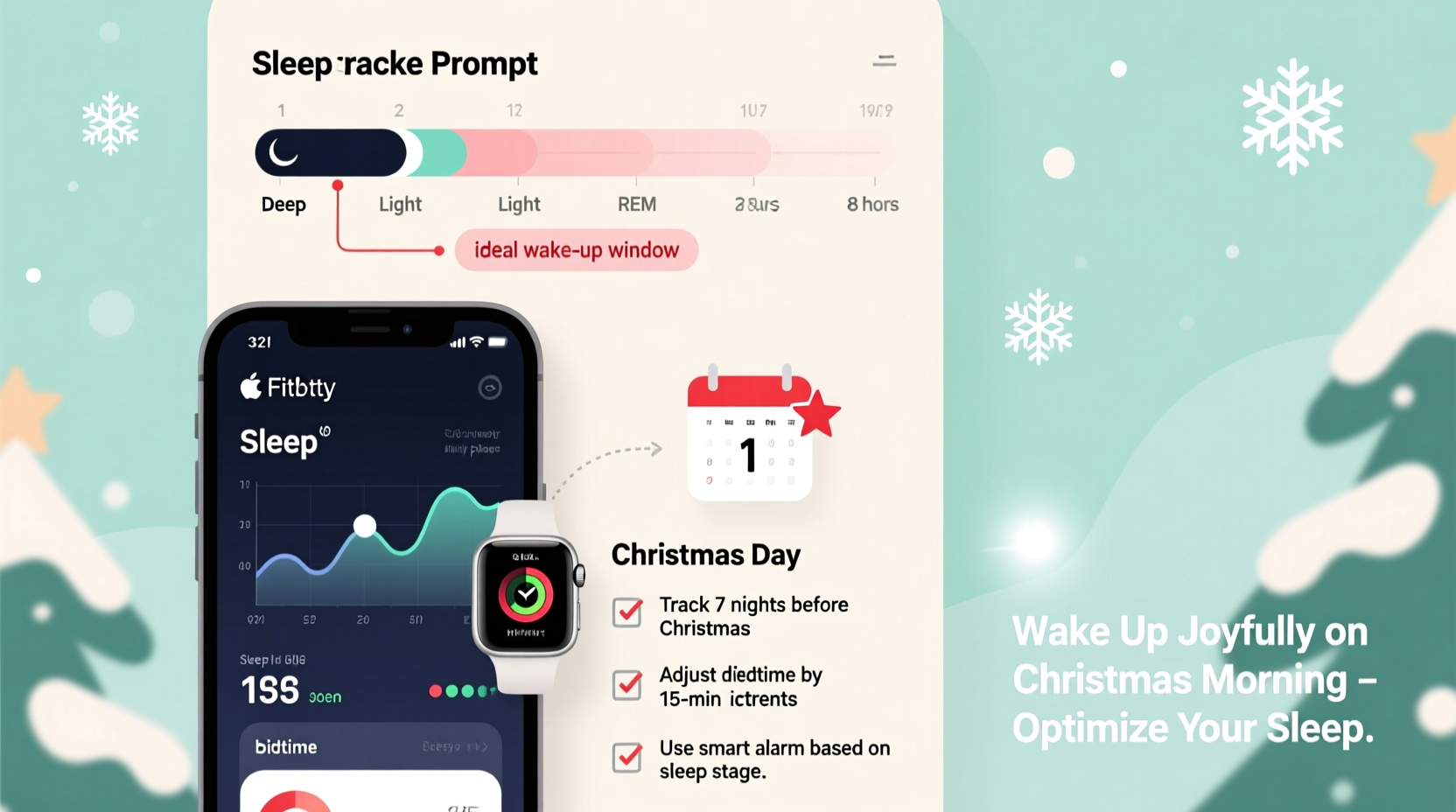
Most people attempt to “catch up” on sleep the week before Christmas by pushing bedtime forward by 90 minutes—or more—on a single night. That strategy contradicts how the human circadian system works. The suprachiasmatic nucleus (SCN), our brain’s master clock, adjusts gradually—typically no more than 15–30 minutes per day—even under ideal conditions. A sudden 2-hour shift triggers sleep onset insomnia, reduced slow-wave sleep, and elevated cortisol at bedtime. Worse, wearable devices often misinterpret restlessness as “asleep,” inflating sleep efficiency scores while masking actual physiological resistance.
Sleep tracking becomes powerful only when used as a feedback loop—not a command center. Your tracker doesn’t tell you *what* to do; it tells you *whether* what you did worked. Did shifting bedtime by 20 minutes on Monday improve your sleep onset latency (SOL) by Tuesday? Did your HRV dip below baseline after three consecutive nights of late-night scrolling? These are signals—not suggestions.
Your 7-Day Pre-Christmas Sleep Optimization Timeline
Start this protocol on the Monday before Christmas (December 18th). It assumes your target wake-up time on Christmas Day is 6:30 a.m.—adjust all times proportionally if yours differs.
- Days 1–2 (Mon–Tue, Dec 18–19): Baseline & Calibration
Go to bed at your usual time. Review your tracker’s historical data for the prior 7 days: note average SOL, total sleep time (TST), deep sleep %, and wake-ups after sleep onset (WASO). Record these in a simple table or notes app. Do not change anything yet—this establishes your personal norm. - Day 3 (Wed, Dec 20): First Micro-Adjustment
Shift bedtime 15 minutes earlier than your baseline average. Example: If you usually fall asleep at 11:22 p.m., aim for lights-out by 11:07 p.m. Keep pre-sleep routine identical—no extra screens, no alcohol, no heavy meals within 3 hours. Track SOL and subjective sleep quality (1–5 scale). - Day 4 (Thu, Dec 21): Reinforce with Light & Temperature
Maintain the 15-minute earlier bedtime. Add two evidence-based anchors: 15 minutes of bright morning light (natural or 10,000-lux lamp) within 30 minutes of waking, and lower bedroom temperature to 60–63°F (15.5–17.2°C) 60 minutes before target bedtime. Both strengthen circadian amplitude. - Day 5 (Fri, Dec 22): Evaluate & Refine
Compare tonight’s SOL and TST to Days 1–2. If SOL improved by ≥5 minutes *and* WASO decreased, proceed. If SOL worsened or HRV dropped >10% from baseline, hold at current bedtime for another night—don’t push further yet. - Day 6 (Sat, Dec 23): Second Adjustment (If Ready)
Only if Day 5 showed improvement: shift bedtime another 15 minutes earlier (now 30 minutes total). Maintain all anchors: morning light, cool room, consistent wind-down. This is the final adjustment. - Day 7 (Sun, Dec 24): Stabilize & Protect
No further shifts. Prioritize sleep continuity over duration: avoid naps longer than 20 minutes, skip caffeine after 1 p.m., and silence non-essential notifications after 8 p.m. Your tracker will likely show higher HRV and deeper N3 sleep tonight—your body’s signal that rhythm is aligning. - Christmas Day (Mon, Dec 25): Wake Up Confidently
You’ll rise near your target time (e.g., 6:30 a.m.) without an alarm—because your SCN has been gently guided, not forced. Cortisol will peak naturally around 6:45 a.m., not 4:15 a.m. You’ll feel alert, not jangled.
What Your Tracker Is Really Telling You—And What It’s Not
Sleep trackers excel at measuring movement, heart rate, and respiration—but they infer sleep stages indirectly. Their accuracy varies significantly across metrics:
| Metric | Typical Accuracy vs. Polysomnography | What It Tells You (When Used Right) | What It Doesn’t Tell You |
|---|---|---|---|
| Sleep Onset Latency (SOL) | ±8–12 minutes | How long your body takes to transition from wakefulness to stable N1/N2—excellent for spotting anxiety-driven delays or circadian misalignment | Whether you were mentally “awake” (e.g., replaying conversations) while motionless |
| Deep Sleep (N3) | ±15–25% error margin | Trends over 5+ nights indicate recovery status, physical stress load, and growth hormone activity | The exact neurochemical signature of restorative processes |
| REM Sleep | Lowest accuracy—often overestimates by 20–40% | Consistent drops across multiple nights correlate strongly with emotional processing deficits or antidepressant use | Whether dreams were vivid, emotionally charged, or memory-consolidating |
| Heart Rate Variability (HRV) | High reliability for relative changes (same device, same position) | Strong predictor of autonomic readiness—rising HRV = parasympathetic dominance = better sleep initiation | Exact vagal tone or clinical cardiac risk |
| Resting Heart Rate (RHR) | Very high reliability | A sustained RHR increase >5 bpm above baseline for 3+ nights signals cumulative fatigue or immune activation | Whether elevated RHR is due to dehydration, caffeine, or infection |
Crucially: never optimize for “more deep sleep” in isolation. A healthy adult spends 13–23% of total sleep in N3. Chasing 25%+ often means sacrificing REM or increasing fragmentation—both counterproductive for emotional resilience on a high-stimulus day like Christmas.
Mini Case Study: Sarah, 38, Marketing Director, Two Kids Under 6
Sarah wore an Oura Ring for 18 months but only checked her dashboard on New Year’s Eve. Her Christmas Eve wake-up was consistently 4:42 a.m.—“like clockwork, even though I’m exhausted.” She started tracking seriously December 18th. Baseline data revealed: average SOL = 42 minutes, TST = 6h 18m, deep sleep = 19%, but HRV was 22% below her 30-day average. She followed the 7-day timeline, adding morning light and cooling her bedroom. By Day 5, SOL dropped to 28 minutes. On Christmas Eve, she fell asleep at 10:51 p.m. (33 minutes earlier than baseline) and woke spontaneously at 6:29 a.m.—alert, calm, and present during her kids’ first moments with Santa’s haul. “I didn’t need coffee until 9 a.m.,” she noted. “For the first time in seven years, I actually *enjoyed* the chaos.”
“The most effective sleep interventions aren’t about adding more tools—they’re about removing friction between intention and biology. A tracker’s power lies in revealing where your habits collide with your physiology—and giving you proof that small, timed adjustments create real change.” — Dr. Elena Ruiz, Behavioral Sleep Medicine Specialist, Stanford Sleep Medicine Center
Realistic Checklist: 5 Non-Negotiables for Success
- ✅ Commit to one tracker for 14 days—no switching devices mid-cycle, no manual log entries unless cross-referencing.
- ✅ Measure SOL objectively—use your tracker’s “sleep onset” timestamp, not your memory or phone-checking habit.
- ✅ Anchor wake-up time—even on weekends before Christmas, rise within 30 minutes of your target wake-up. This stabilizes your SCN faster than bedtime shifts alone.
- ✅ Block blue light after 8 p.m.—wear amber lenses or enable strict night mode on all devices. Melanopsin receptors remain sensitive to short-wavelength light until midnight.
- ✅ Prioritize consistency over perfection—if you miss one micro-adjustment, resume the next night. Three consecutive aligned nights matter more than seven flawless ones.
FAQ: Addressing Common Concerns
My tracker says I got “great sleep” on Christmas Eve—but I felt awful the next day. Why?
Trackers assess sleep primarily through movement and heart rate regularity. They cannot detect hyperarousal—a state where your nervous system is physiologically primed for threat (e.g., anticipating gift reactions, family dynamics, or financial stress) despite minimal movement. Look for elevated resting heart rate, low HRV, or frequent brief awakenings (<2 min) masked as “continuous sleep.” These are red flags your tracker may miss.
Can I use melatonin to help shift my rhythm faster?
Short-term, low-dose (0.3–0.5 mg) melatonin taken 2–3 hours before your *current* bedtime can support phase advancement—but only if used alongside light management. Taking it too late (within 1 hour of bed) or at high doses (>1 mg) blunts natural melatonin production and disrupts next-night onset. It’s a catalyst, not a substitute for behavioral timing.
What if I travel for Christmas? How does jet lag affect this plan?
If crossing ≥2 time zones, start phase-shifting 3 days before departure using light exposure: seek morning light if traveling east (to advance rhythm), evening light if traveling west (to delay). Adjust your tracker’s time zone setting *only after arrival*, and base all bedtime targets on local time—not home time. Your SCN adapts fastest when light cues match local solar time.
Conclusion: Your Christmas Morning Starts Tonight
Optimizing for Christmas morning isn’t about endurance—it’s about intentionality. Every data point your tracker collects is a quiet conversation with your biology: your SOL whispers about stress thresholds, your HRV hums about nervous system balance, your deep sleep percentage reflects how deeply your body trusts the night. Using that information doesn’t require expertise—just curiosity, consistency, and the willingness to treat sleep not as downtime, but as active preparation. You wouldn’t run a marathon without training your muscles. You wouldn’t host a holiday dinner without planning the menu. Why treat the most emotionally demanding day of the year as if your energy reserves were infinite? Start tonight—not with a new app or supplement, but with one deliberate 15-minute shift, one intentional breath before turning off the light, one moment of gratitude for the quiet before the joy arrives. Your future self, standing barefoot in the hallway at 6:30 a.m. watching snow fall while your children laugh upstairs, will thank you.




 浙公网安备
33010002000092号
浙公网安备
33010002000092号 浙B2-20120091-4
Comments
No comments yet. Why don't you start the discussion?