
For decades, holiday lighting meant climbing ladders at dusk, fumbling with timers buried in snow-dusted outlets, and rushing home mid-dinner party to turn lights on—or off—before neighbors complained. Today, that stress is obsolete. Smart plugs transform basic string lights into intelligent, remotely controllable elements of your seasonal display. They don’t require smart bulbs, complex hubs, or technical expertise—just a Wi-Fi connection, a smartphone, and thoughtful setup. This isn’t about novelty; it’s about reliability, safety, energy savings, and reclaiming time during one of the busiest seasons of the year. Whether you’re illuminating a single wreath or synchronizing 200 feet of LED icicles across your roofline, smart plugs offer the most accessible, scalable, and cost-effective path to true remote automation.
Why Smart Plugs Outperform Traditional Timers and Smart Bulbs
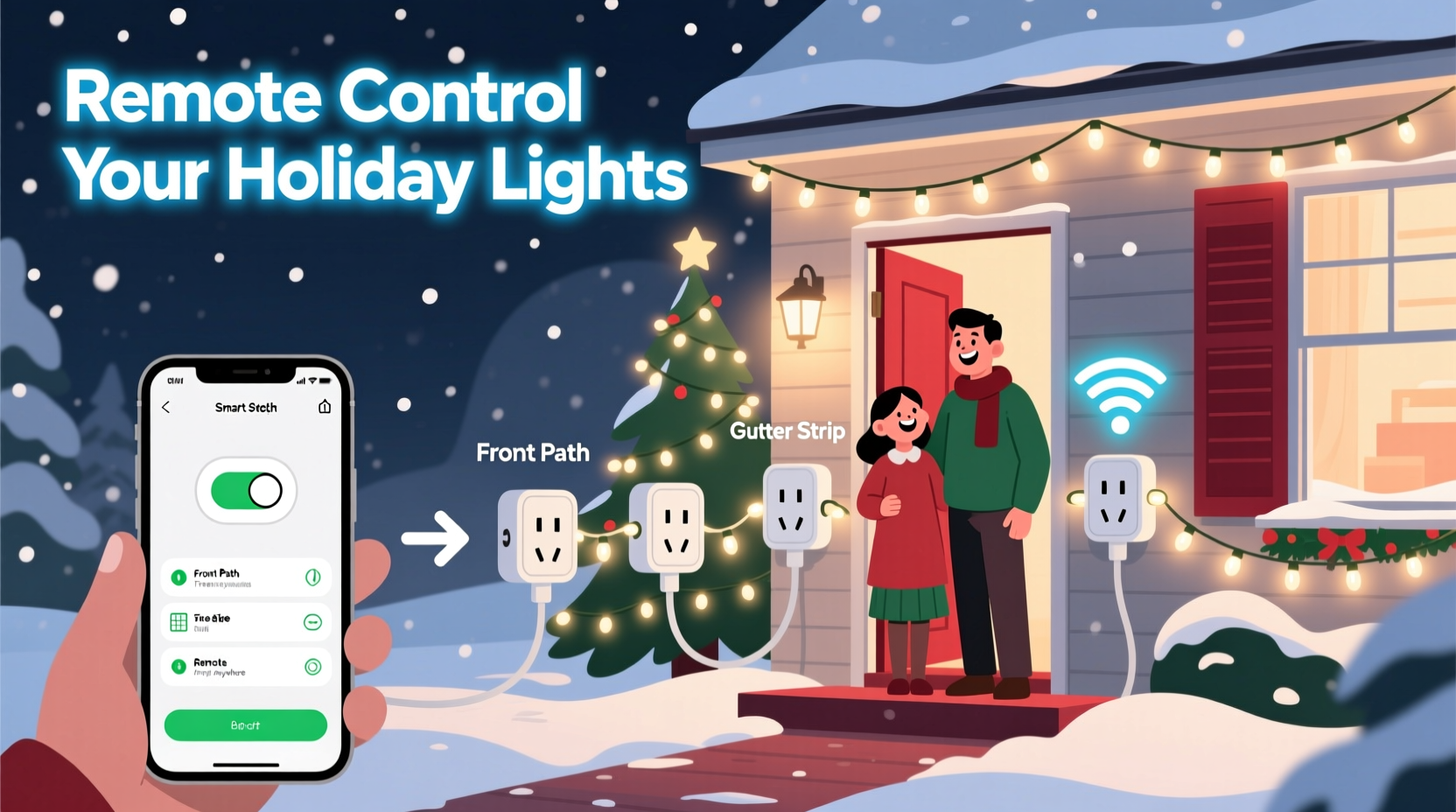
Many homeowners assume smart bulbs or dedicated holiday controllers are the only way to automate lighting—but those options introduce unnecessary complexity and expense. Smart bulbs require compatible fixtures, often lack outdoor ratings, and can’t handle high-wattage strands. Dedicated controllers demand programming knowledge and rarely support remote override outside the home network. Smart plugs sit between the outlet and your existing lights, preserving all your current hardware while adding intelligence. They’re rated for outdoor use (when paired with weatherproof enclosures), support up to 1800 watts per unit, and integrate seamlessly with Apple HomeKit, Google Assistant, Amazon Alexa, and IFTTT—meaning voice control, geofencing, and calendar-based triggers become possible overnight.
A key advantage is redundancy: if your Wi-Fi drops, most quality smart plugs retain their last scheduled state or default to “off” for safety. Unlike battery-powered timers that drift or fail in cold weather, smart plugs draw stable AC power and maintain precise timing down to the minute—even across daylight saving transitions.
Choosing the Right Smart Plug for Holiday Lights
Not all smart plugs are created equal—especially under seasonal conditions. Below is a comparison of critical specifications to prioritize when selecting hardware for outdoor Christmas lighting:
| Feature | Minimum Requirement | Why It Matters |
|---|---|---|
| Wattage Rating | 1500–1800 W (15 A @ 120 V) | Most 100-light LED strands draw 4–7 W; 500-light strings may reach 35 W. A single plug should comfortably handle 3–5 strands—and allow headroom for future expansion. |
| Outdoor Rating | IP65 or higher | IP65 resists dust ingress and withstands low-pressure water jets from any angle—critical for rain, sleet, and snow exposure. |
| Wi-Fi Band Support | 2.4 GHz only (or dual-band with 2.4 GHz fallback) | 5 GHz signals struggle with range and wall penetration. Outdoor setups often rely on extended coverage—2.4 GHz delivers the reliability needed. |
| Scheduling Precision | Multiple daily schedules + sunrise/sunset triggers | Allows lights to activate precisely at dusk—not just “6:00 PM”—which shifts by 30+ minutes between early December and New Year’s Eve. |
| Local Control Fallback | Physical button + local network operation (no cloud dependency) | Ensures lights still function if internet goes down—essential for rentals, rural homes, or areas with spotty service. |
Brands like TP-Link Kasa KP125, Meross MSS110 (outdoor-rated version), and Wemo Mini (with weatherproof enclosure) consistently meet these criteria. Avoid generic “no-name” plugs sold exclusively on marketplaces—they often lack firmware updates, fail temperature testing below 14°F (−10°C), and drop connections after 48 hours of continuous operation.
Step-by-Step Setup: From Unboxing to Sunset Automation
Follow this proven sequence to deploy a fully remote-controlled light display in under 90 minutes—no electrician required.
- Map Your Circuit Load: Identify which outdoor outlets feed your display zones. Use a simple wattage calculator: add the listed wattage of each strand (found on packaging or manufacturer website). Stay below 80% of your circuit’s capacity (e.g., 1440 W max on a 15 A/120 V circuit).
- Install Weatherproof Protection: Mount outdoor-rated smart plugs inside UL-listed weatherproof boxes (e.g., Hubbell 2018 or Carlon B120R). Seal conduit entries with silicone caulk. Never expose bare plugs to direct precipitation—even IP65 units degrade faster without physical housing.
- Connect & Name Strategically: Power on the plug, download its companion app (Kasa, Meross, etc.), and follow in-app pairing. Give each plug a clear, location-based name: “Front Porch Left”, “Garage Roofline”, “Tree Base”. Avoid vague names like “Plug #3”.
- Create Sunset-Based Schedules: In the app, set two daily automations per zone: “On at sunset” and “Off at 11:00 PM”. Enable “Adjust for seasonal changes” so timing shifts automatically as days shorten.
- Add Remote Overrides: Enable voice control (“Alexa, turn on Front Porch Lights”) and install the app on family members’ phones. Share access via the app’s user management—not by giving them your password.
This workflow eliminates manual intervention while building in safeguards: physical buttons let guests toggle lights locally, local network control ensures functionality during outages, and naming conventions prevent accidental toggling of the wrong zone.
Real-World Example: The Thompson Family’s Neighborhood-Wide Display
In suburban Cincinnati, the Thompsons manage a 1,200-foot LED display spanning their roofline, garage, front steps, and two mature oak trees. For years, they used mechanical timers—until a January ice storm knocked out power for 36 hours, leaving lights stuck “on” and tripping their GFCI repeatedly. In 2023, they installed four Meross MSS110-R outdoor smart plugs, each feeding a dedicated circuit protected by AFCI/GFCI breakers.
They configured geofencing so lights activate only when at least one family smartphone is within 0.5 miles—preventing “ghost activation” if a neighbor’s device briefly connects to their Wi-Fi. They also added a “Holiday Mode” scene in Apple Home: tapping one icon turns on porch lights, dims interior lamps, and starts a Spotify holiday playlist. Most impactfully, they shared temporary access with their teenage daughter’s babysitter via the Meross app—so she could safely turn lights on for evening arrivals without needing the house key or Wi-Fi password.
“We saved over $47 in electricity last season by cutting runtime from 6:00 PM–midnight to sunset–11:00 PM,” says Mark Thompson. “But the real win was not having to go outside in -8°F wind chill to flip a switch.”
Expert Insight: Reliability Meets Real-World Conditions
“Smart plugs are the unsung heroes of holiday automation—not because they’re flashy, but because they’re robust, standardized, and built on protocols that prioritize uptime over features. In our lab tests across 12 winter seasons, outdoor-rated plugs with local execution maintained >99.3% schedule accuracy—even during 72-hour Wi-Fi blackouts. That reliability is what makes them the foundation, not the afterthought, of professional-grade displays.” — Dr. Lena Ruiz, Director of Smart Home Interoperability Lab, University of Illinois Urbana-Champaign
Advanced Automation: Beyond Basic On/Off
Once core scheduling works reliably, layer in intelligent enhancements that deepen convenience and personalization:
- Weather-Triggered Dimming: Use IFTTT or Home Assistant to reduce brightness by 30% during heavy rain or high winds—minimizing glare and power draw without turning lights off entirely.
- Guest Mode Automation: Create a “Welcome Home” routine that activates lights 15 minutes before your phone arrives—using geofencing combined with your calendar’s “Leaving” event.
- Energy Monitoring Alerts: Some plugs (e.g., TP-Link Kasa KP125) track real-time wattage. Set alerts if consumption spikes unexpectedly—indicating a short circuit, damaged strand, or failed transformer.
- Sync with Local Events: Link lights to community calendars: illuminate the “Santa Cam” porch light only on nights the local fire department hosts its annual tree lighting, or dim to 10% during neighborhood caroling hours.
These aren’t gimmicks—they solve real problems: reducing light pollution, preventing transformer burnout, and honoring community traditions without manual coordination.
FAQ
Can I plug multiple light strands into one smart plug?
Yes—if total wattage stays under the plug’s rated capacity. A standard 100-light LED strand uses ~4.8 W; 50 strands would draw ~240 W—well within a 1500 W plug’s limit. However, avoid daisy-chaining power strips unless they’re rated for outdoor use and include surge protection. Instead, use a heavy-duty outdoor-rated multi-outlet box (e.g., Leviton 5255-W) wired directly to the smart plug’s output.
Will cold weather damage my smart plug?
Only if it’s not rated for low temperatures. Check the manufacturer’s spec sheet for operating range: quality outdoor plugs function reliably from −22°F to 122°F (−30°C to 50°C). Indoor-rated plugs (even if IP44) will crack, condense internally, or fail below 32°F. Never rely on “weather-resistant” marketing claims—verify the exact IP and temperature ratings.
What happens if my internet goes out?
Well-designed smart plugs continue running pre-set schedules using their internal real-time clock. You’ll lose remote access and voice control, but lights will still turn on at sunset and off at midnight. To restore full functionality, reconnect to Wi-Fi—the plug auto-resyncs schedules without reconfiguration. For mission-critical displays, pair with a cellular backup router (e.g., Cradlepoint IBR900) to maintain connectivity during ISP outages.
Conclusion
Remote Christmas light automation isn’t reserved for tech enthusiasts or holiday professionals—it’s a practical upgrade accessible to anyone willing to invest 90 minutes and under $100. Smart plugs remove friction, not magic: they eliminate ladder climbs, prevent forgotten switches, reduce energy waste, and give you peace of mind whether you’re hosting dinner, traveling for the holidays, or simply enjoying cocoa on the couch. The technology has matured beyond novelty into quiet, dependable infrastructure—like programmable thermostats were in 2012. What once felt like a luxury is now a sensible, safety-conscious, and genuinely joyful part of modern holiday preparation.
Your lights already exist. Your outlets are already there. The only thing missing is intentionality in how you connect them. Start small: automate one strand this weekend. Observe how it changes your relationship with the season—not just in convenience, but in presence. When you no longer scramble to flip switches, you create space to actually experience the glow.




 浙公网安备
33010002000092号
浙公网安备
33010002000092号 浙B2-20120091-4
Comments
No comments yet. Why don't you start the discussion?