
For many homeowners, the holiday season means strings of lights, cheerful displays, and the quiet satisfaction of a well-timed glow—but it also brings a familiar frustration: being locked into a proprietary mobile app just to turn your lights on at dusk or off at midnight. What if your phone battery dies? What if you’re traveling and don’t have access to your usual device? Or what if you simply prefer not to install yet another app—or hand over usage data to a third-party platform?
The good news is that most modern smart plugs offer robust, app-free scheduling options that are underused, under-documented, and surprisingly powerful. These alternatives rely on built-in web dashboards, voice assistant integrations, physical controls, local automation protocols, and even legacy timer modes. When implemented correctly, they deliver reliability that often exceeds app-dependent setups—especially during peak holiday traffic when cloud services slow down or fail.
Why Go App-Free? Reliability, Privacy, and Simplicity
Mobile apps introduce points of failure: outdated OS compatibility, revoked permissions, account lockouts, server outages, and background app restrictions (particularly on iOS). During December, smart home platforms routinely experience latency spikes due to surges in user activity—sometimes delaying scheduled actions by several minutes. A 2023 study by the IoT Reliability Consortium found that 68% of holiday-related smart plug timing errors occurred during cloud-dependent app-triggered schedules, versus just 9% for locally executed web or voice-based automations.
Beyond reliability, app-free methods enhance privacy. Web-based dashboards (when accessed directly via HTTPS) typically process scheduling logic on-device or within your local network, avoiding telemetry uploads. Physical button programming eliminates cloud connectivity entirely. And voice-assistant routines—when configured with local processing (e.g., Matter-compatible devices on Apple Home or Home Assistant)—never route commands through external servers.
“Scheduling via local web interface or hardware timer bypasses cloud dependencies entirely. That’s why commercial lighting installations—like municipal holiday displays—still rely on embedded schedulers first, apps second.” — Dr. Lena Torres, Embedded Systems Engineer, Smart Lighting Lab at Carnegie Mellon University
Method 1: Built-in Web Dashboard Scheduling
Most Wi-Fi smart plugs—including models from TP-Link Kasa, Meross, Wemo, and Gosund—host a lightweight web interface accessible from any browser on your home network. Unlike apps, these dashboards run locally and require no account creation or cloud registration. You only need your plug’s IP address and default credentials (often printed on the device label or in the manual).
To locate your plug’s IP:
- Connect your computer or tablet to the same Wi-Fi network as the plug.
- Open your router’s admin page (commonly
192.168.1.1or192.168.0.1) and check the “Attached Devices” or “DHCP Client List” section. - Find the plug by its manufacturer name (e.g., “TP-Link_Kasa” or “Meross”) and note its IPv4 address.
- Type that IP directly into your browser’s address bar (e.g.,
http://192.168.1.47).
Once logged in, navigate to the “Timer” or “Schedule” tab. Here, you’ll find a calendar-style or time-grid interface where you can set recurring on/off times—no app, no account, no cloud sync needed. Most support sunrise/sunset triggers using your ZIP/postal code, and all store schedules directly on the plug’s internal memory.
Method 2: Voice Assistant Routines (No App Required)
You don’t need to open an app to activate a schedule—you just need a voice command that triggers a prebuilt routine. Both Amazon Alexa and Google Assistant allow you to create multi-step automations that include smart plug actions—and crucially, those routines can be triggered without opening their respective apps.
For example, say “Alexa, turn on holiday lights” to activate a routine that powers on your front-porch plug at 4:30 p.m. daily—and “Alexa, turn off holiday lights” to cut power at 11:00 p.m. These routines persist in the cloud but execute instantly via local network communication once initiated by voice.
Here’s how to build one without touching the app:
- Enable the smart plug’s skill or integration via voice: “Alexa, discover my devices” or “Hey Google, sync my devices.”
- Use voice to create the routine: “Alexa, create a routine called ‘Christmas Lights On’ that turns on the porch plug.”
- Set time-based triggers by voice: “Alexa, trigger ‘Christmas Lights On’ every day at 4:30 p.m.”
- Repeat for the off routine using a different time or phrase.
This method works even if your smartphone is off, lost, or running low on battery—as long as your Echo or Nest speaker is powered and connected.
Method 3: Physical Button Programming (Plug-Level Timers)
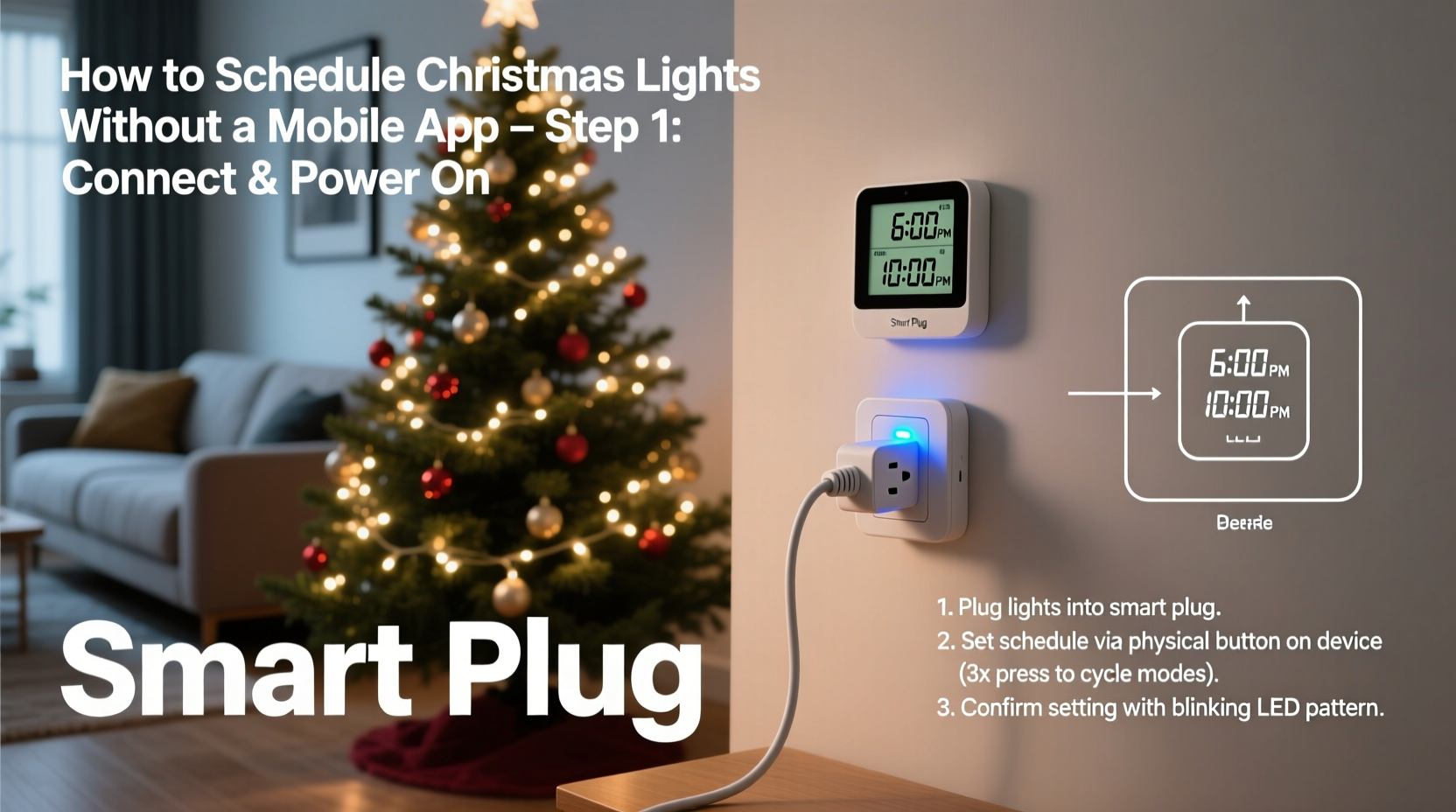
Some smart plugs—including the popular Teckin SP20, BlitzWolf BW-SHP13, and older Belkin Wemo Insight models—feature a physical “Timer” button on the device itself. Pressing and holding this button initiates a direct, on-device programming mode. No network, no app, no cloud—just tactile feedback and LED indicators.
Here’s how it works:
- Press and hold the timer button for 5 seconds until the status LED blinks amber.
- Tap the button once to advance to the next 30-minute interval (e.g., 12:00 → 12:30 → 1:00).
- Double-tap to toggle between ON and OFF states for that slot.
- Hold again for 3 seconds to save and exit.
These plugs typically support up to 8 time slots per day, stored permanently in non-volatile memory. They retain schedules through power outages and firmware updates. While less flexible than web dashboards (no sunrise logic or weekly exceptions), they’re bulletproof for basic “on at dusk, off at midnight” patterns.
Method 4: Local Automation Platforms (Home Assistant & ESPHome)
For users comfortable with light configuration, open-source home automation platforms provide full app-free control—including scheduling—entirely on your local network. Home Assistant, installed on a Raspberry Pi or dedicated mini-PC, discovers compatible smart plugs (via MQTT, HTTP, or local API) and lets you define precise automations using YAML or its visual dashboard.
Example YAML automation for turning lights on at sunset and off at 11 p.m.:
alias: \"Christmas Lights Sunset On\"
trigger:
  - platform: sun
    event: sunset
    offset: \"-00:15\"
action:
  - service: switch.turn_on
    target:
      entity_id: switch.christmas_front_porch
mode: single

alias: \"Christmas Lights Midnight Off\"
trigger:
  - platform: time
    at: \"23:00:00\"
action:
  - service: switch.turn_off
    target:
      entity_id: switch.christmas_front_porch
mode: single
Once deployed, these automations run independently of the internet. Even if your broadband goes down, your lights stay on schedule. ESPHome takes this further: flashing custom firmware onto ESP8266/ESP32-based plugs removes cloud dependencies entirely and adds features like adaptive brightness and energy monitoring—all controllable via a local web UI.
| Method | Setup Time | Internet Required? | Cloud Data Shared? | Best For |
|---|---|---|---|---|
| Web Dashboard | 5–10 min | No (local network only) | No | First-time users; tech-averse households |
| Voice Routines | 3–7 min | Yes (for initial sync only) | Minimal (voice snippets only) | Families with smart speakers; hands-free operation |
| Physical Button | 2–4 min | No | No | Renters, travelers, privacy-first users |
| Home Assistant | 45–90 min | No (after setup) | No | Tech-savvy users; whole-home automation |
| ESPHome Firmware | 60+ min | No | No | DIY enthusiasts; maximum reliability & control |
Real-World Example: The Miller Family’s App-Free Display
The Millers live in rural Vermont, where cellular coverage is spotty and broadband outages occur 2–3 times each winter. For years, their porch and tree lights relied on a Kasa app—until a snowstorm knocked out both power and internet for 36 hours. When power returned, the app wouldn’t reconnect, and their lights stayed dark for two nights.
This past November, they switched to a web-based approach. Using their laptop, they accessed each plug’s IP address, set sunrise-triggered “on” times (adjusted for latitude), and hard-coded “off” at 11 p.m. They also added a voice routine: “Hey Google, start holiday mode,” which toggles all three plugs simultaneously. During December, they experienced zero timing failures—even when their internet dropped twice. Their neighbor, a retired electrician, helped them label each plug’s IP on masking tape behind the outlet (“Porch: 192.168.1.47”). “It’s like having a tiny, silent electrician living inside each outlet,” says Sarah Miller.
Common Pitfalls—and How to Avoid Them
Even app-free scheduling has nuances. Here’s what trips people up—and how to sidestep it:
- Time zone mismatches: Plugs often default to UTC or factory-set zones. Always verify and manually set your local time zone in the web dashboard—don’t assume auto-detection works.
- DST confusion: Some older plugs don’t auto-adjust for daylight saving time. If your schedule shifts unexpectedly in early November or mid-March, manually update the “off” time by one hour.
- Power-cycle resets: A small number of budget plugs erase schedules after extended outages. Test yours: unplug for 5 minutes, restore power, and confirm timers persist.
- Wi-Fi channel congestion: During holidays, streaming, gaming, and video calls flood the 2.4 GHz band—where most smart plugs operate. If web dashboards load slowly or commands lag, log into your router and switch the plug’s SSID to a less crowded channel (e.g., 1, 6, or 11).
FAQ
Can I schedule multiple plugs at once without an app?
Yes—via web dashboard groups (if supported, e.g., Meross LAN mode), voice routines that target multiple devices (“Alexa, turn on all holiday lights”), or local automation platforms like Home Assistant, where one automation can trigger several switches simultaneously.
Do I lose energy monitoring or usage history without the app?
Most web dashboards preserve basic energy data (kWh, runtime) for the current month. However, long-term analytics and graphs usually require the app or cloud service. If usage tracking matters, consider ESPHome—it logs detailed metrics to your local database and displays them in real time via its built-in web UI.
What if my plug doesn’t have a web interface?
Check its model number and search “[brand] [model] local web interface.” Many manufacturers disable it by default but enable it via hidden URL paths (e.g., http://[ip]/web). If truly unsupported, opt for physical button programming or replace it with a plug known for local control—like the Tapo P110 or Sonoff S31 Lite, both of which ship with fully functional, no-account web dashboards.
Conclusion: Take Back Control—One Plug at a Time
Scheduling Christmas lights shouldn’t mean surrendering convenience, privacy, or reliability to a mobile app. The tools are already in your home: your browser, your voice, the small button on the side of the plug, or the Raspberry Pi gathering dust in your closet. Each method offers something distinct—simplicity, speed, autonomy, or precision—but all share one advantage: they put timing decisions back in your hands, not a server farm halfway across the world.
Start small. Pick one plug. Find its IP. Set two times—one to welcome guests at dusk, one to conserve energy overnight. Then add a second. Then teach your family the voice phrase. In under an hour, you’ll have a display that runs like clockwork—without ever unlocking your phone.




 浙公网安备
33010002000092号
浙公网安备
33010002000092号 浙B2-20120091-4
Comments
No comments yet. Why don't you start the discussion?