
S-prefixed files—those beginning with the letter \"S\" followed by numbers or additional characters—are commonly encountered in enterprise systems, legacy environments, and structured data workflows. These files often represent system-generated logs, saved states, temporary snapshots, or serialized data. While they may appear cryptic at first glance, understanding how to identify, open, and interpret them is essential for IT professionals, developers, and even advanced users managing digital assets.
This guide demystifies S-prefixed files, offering practical strategies to view and work with them across platforms and applications. Whether you're troubleshooting a system issue or recovering archived data, the insights here will help you navigate these files confidently.
Understanding S-Prefixed Files: What They Are and Why They Exist
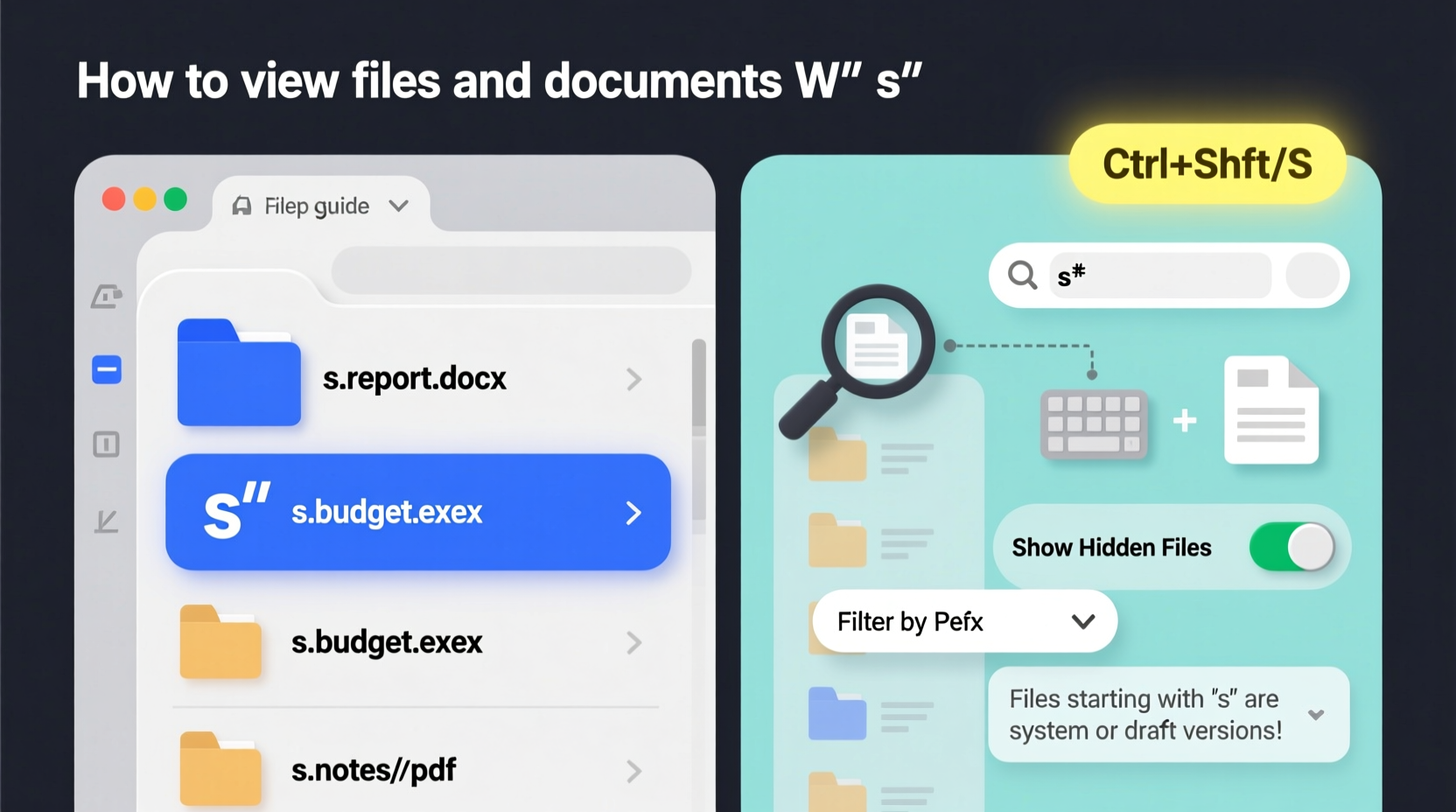
The \"S\" prefix is not standardized across all systems but typically denotes a specific category of file based on naming conventions used by software suites or operating environments. Common contexts include:
- System backups – Temporary save states in CAD software or virtual machines (e.g., S001, S002).
- Serialized data – Output from programming environments like MATLAB or Python (e.g., S_data.mat).
- Log sequences – Rotated log files in server applications (e.g., S_log_20240401.log).
- Staging files – Intermediate processing files in database or ETL pipelines.
These files are often created automatically. Their naming convention allows systems to manage versioning, sequencing, or status tracking without overwriting critical data.
“S-prefixed files serve as silent checkpoints in automated workflows—they’re not meant for casual browsing, but ignoring them can lead to missed diagnostics.” — Dr. Lena Torres, Systems Architecture Lead at NetSys Labs
Step-by-Step Guide to Accessing S-Prefixed Files
Opening an S-prefixed file requires identifying its origin and format. Follow this sequence to safely inspect and use such files:
- Determine the file extension: Check the full filename (e.g., S1234.tmp, S_config.json). The extension reveals the format and compatible tools.
- Inspect file properties: Right-click the file > Properties (Windows) or Get Info (macOS) to see creation date, size, and type.
- Use a hex editor for unknown types: Tools like HxD (Windows) or Hex Fiend (macOS) allow you to examine raw data headers and detect file signatures.
- Try opening with associated software: If the file comes from AutoCAD, try opening it in AutoCAD; if it's from a database tool, use that application.
- Convert if necessary: Use format conversion tools (e.g., Pandoc for text, FFmpeg for media-related data) only after confirming the file structure.
Common File Types and How to Open Them
Not all S-prefixed files look the same. Below is a reference table outlining frequent variants and recommended actions:
| Filename Example | Likely Origin | How to View | Risks |
|---|---|---|---|
| S0001.part | Download manager or file splitter | Recombine using original tool (e.g., JDownloader) | Data corruption if incomplete |
| S_state.sav | Game or simulation software | Load via application’s “Load Game” feature | Incompatible versions may fail to read |
| S_log_0425.txt | Application logging system | Open with Notepad++, VS Code, or terminal (cat command) | Large files may freeze basic editors |
| S_export.dat | Proprietary software export | Check vendor documentation; may require API or SDK | Binary format; human-readable only with decoder |
| S_config.json | Configuration backup | Edit with any JSON-aware editor (e.g., Sublime Text) | Misconfiguration if edited incorrectly |
Tips for Handling S-Prefixed Files Safely
Because many S-prefixed files are part of automated processes, improper handling can disrupt system operations. Use the following checklist before interacting with them:
- ✅ Verify the file is not currently in use by checking Task Manager (Windows) or Activity Monitor (macOS).
- ✅ Make a copy before attempting to open or modify the original.
- ✅ Confirm file integrity using checksums if available (e.g., MD5, SHA-256).
- ✅ Avoid renaming or moving files within system directories unless authorized.
- ✅ Document changes made for audit or recovery purposes.
file S1234.dat) to auto-detect file type based on content, not just extension.
Real-World Scenario: Recovering a Lost Project Snapshot
A freelance designer using Blender reported losing a project after a crash. Upon inspection, several files named S_001, S_002, and S_final were found in the project directory, with no .blend extension. Using the file command in Linux, one was identified as “Blender 3D scene data.” By renaming S_final to project_recovered.blend, the file opened successfully in Blender, restoring nearly all work.
This case illustrates two key points: first, S-prefixed files often contain recoverable data; second, relying solely on extensions can mislead. Always verify content type independently.
Frequently Asked Questions
Can I delete S-prefixed files to free up space?
Only if you’re certain they are temporary or redundant. Some S-files are active checkpoints or logs required by running applications. Deleting them may cause instability or data loss. When in doubt, archive rather than delete.
Why do some S-files have no extension?
Legacy systems or embedded environments sometimes omit extensions for simplicity or performance. These files rely on internal metadata or external configuration to determine usage. Use a hex editor or consult system documentation to interpret them correctly.
Is there a way to batch-view multiple S-files?
Yes. Use command-line tools like less, head, or grep on Linux/macOS to preview content in bulk. For example: for f in S_*; do echo \"=== $f ===\"; head -n 5 \"$f\"; done previews the first five lines of each S-file in the folder.
Best Practices for Long-Term Management
To prevent confusion and ensure accessibility, adopt these organizational habits:
- Document naming conventions used in your environment, especially for team-shared folders.
- Create a mapping file (e.g., file_types.md) that explains what S-prefixes mean in your workflow.
- Automate cleanup using scripts that move old S-files to archive folders based on age or size.
- Use version control for critical S-config or S-state files when possible, treating them like code.
Proper management turns potentially chaotic file clusters into structured, searchable assets.
Conclusion: Turn Mystery Files into Usable Resources
S-prefixed files are more than obscure artifacts—they’re functional components of modern computing ecosystems. With the right approach, you can unlock valuable data, recover lost work, and improve system transparency. The key lies in methodical identification, cautious handling, and informed tool selection.




 浙公网安备
33010002000092号
浙公网安备
33010002000092号 浙B2-20120091-4
Comments
No comments yet. Why don't you start the discussion?