
A beautifully lit Christmas tree is the centerpiece of holiday decor. But achieving that even, radiant glow—where every branch sparkles without dark spots or tangled clusters—is harder than it looks. Most people plug in their lights only to find glaring gaps near the trunk, overcrowded lower branches, or entire sections that feel sparse. The difference between amateur and professional lighting isn’t more bulbs—it’s technique. With the right method, you can transform any tree into a luminous masterpiece, whether it’s real, artificial, pre-lit, or freshly assembled.
The key lies in consistency, planning, and a strategic wrapping pattern that follows the tree’s natural shape. This guide walks through the proven process used by professional decorators to achieve flawless, camera-ready results—every time.
Start with the Right Equipment
Before you touch a single bulb, ensure you have the right tools. Using mismatched strands, low-quality lights, or insufficient length will sabotage your efforts before they begin.
- LED vs. Incandescent: LED lights are cooler, more energy-efficient, and last longer. They’re ideal for extended display periods and safer around dry trees.
- Bulb Spacing: Choose strands with consistent spacing (typically 4–6 inches apart). Avoid random-bunching sets often found in bargain packs.
- Length per Tree: A general rule: use 100 lights per foot of tree height. For a 6-foot tree, that’s about 600 bulbs—or three 100-light strands. Larger or fuller trees may need up to 150 lights per foot.
- Plug Style: Opt for end-to-end connectable strands with male/female connectors that allow daisy-chaining without bulky overlaps.
The Pro Method: Spiral Wrapping from Top to Bottom
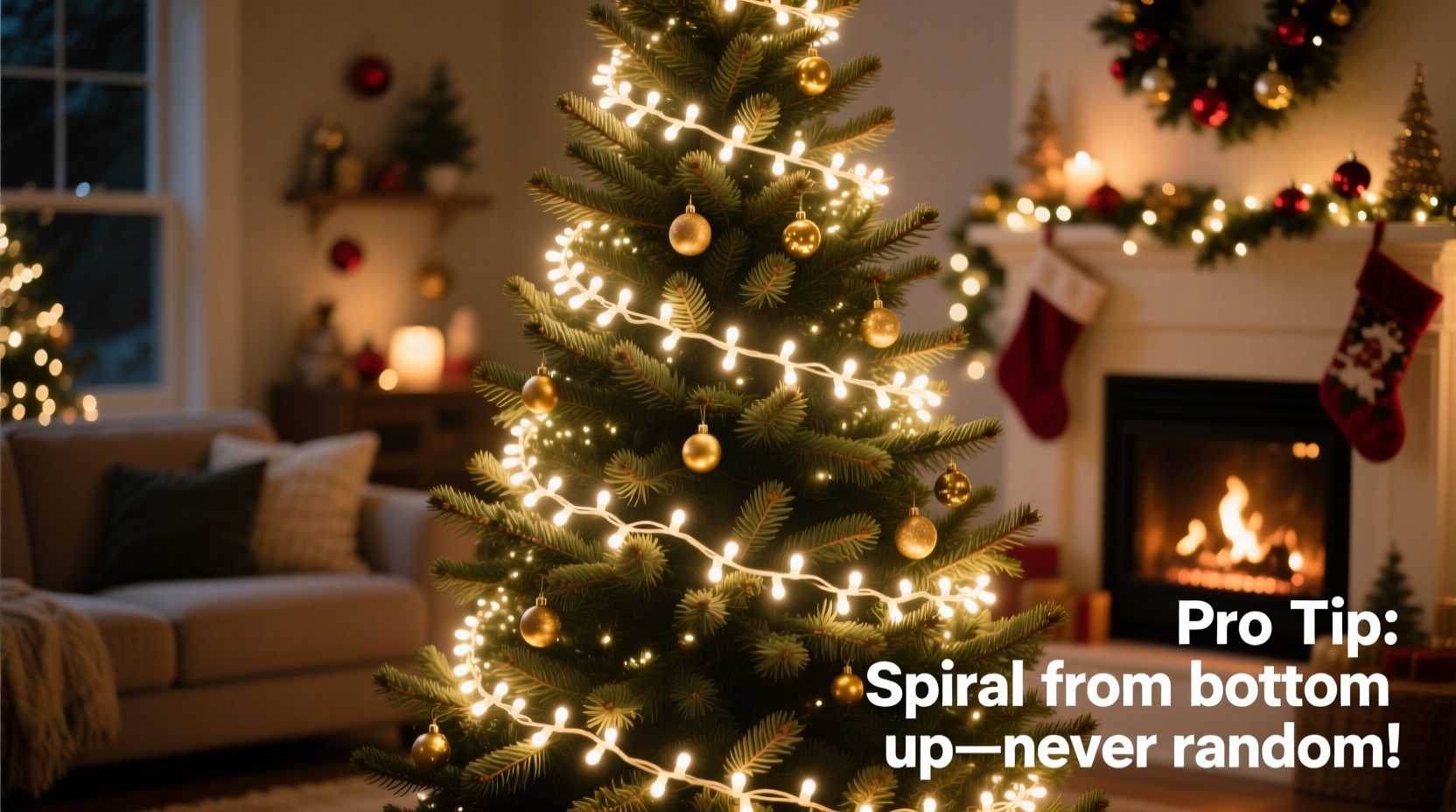
Forget haphazard draping or vertical drops. The industry-standard technique is spiral wrapping—similar to winding a present with ribbon. This ensures even distribution and mimics natural light diffusion through foliage.
- Begin at the top: Start just below the tree topper. Anchor the non-plug end of the first strand with a twist tie or hidden hook. Do not cut the strand.
- Angle downward at 45 degrees: Guide the cord diagonally across the branches, moving outward and down in a continuous spiral. Think of drawing a helix around a cone.
- Weave into the canopy: Don’t just lay lights on the surface. Gently tuck each bulb slightly inward, about 2–3 inches deep into the branch layer. This creates depth and prevents a “skin” of light with darkness behind.
- Maintain consistent spacing: Keep each loop of the spiral roughly 6–8 inches apart vertically. Use your hand span as a quick gauge—one hand width between turns.
- Work section by section: Focus on one quadrant at a time if needed. Complete a full rotation before adjusting tension or direction.
- End at the base: Finish at the bottom rear, routing the plug toward the outlet along the backside of the stand. Conceal cords with a skirt or fabric wrap.
This spiral method eliminates guesswork and ensures no area is skipped. It also allows light to radiate from within the tree, not just its shell, giving a warm, dimensional glow.
Do’s and Don’ts of Christmas Light Placement
Even with the right technique, small mistakes can ruin an otherwise perfect setup. Follow these guidelines to maintain balance and visual harmony.
| Do | Don't |
|---|---|
| Use multiple shorter strands instead of one ultra-long one for easier control and redundancy. | String one continuous line from top to bottom without anchoring intermediate points—risk of sagging or pulling. |
| Tuck bulbs beneath outer branches to diffuse light and reduce glare. | Let cords hang visibly or create straight lines across the front of the tree. |
| Step back every few minutes to check for symmetry and coverage. | Work only from one angle—always view the tree from multiple positions. |
| Layer colors or white tones gradually for dimension (e.g., warm white inside, cool white outside). | Mix color temperatures randomly—can create a patchy, unprofessional look. |
| Secure excess cord behind the tree base instead of coiling it on branches. | Leave dangling plugs or loose wires exposed on floor or stand. |
Real Example: From Patchy to Perfect in One Hour
Sarah, a homeowner in Portland, had struggled for years with her 7-foot pre-lit artificial tree. Despite having 700 built-in lights, she always ended up with a bright ring at the bottom and a dim, spotty upper half. After adding two extra strands using the spiral method, she transformed her display.
She started by turning off the existing lights to assess coverage. She noticed most bulbs were clustered on outward-facing tips, leaving inner layers dark. Using two additional 100-light LED strands, she began at the top and spiraled down, weaving each bulb 3 inches into the branch structure. She focused on filling voids near the trunk and upper backside—areas previously ignored.
After one hour, she stepped back. The tree now glowed uniformly from all angles. Her husband remarked, “It looks like it’s lit from within.” Sarah now uses the same method annually, adjusting only for new ornaments or layout changes.
Expert Insight: What Professional Decorators Know
Industry veterans emphasize precision and patience over speed. According to Marcus Bell, lead decorator at Evergreen Holiday Styling in Denver:
“Amateurs try to cover the tree. Pros illuminate it. The difference is depth. You don’t want lights on the surface—you want them embedded in the architecture of the tree. That means hands-on placement, not tossing strands and hoping.”
Bell also stresses the importance of mock-ups: “Set up your tree at least three days before decorating. Light it first, let it sit overnight, then walk by it at different times of day. You’ll spot imbalances under natural and artificial light that aren’t obvious during installation.”
Checklist: Flawless Christmas Tree Lighting in 10 Steps
Follow this concise checklist to ensure professional results every time:
- Measure your tree and calculate required lights (100 bulbs per foot).
- Test all strands; replace faulty ones.
- Fluff the tree fully—do not light a flat or compressed tree.
- Start at the top with the non-plug end secured.
- Spiral downward at a 45-degree angle.
- Weave each bulb 2–3 inches into the branch layer.
- Keep vertical spacing consistent (6–8 inches between loops).
- Step back frequently to check coverage from multiple angles.
- Route cords neatly down the back and hide the plug at the base.
- Turn off room lights and inspect after completion—adjust as needed.
Frequently Asked Questions
How do I avoid creating clumps when wrapping lights?
Clumping usually happens when you bunch the cord while unwinding or fail to space loops evenly. Always unwind lights slowly from the spool or box before starting. Hold the strand loosely and maintain steady tension as you spiral. If you notice a dense area, gently redistribute the bulbs by shifting the cord along the branch.
Should I light the tree before or after adding ornaments?
Always light the tree before hanging ornaments. Ornaments can block access to branches and obscure gaps in lighting. Installing lights first lets you see exactly where illumination is needed. Plus, larger decorations can be positioned to complement, not conceal, the light pattern.
What if my tree already has built-in lights?
Many pre-lit trees have poor light distribution—often concentrated on outer tips. Use supplemental strands to fill in dark zones, especially near the center and back. Apply the spiral method with additional lights just as you would on a bare tree. Focus on depth and coverage, not just adding more brightness.
Final Tips for a Showstopping Display
Achieving pro-level lighting isn’t about expensive gear—it’s about disciplined technique. Even a modest tree becomes striking when lit with intention. Consider these final refinements:
- Use a dimmer switch or smart plug to adjust brightness for mood or time of day.
- Choose one dominant light color—warm white for classic charm, cool white for modern elegance, or multicolor for family-centered fun.
- Add a tree collar or skirt to hide the base and cords, creating a clean, finished look.
- Photograph your tree at night with your phone—camera sensors often reveal gaps invisible to the eye.
Conclusion: Shine Bright This Season
Wrapping a Christmas tree in lights like a pro isn’t magic—it’s method. By following a deliberate spiral pattern, embedding lights within the branches, and checking coverage from all angles, you eliminate gaps and clumps for good. The result is a tree that doesn’t just glow, but breathes light—a focal point that draws people in and sets the tone for your entire holiday home.
This season, skip the frustration and embrace the technique trusted by professionals. Your tree deserves more than scattered sparkle. It deserves even, radiant brilliance from top to bottom. Set aside an hour, gather your strands, and wrap with purpose. When you flip the switch and see that seamless glow, you’ll know it was worth every careful turn.




 浙公网安备
33010002000092号
浙公网安备
33010002000092号 浙B2-20120091-4
Comments
No comments yet. Why don't you start the discussion?