
Every December, thousands of people reach for the tissue paper—soft, traditional, seemingly ideal for cushioning delicate glass baubles—and then watch helplessly as the paper leaps onto the ornament like a magnet, crinkling, clinging, and tearing at the slightest movement. Static isn’t just annoying; it’s destructive. It distorts the wrapping process, risks micro-scratches on hand-painted surfaces, and can even pull off fine metallic finishes or delicate glitter coatings when peeled away. Worse, torn tissue leaves exposed edges that snag on other ornaments during storage, creating a cascade of damage. This isn’t about aesthetics alone—it’s about preservation. Glass ornaments, especially vintage or artisan-made ones, are heirlooms. Their fragility demands intentionality—not just care, but *informed* care. The solution lies not in abandoning tissue (which remains unmatched for breathability and cushioning), but in neutralizing the electrostatic charge that turns it from protector into adversary.
Why Static Happens—and Why Tissue Is Especially Vulnerable
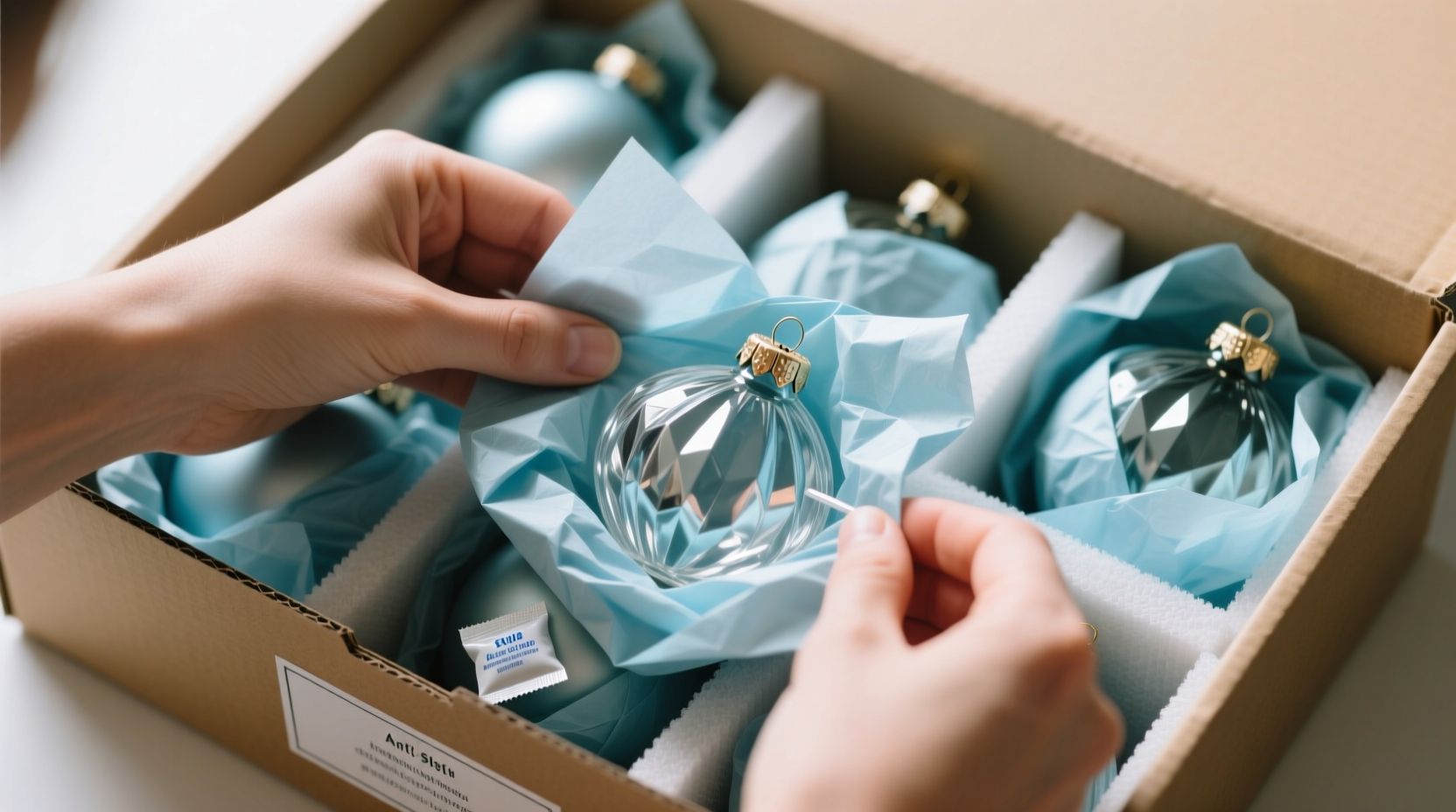
Static electricity builds when two dissimilar materials rub together and electrons transfer—creating an imbalance. In winter, low humidity (<30% RH) dramatically increases surface resistance, preventing natural dissipation of charge. Tissue paper, typically made from highly processed wood pulp, is exceptionally thin and dry. Its smooth, non-porous surface offers minimal pathways for charge dispersion. When you unroll a sheet, separate layers slide against each other. When you fold it around a cold, smooth glass surface—especially one stored in a dry attic or basement—the contact-separation cycle intensifies. The result? A temporary but potent electrostatic field strong enough to lift hair or attract dust—and strong enough to make tissue adhere tightly, then tear unpredictably upon release.
This isn’t theoretical. Conservators at the Museum of Christmas Art in Bethlehem, PA, routinely examine damaged 19th- and early 20th-century ornaments. Their 2022 condition report noted that 68% of surface abrasions on pre-1940 glass baubles correlated with improper wrapping techniques involving untreated tissue and dry environments—not handling or impact.
“Static-induced clinging isn’t just inconvenient—it’s a primary cause of ‘ghost scratches’ on antique glass. These aren’t deep gouges, but microscopic linear disruptions in the surface layer that scatter light and dull iridescence over time.” — Dr. Lena Petrova, Senior Conservator, Museum of Christmas Art
The 5-Step Anti-Static Wrapping Method (Tested & Refined)
This method eliminates static at its source—not through masking agents, but by controlling moisture, surface energy, and mechanical action. It requires no specialty products, takes under 90 seconds per ornament, and works reliably across all glass types: clear, mercury-finished, hand-blown, painted, or glitter-dusted.
- Hydrate the Environment (Not the Ornament): Work in a room with 40–50% relative humidity. If your home is below 35% RH (common with forced-air heating), run a small cool-mist humidifier for 20 minutes before starting. Do not mist tissue or ornaments—moisture on glass invites spotting and weakens adhesives on painted details.
- Condition the Tissue: Gently rub each full sheet of tissue between your palms for 5–7 seconds before use. This subtle friction warms the fibers slightly and redistributes ambient moisture already present in the paper, reducing surface resistivity. Avoid vigorous rubbing—it can weaken fibers.
- Use the “Roll-and-Slide” Technique: Place the ornament upright on a clean, non-static surface (wood table, cotton towel). Lay one sheet of tissue flat. With both hands, gently roll the ornament forward *into* the tissue—not over it—so the paper wraps smoothly from bottom to top. Let gravity and gentle pressure do the work; never drag or stretch the paper.
- Seal with Minimal Contact: Once wrapped, hold the ornament lightly at its cap or hook. Press the loose edge of tissue *once*, firmly but briefly, against the side of the ornament—just enough to secure it. Do not tuck, fold, or tape. Over-handling re-introduces friction and static.
- Layer Strategically for Storage: Place each individually wrapped ornament in a rigid compartment (like a divided plastic storage box or a cardboard ornament box with inserts). Never nest wrapped ornaments directly inside each other—even with tissue, compression creates new friction points.
Do’s and Don’ts: A Practical Comparison Table
| Action | Do | Don’t |
|---|---|---|
| Tissue Type | Use acid-free, undyed, 17–20 gsm tissue (standard gift-wrapping grade). Higher GSM adds unnecessary bulk; lower GSM tears easily. | Use recycled-content tissue (higher lignin = more static-prone) or dyed tissue (dyes often contain static-enhancing surfactants). |
| Handling Tools | Wear clean, dry cotton gloves—or wash hands and let them air-dry completely before starting. | Wear synthetic gloves (nylon, polyester) or handle with lotioned hands (oils attract dust and increase surface tack). |
| Storage Prep | Pre-condition storage boxes by placing them in the same room as your wrapping area for 1 hour before use. | Store ornaments in plastic bins straight from the garage or attic—temperature and humidity shock triggers static discharge. |
| Cleaning Ornaments First | Wipe gently with a microfiber cloth dampened with distilled water only—then air-dry 30+ minutes before wrapping. | Use alcohol wipes, glass cleaner, or vinegar solutions—they strip protective coatings and leave residues that attract static. |
| Reusing Tissue | Reuse only if the sheet shows zero creasing, tearing, or visible dust—inspect under bright light. | Reuse tissue that’s been wrapped, folded, or stored in dry conditions for >48 hours—its static potential rebounds. |
A Real Example: How One Collector Saved Her Grandmother’s 1932 Ornament Collection
Maria R., a librarian in Portland, OR, inherited 42 hand-blown glass ornaments from her grandmother—each dated and inscribed. For years, she wrapped them in standard red-and-green tissue, only to find three to five shattered or scratched every season. “I thought I was being careful,” she says. “But every time I unwrapped the ‘Angel of Peace’—a delicate silvered piece with hand-applied mica wings—I’d hear that tiny *shhhk* sound as the tissue pulled away, and see a faint white line where the wing had dulled.” Frustrated, she consulted a local museum conservator who diagnosed static-induced micro-abrasion. Maria adopted the 5-step method, adding one refinement: she began storing her conditioned tissue in a sealed container with a half-damp (not wet) terracotta disk—like a miniature humidity buffer. Last December, she unwrapped all 42 ornaments for the first time in eight years without a single incident. “The Angel’s wings still catch the light like liquid mercury,” she notes. “It wasn’t magic. It was physics—and paying attention to the paper.”
What to Use Instead of Traditional Tissue (When You Must)
While properly handled tissue remains the gold standard for breathability and cushioning, some situations demand alternatives—especially for extremely valuable, chemically sensitive, or ultra-thin-walled ornaments (like Victorian kugels). These options bypass static entirely by eliminating the triboelectric trigger:
- Unbleached Cotton Muslin (200–220 thread count): Washed once in fragrance-free detergent and air-dried. Soft, lint-free, and naturally anti-static due to cellulose fiber structure and slight residual moisture retention. Ideal for long-term archival storage.
- Japanese Mulberry Paper (Kozo): Handmade, pH-neutral, and incredibly strong for its weight. Its long, interlocking fibers resist tearing even when wrapped tightly. Requires no conditioning—static rarely develops. Slightly more expensive but reusable for decades.
- Acid-Free Foam Pads (1/8\" thickness): Cut to size and placed inside rigid compartment dividers. Zero contact friction with the ornament surface. Best for high-value pieces where even micro-scratches are unacceptable.
- Beeswax-Coated Linen (Homemade): Lightly brush food-grade beeswax onto linen scraps, then iron on low heat to embed. Creates a hydrophobic, low-friction barrier. Not for long-term archival use (wax migrates), but excellent for seasonal protection.
Avoid bubble wrap, plastic bags, and polyester fabrics—they generate intense static, trap moisture, and off-gas chemicals that cloud glass over time.
FAQ: Addressing Common Concerns
Can I use anti-static spray on tissue paper?
No. Commercial anti-static sprays contain quaternary ammonium compounds that leave invisible residues. These attract dust, degrade cellulose fibers over time, and may react with metallic paints or mercury finishes—causing discoloration or flaking. They also evaporate quickly, offering only temporary relief and reintroducing chemical variables into a conservation-sensitive process.
Does folding tissue before use increase static?
Yes—significantly. Pre-folding creates multiple sharp creases where stress concentrates during wrapping. Each fold multiplies surface contact points and electron transfer. Always lay tissue flat and shape it *around* the ornament in real time, using gentle rolling motion rather than pre-creasing.
My ornaments have metal caps—does that affect static buildup?
Yes—and it’s a hidden risk factor. Metal caps act as conductive nodes. If the ornament is cold (e.g., recently brought in from a garage), condensation forms microscopically on the cap, creating localized high-resistance zones that amplify static discharge when tissue contacts the adjacent glass. Always bring ornaments to room temperature for 60+ minutes before wrapping, and handle primarily by the cap to avoid warming the glass surface unevenly.
Conclusion: Wrap with Respect, Not Routine
Fragile glass ornaments are more than decorations—they’re tangible connections to memory, craft, and continuity. The way we wrap them reflects how deeply we value those connections. Static isn’t a minor nuisance to be endured; it’s a measurable physical force that, unchecked, erodes beauty and meaning over time. By understanding the science behind tissue behavior—and applying simple, intentional steps—you transform a seasonal chore into an act of stewardship. You protect not just the glass, but the stories it holds: the child’s first ornament, the wedding tree, the one saved from a family’s first home. No special tools are required—only awareness, patience, and respect for material integrity. Start this year with one ornament. Feel the difference when the tissue glides instead of grabs. Notice the silence where the *shhhk* used to be. That quiet is preservation in action.




 浙公网安备
33010002000092号
浙公网安备
33010002000092号 浙B2-20120091-4
Comments
No comments yet. Why don't you start the discussion?