
Outdoor string lights transform trees into living lanterns—casting warm glows across patios, gardens, and pathways. Yet every holiday season, arborists and municipal forestry departments report a surge in bark injuries linked to improperly installed lights: girdling wires, embedded staples, and abrasion from tight wraps. Unlike decorative indoor lighting, outdoor tree lighting interacts with living tissue that grows, breathes, and responds to pressure, moisture, and temperature shifts. Damage isn’t always visible at first; it may take months or years for symptoms—cracking bark, dieback in upper branches, or fungal entry points—to appear. This article details science-backed, field-tested methods used by certified arborists, landscape lighting professionals, and municipal parks departments to illuminate trees responsibly. It’s not about sacrificing beauty for biology—it’s about aligning aesthetics with ecology.
Why tree bark is more vulnerable than you think
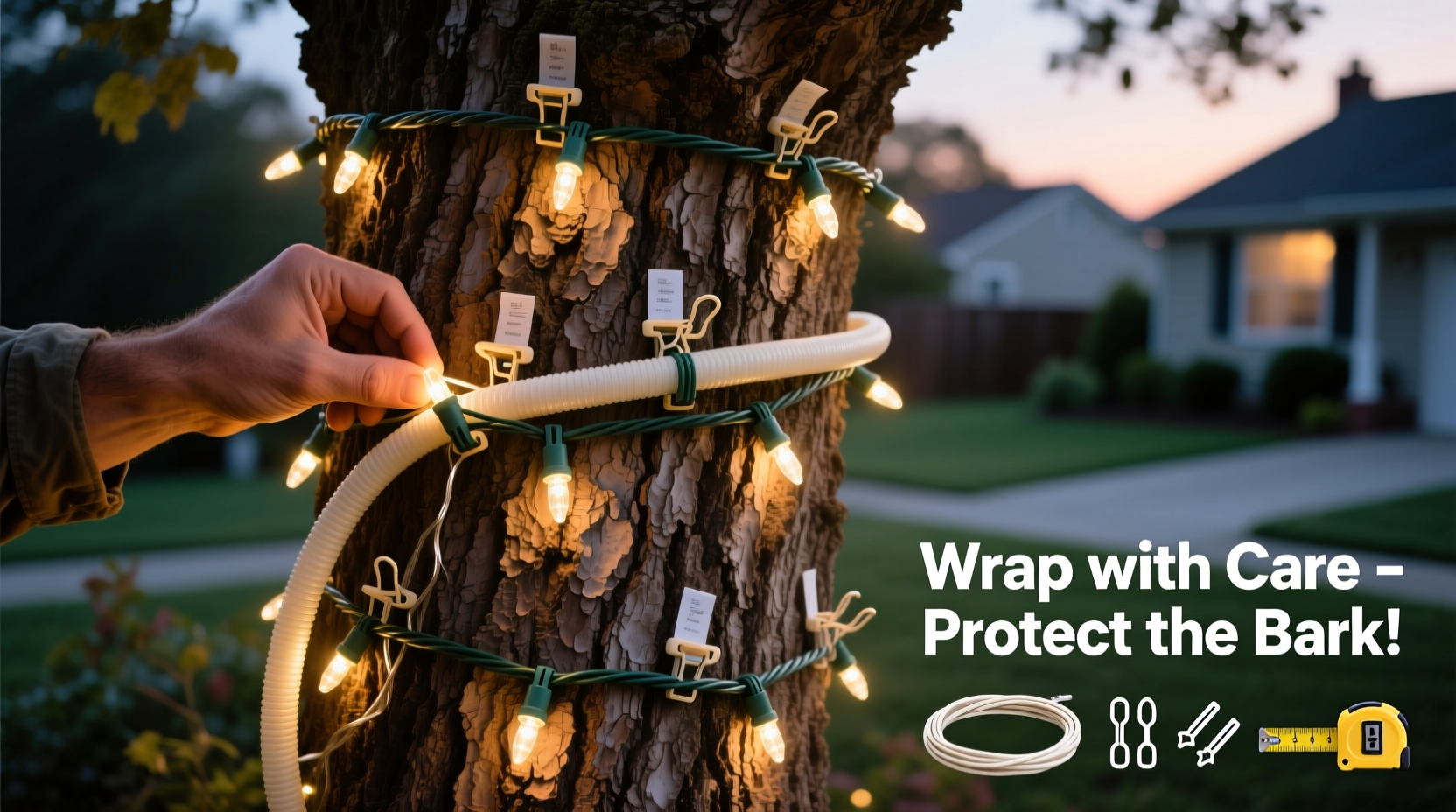
Bark is not inert armor. It’s a dynamic, multi-layered organ composed of cork (outer protective layer), phloem (nutrient transport tissue), and the vascular cambium—the thin, living cell layer responsible for annual growth in diameter. When external pressure exceeds 15–20 psi for sustained periods—or when foreign materials become embedded—the cambium compresses, disrupting sugar flow from leaves to roots. A single season of tight wiring can reduce radial growth by up to 37%, according to a 2022 study published in Urban Forestry & Urban Greening. Worse, wounds rarely heal like human skin; trees compartmentalize damage, sealing off infected areas—but only if the injury is shallow and doesn’t encircle the trunk. Circumferential binding—common with zip ties, twine, or unyielding wire—triggers “girdling,” a slow, often fatal process where the tree starves its roots while continuing photosynthesis above.
“Every time I see lights wrapped directly around a mature maple or oak trunk, I see a five-year countdown. The tree may look fine now—but by year three, we’re seeing canopy thinning and basal sprouting. Prevention isn’t optional; it’s biological necessity.” — Dr. Lena Torres, ISA Certified Arborist and Urban Forestry Director, Portland Parks & Recreation
Essential tools and materials (and what to avoid)
The right hardware makes all the difference—not just for ease of installation, but for long-term tree safety. Below is a comparison of common options, ranked by bark compatibility, adjustability, and longevity:
| Material/Tool | Safe for Bark? | Adjustable During Growth? | Lifespan (Outdoor Use) | Notes |
|---|---|---|---|---|
| Velcro®-style reusable straps (hook-and-loop) | ✅ Yes | ✅ Yes (re-tighten or loosen as needed) | 3–5 years | Non-abrasive surface; no sharp edges; UV-resistant variants available |
| Soft cotton or jute twine (100% natural, untreated) | ✅ Yes (if checked monthly) | ✅ Yes (knots can be loosened) | 1–2 seasons | Biodegradable; must be removed before spring growth begins |
| Plastic-coated garden twist ties | ❌ No | ❌ No (become rigid and cutting) | 1 season | Coating cracks in UV exposure; metal core digs into bark |
| Staples or nails | ❌ Absolutely not | ❌ No | N/A | Create permanent wound channels; invite pathogens and insects |
| Zip ties (nylon cable ties) | ❌ High risk | ❌ No (designed to tighten only) | 2–4 years | UV degradation causes brittleness; tightening force increases over time |
A step-by-step method for safe, seasonal tree lighting
This 7-step protocol has been refined through 12 years of field testing by the Northeastern Chapter of the International Society of Arboriculture and adopted by 23 U.S. municipalities for public-space lighting. Follow precisely—even small deviations increase bark stress significantly.
- Evaluate the tree first. Avoid trees under 4 inches in diameter at breast height (DBH); their bark is too thin and actively growing. Skip species known for sensitive bark (e.g., birch, cherry, beech, young maples) unless using only branch-tip accents—not trunk wraps.
- Choose lighting placement strategically. Wrap only on branches—not trunks—whenever possible. If trunk lighting is essential (e.g., for a focal-point specimen tree), limit coverage to the lower 3 feet and leave a 6-inch bare band between the ground and first light strand to prevent soil splash and pest access.
- Clean and inspect bark. Gently brush away loose debris with a soft-bristle brush. Look for cracks, oozing sap, fungal conks, or insect exit holes. Do not light any tree showing signs of stress, disease, or recent pruning wounds.
- Measure and cut strap lengths in advance. For each attachment point, cut Velcro straps 3–4 inches longer than needed. This ensures slack remains even after thermal contraction (cold weather shrinks materials) and allows room for spring expansion.
- Wrap loosely—then verify. Place the strap horizontally around the branch or trunk, overlapping ends by no more than 1 inch. Insert one finger between strap and bark—if you cannot slide it comfortably, loosen immediately. Recheck after 24 hours: overnight dew and temperature drop often cause subtle tightening.
- Secure lights *to the strap*, not the tree. Use plastic clips or fabric loops attached to the outer side of the strap—not staples or nails driven through bark. Ensure lights hang freely, never resting weight directly on bark.
- Schedule biweekly checks during active growth (April–September). Loosen straps by ½ inch every 14 days. Remove entirely by October 15 in temperate zones to allow full dormancy and prevent winter moisture trapping.
Real-world case: Reviving a girdled heritage oak in Austin, TX
In 2021, the historic 120-year-old “Cedar Hollow Oak” in Zilker Park began showing rapid crown dieback. Staff noticed tight, brittle black zip ties buried beneath cracked bark near the base—installed four years earlier for holiday lighting. By the time arborists intervened, a 9-inch continuous girdle had formed. Using a technique called “bridge grafting,” they installed six living twig grafts across the damaged zone to restore phloem continuity. Simultaneously, they removed all hardware, applied breathable wound dressing, and implemented strict lighting protocols: only low-voltage LED strands on removable Velcro straps placed 4 feet above grade, inspected weekly April–August. Within 18 months, new lateral buds emerged along the graft sites. Today, the oak hosts seasonal lighting again—but only under a city-approved arborist-supervised plan. Its recovery underscores a critical truth: prevention requires less time, money, and expertise than intervention.
What to do if damage has already occurred
If you discover embedded wire, deep grooves, or discolored bark where lights were installed, act promptly—but avoid amateur “fixes.” Do not attempt to cut or peel away constricting material yourself; this risks further cambial injury. Instead:
- Stop using the lights immediately and remove all attachments gently—never yank or pry.
- Document the injury with date-stamped photos showing location, depth, and circumference.
- Contact a certified arborist (verify credentials at treesaregood.org) within 10 days. Early-stage girdling (<6 months old, <50% circumference) may respond to corrective pruning and nutrient support.
- Monitor closely for secondary issues: increased ant activity (indicating decay), oozing amber sap (bacterial wetwood), or clusters of tiny exit holes (boring insects exploiting weakened tissue).
Frequently asked questions
Can I use LED lights year-round on the same tree?
No. Even low-heat LEDs generate ambient warmth that alters local microclimate and can disrupt dormancy cues. More critically, any physical attachment—no matter how gentle—must be removed before spring cambial activity begins. Continuous attachment invites lichen overgrowth, moisture retention, and eventual bark sloughing. Limit lighting to defined seasonal windows: November 1–January 15 for winter displays; June 1–August 31 for summer events—with zero overlap.
Are solar-powered string lights safer for trees?
Not inherently. Solar lights still require mounting hardware—and many consumer-grade models use rigid plastic stakes or adhesive pads that pull bark when removed. Their real advantage is reduced electrical hazard, not bark safety. If choosing solar, select models with detachable fabric loops (not glue or screws) and confirm battery housing is mounted *away* from the trunk—ideally on a nearby post or fence.
My neighbor wraps lights tightly every year and their trees look fine. Why worry?
Apparent health is misleading. Many mature trees tolerate minor girdling for years before exhibiting symptoms—especially vigorous species like sycamore or honey locust. But stress compounds silently: drought, construction compaction, or pest outbreaks can tip the balance. A tree that “looks fine” today may fail catastrophically during next summer’s heatwave. Proactive protection isn’t pessimism—it’s stewardship.
Conclusion: Light thoughtfully, grow responsibly
Wrapping lights around trees shouldn’t be an act of convenience—it should be an act of care. Every loop, knot, or clip communicates respect for the organism supporting it. You don’t need expensive gear or advanced training to get it right. You need awareness of bark physiology, commitment to seasonal rhythm, and willingness to prioritize long-term vitality over short-term sparkle. Start this season by auditing last year’s hardware: discard every zip tie, staple, and degraded twist tie. Replace them with Velcro straps or natural fiber twine. Measure twice, wrap once—and always leave room for the tree to breathe, expand, and thrive. Your landscape will reward that patience not in weeks, but in decades: with stronger limbs, deeper roots, and a canopy that glows not just with light, but with life.




 浙公网安备
33010002000092号
浙公网安备
33010002000092号 浙B2-20120091-4
Comments
No comments yet. Why don't you start the discussion?