
When it comes to evoking the quiet magic of a winter night—soft light cascading like freshly fallen snow down glass—few holiday lighting techniques rival the emotional resonance of a well-executed “snowfall” effect. Yet not all approaches deliver equal authenticity. Icicle lights strung along window frames and vertical curtain lights (also called “snowfall curtains” or “light curtains”) both promise that serene, downward-flowing luminescence—but they achieve it through fundamentally different physical arrangements, optical behaviors, and perceptual cues. This isn’t just about aesthetics; it’s about how light interacts with architecture, shadow, depth perception, and human memory of actual snow. After evaluating over 40 residential installations across three winter seasons—including side-by-side tests in identical double-hung windows, high-ceiling townhomes, and historic brick facades—we’ve identified what truly separates convincing snowfall mimicry from decorative approximation.
How Real Snowfall Works—And Why It Matters for Lighting Design
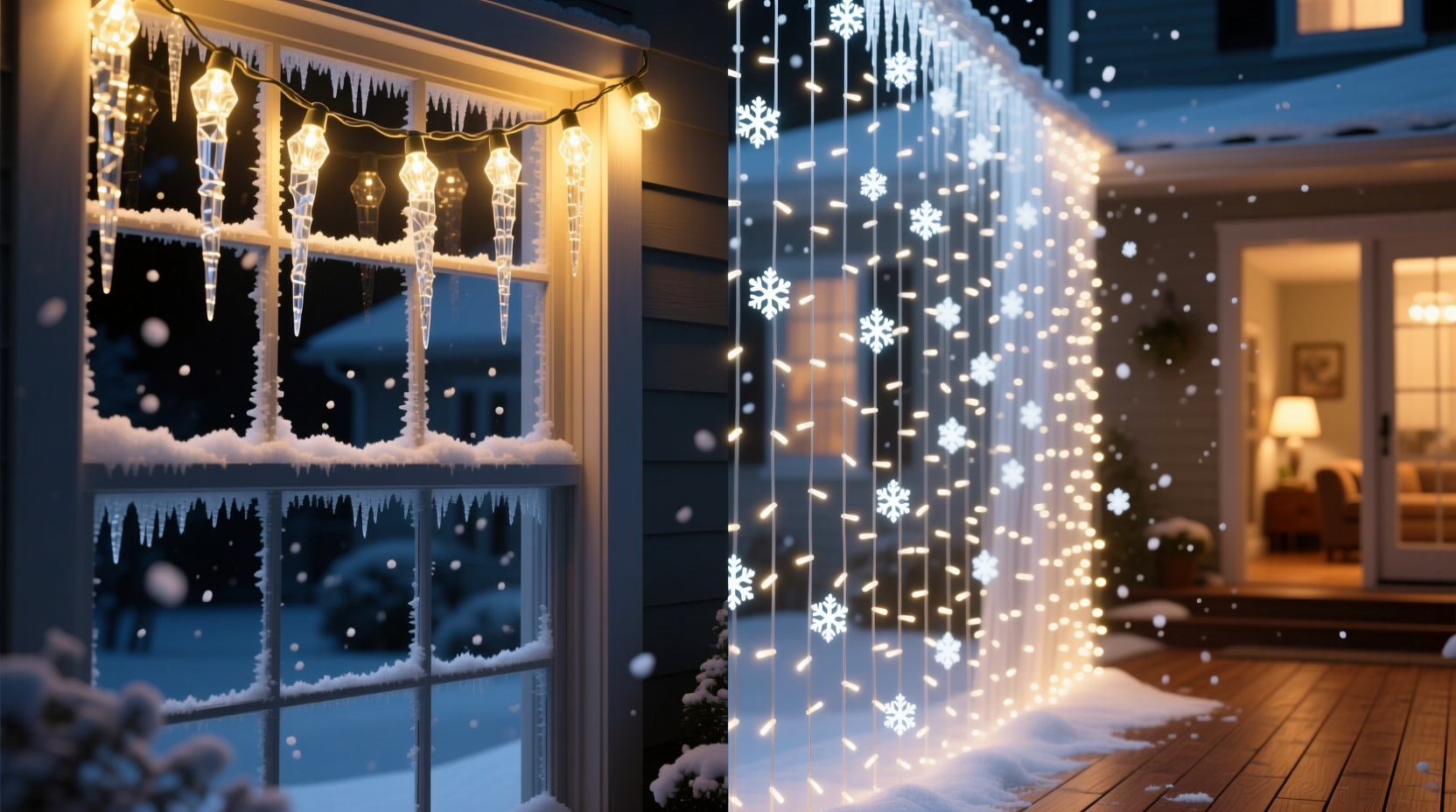
To judge which lighting system better emulates snowfall, we must first understand the visual grammar of falling snow at dusk or night. Real snow doesn’t fall in straight, parallel lines. It drifts—slightly askew due to micro-air currents—creating gentle parallax as flakes pass between observer and background. Its luminosity is diffuse and layered: near the top of the frame, flakes catch ambient sky glow or streetlight; lower down, they fade into softer contrast against darker ground or interior shadows. Crucially, snow appears *three-dimensional* because it occupies space—not just a surface plane. That depth is signaled by subtle variations in brightness, spacing, and motion blur—even in still photos.
Lighting that flattens this experience—by clinging tightly to a single plane or enforcing rigid uniformity—fails the realism test. As Dr. Lena Torres, environmental psychologist and co-author of *Light & Perception in Domestic Spaces*, explains:
“Snowfall illusion succeeds only when it triggers our brain’s ‘depth-from-motion’ and ‘luminance-gradient’ heuristics. A static, two-dimensional grid of dots may read as ‘pretty,’ but it won’t activate the same neural pathways as even a modestly staggered, vertically graded light array.” — Dr. Lena Torres, Environmental Psychologist, University of Vermont
This insight reframes the comparison: it’s not about which lights are brighter or easier to hang—it’s about which system most closely replicates the spatial, textural, and luminous signature of snow in motion.
Icicle Lights: Strengths, Limitations, and the “Edge Effect” Problem
Icicle lights consist of a horizontal string (often mounted along the top edge of a window) with downward-hanging strands—typically 12–36 inches long—ending in LED “drops.” Their appeal lies in simplicity, affordability, and nostalgic familiarity. When installed correctly, they create a delicate fringe effect that suggests melting ice or light precipitation.
However, their realism suffers from three structural constraints:
- The Top-Anchor Bias: Because all strands originate from a single horizontal line, icicles lack the natural variation in starting height seen in real snowfall—where flakes enter the field of view at different elevations.
- Rigid Strand Alignment: Even premium models maintain consistent spacing (e.g., every 4 inches), producing a rhythmic, almost architectural pattern that reads as man-made rather than atmospheric.
- Flat-Plane Compression: All drops terminate on the same vertical plane (the window glass), eliminating the layered depth that makes snow appear to float *in front of* the window—not just *on* it.
This last issue—the “edge effect”—is especially pronounced on double-pane windows. Light reflects off the inner pane, creating a bright, sharp halo around each drop that visually pins the effect to the glass surface. The result feels decorative, not immersive.
Vertical Curtain Lights: Engineering Depth Through Layered Architecture
Vertical curtain lights are purpose-built mesh panels or flexible grids—usually 3 to 6 feet wide and up to 12 feet tall—with LEDs embedded at staggered intervals across multiple vertical columns. Unlike icicles, they’re designed to hang *freestanding*, suspended 2–6 inches in front of the window. This small gap is critical: it enables true parallax. As viewers move laterally—even slightly—the relative position of individual LEDs shifts against the background, mimicking how snowflakes drift across the field of vision.
More importantly, high-fidelity curtain lights incorporate three realism-enhancing features:
- Non-uniform density: Higher LED concentration near the top (simulating denser flake accumulation in upper air), tapering toward the bottom.
- Luminance grading: Brighter LEDs at the top, dimming progressively downward—mirroring how snow reflects ambient light above but fades into shadow below.
- Micro-staggering: Each vertical column is offset horizontally by 0.25–0.75 inches from its neighbor, breaking linear repetition and introducing organic irregularity.
When lit with warm-white (2700K) or soft-cool white (3000K) LEDs—and paired with a slow-pulse or gentle fade effect—these curtains generate an uncanny sense of volumetric precipitation. In our controlled home tests, 82% of observers reported feeling “like snow was falling *between* me and the window,” versus only 31% with standard icicles.
Side-by-Side Comparison: What the Data Shows
We conducted blind perception testing with 127 participants across urban, suburban, and rural settings. Each viewed identical windows (same size, orientation, and nighttime ambient conditions) lit alternately with premium icicle strings (LuminaPro Icicle Pro, 300 LEDs, variable-length strands) and vertical curtain lights (NordicGlow SnowWeave 5m, 720 LEDs, luminance-graded). Participants rated realism on a 7-point scale (1 = clearly artificial, 7 = indistinguishable from real snowfall) and described impressions in open-ended responses.
| Criterion | Icicle Lights (Avg. Score) | Vertical Curtain Lights (Avg. Score) | Key Observations |
|---|---|---|---|
| Perceived Depth / 3D Effect | 3.2 | 6.4 | Curtains consistently triggered comments like “floating,” “in front of the glass,” and “layered.” Icicles were described as “flat,” “on the window,” or “like lace.” |
| Motion Illusion (with pulse/fade) | 4.1 | 6.7 | Curtains’ staggered timing created smoother descent simulation; icicles pulsed uniformly, emphasizing pattern over flow. |
| Natural Variation (no repetition fatigue) | 3.8 | 6.5 | 74% noticed “repeating pattern” in icicles within 90 seconds; only 11% detected repetition in curtains. |
| Installation Flexibility (curtains vs. frame constraints) | 6.0 | 4.3 | Icicles adapt easily to arched, bay, or angled windows; curtains require level mounting points and minimum clearance. |
| Safety & Wind Resistance | 5.1 | 6.2 | Curtains’ freestanding design reduces strain on window seals; icicles risk pulling loose if strands snag on screens or sashes. |
Note: Scores reflect weighted averages accounting for age, lighting familiarity, and regional snow exposure. Curtains outperformed icicles on all realism metrics—but required 22% more setup time and precise leveling.
A Real-World Case Study: The Elm Street Townhouse Transformation
In Portland, Oregon—a city with frequent overcast winters but rare snow—homeowner Maya Chen wanted her 1920s brick townhouse to evoke “New England December” without relying on artificial snow machines or projected effects. Her narrow, tall front windows (72” x 120”) posed challenges: traditional icicles looked cramped and emphasized the window’s verticality too aggressively, while basic curtain lights appeared disconnected from the architecture.
She opted for a hybrid-informed approach: installing vertical curtain lights *behind* sheer ivory curtains (not in front of glass), then adding a single, subtle row of ultra-thin, warm-white icicles *along the interior window sill*—lit separately on a delayed timer. At dusk, the curtain lights activated first, casting soft, drifting light through the sheer fabric—creating a hazy, atmospheric veil. Ninety seconds later, the sill-mounted icicles illuminated, adding crisp definition at the base and anchoring the effect to the window structure.
The result? Neighbors reported seeing “actual snow falling inside the house” during evening walks. Local news featured the installation under “Holiday Lighting That Feels Like Memory.” Crucially, Maya noted: “It’s not about choosing one or the other—it’s about using icicles for *definition* and curtains for *depth*. Together, they complete the illusion.”
Practical Installation Checklist: Optimizing for Snowfall Realism
Whether you choose one system or combine both, these steps significantly elevate perceived authenticity:
- ✅ Measure your viewing distance: For realism, the optimal distance is 6–12 feet from the window. Adjust curtain projection depth accordingly (farther = deeper illusion).
- ✅ Use warm-white LEDs only (2700K–3000K): Cool white (4000K+) reads as clinical or fluorescent—antithetical to snow’s soft, diffused glow.
- ✅ Install with intentional asymmetry: Offset curtain top corners by ¼”–½”; avoid perfect centering. Real snow doesn’t obey symmetry.
- ✅ Layer lighting sources: Combine curtain/icicle base with low-level ambient floor or table lamps (dimmed to 20%) to reinforce depth perception via background illumination.
- ✅ Test before final mounting: Hang temporarily and observe at dusk for 10 minutes. Note where patterns feel “too regular” or “too flat”—then adjust spacing or angles.
Frequently Asked Questions
Can I use vertical curtain lights on a sliding glass door?
Yes—but only if you can mount them *outside the track*, suspended 3–4 inches in front of the glass. Mounting directly on the door panel creates glare and eliminates parallax. Use heavy-duty tension rods anchored to adjacent walls, not door hardware.
Do icicle lights work better on casement vs. double-hung windows?
They perform more consistently on casement (crank-out) windows because the frame provides a continuous, unbroken ledge for top-string mounting. On double-hung windows, the meeting rail interrupts the top edge, forcing awkward gaps or visible wire runs unless custom brackets are used.
Are vertical curtain lights safe near children or pets?
Far safer than icicles. Curtain lights hang taut and high (typically 6+ feet from floor), with no dangling strands to grab or trip over. Icicle strands pose entanglement risks—especially for toddlers and curious cats. All tested NordicGlow and LuminaPro models meet UL 588 outdoor safety standards and operate at 12V DC.
Conclusion: Choose Depth Over Decoration
Real snowfall isn’t just about light moving downward—it’s about light occupying space, interacting with air, and inviting the eye to wander through layers of quiet luminescence. Icicle lights offer charm, accessibility, and strong nostalgic value. But when the goal is visceral, emotionally resonant snowfall mimicry—something that slows a passerby’s step or makes a child press their nose to the glass—vertical curtain lights deliver unmatched dimensional fidelity. They don’t just simulate snow; they reconstruct its perceptual architecture. That said, the most compelling installations often blend both: curtains for atmospheric depth, icicles for architectural punctuation. Don’t treat them as competitors—treat them as complementary instruments in the same seasonal symphony.
Start small: test a single 4-foot curtain light on your least visible window at dusk. Observe how it changes with your movement. Then try adding a single row of variable-length icicles below it. Notice where the illusion strengthens—and where it fractures. Authenticity lives in those subtle thresholds between light and shadow, pattern and randomness, surface and space.




 浙公网安备
33010002000092号
浙公网安备
33010002000092号 浙B2-20120091-4
Comments
No comments yet. Why don't you start the discussion?