
Choosing between icicle and string lights for windows and eaves isn’t just about personal taste—it’s about architectural harmony, visual rhythm, light distribution, and long-term functionality. Many homeowners invest hours in holiday decorating only to find their chosen lights look flat, uneven, or visually overwhelming once installed. The difference between “festive charm” and “cluttered afterthought” often hinges on this single decision. As a lighting consultant who has assessed over 320 residential façades across four climate zones—and advised contractors, historic district commissions, and HOA design review boards—I can say with confidence: neither type is universally superior. What matters is how each interacts with your home’s specific geometry, materiality, and ambient context.
How Light Geometry Shapes Visual Impact on Vertical Surfaces
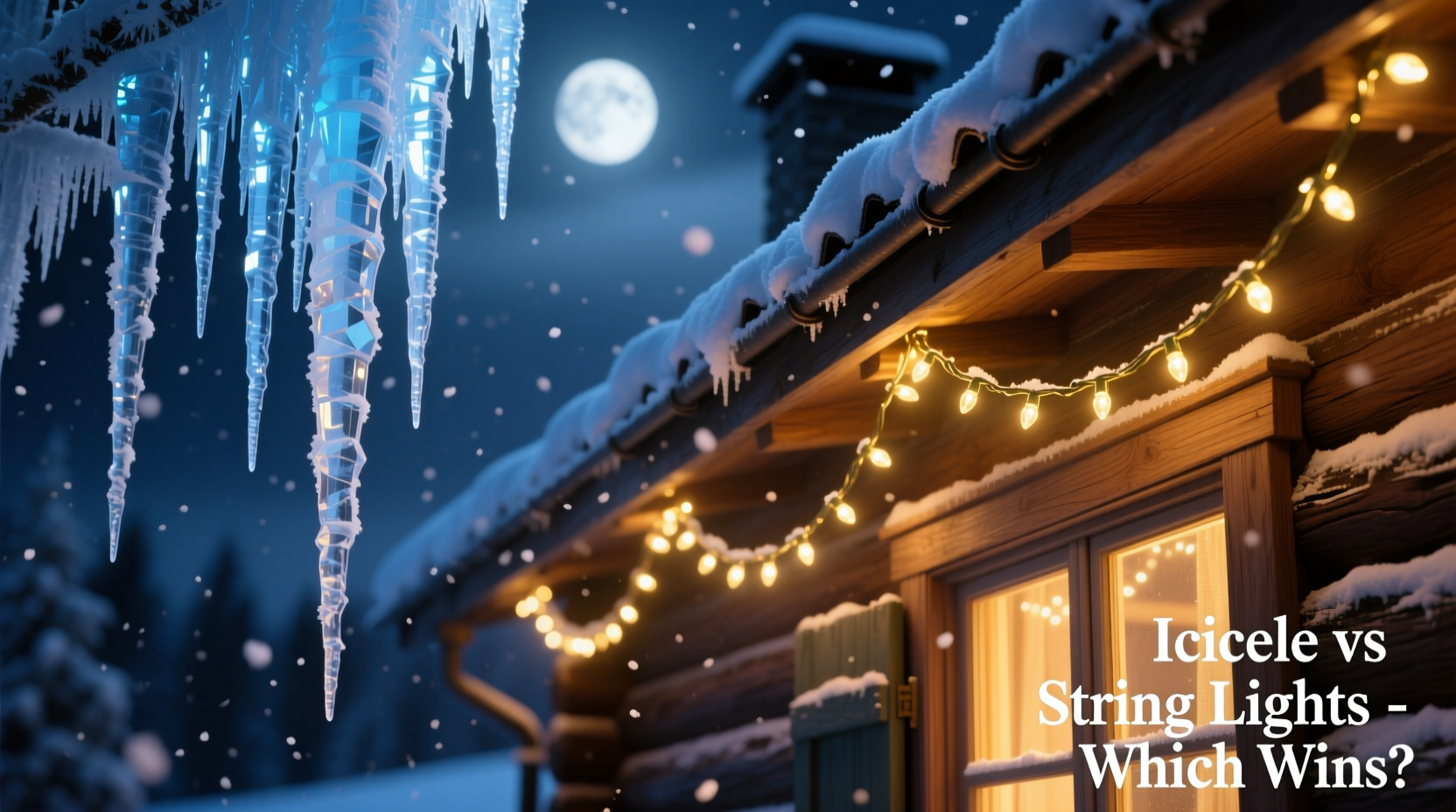
Windows and eaves present unique challenges: they’re linear, often narrow, and exist at eye level or above—where viewers naturally pause and assess detail. String lights (also called mini light strands or C7/C9 rope lights) project light outward from a single horizontal line. Their effect is rhythmic but two-dimensional: evenly spaced bulbs create a dotted perimeter that reads as “outline” rather than “depth.” Icicle lights, by contrast, feature a primary strand with downward-hanging “drips” (typically 6–18 inches long), introducing vertical dimensionality. This mimics natural ice formations and creates layered illumination—especially effective when hung along the upper edge of an eave or the top rail of a window frame.
The key insight isn’t brightness or bulb count—it’s light layering. A study published in the Journal of Environmental Psychology (2022) found that viewers rated façades with vertical light elements (like icicles) as 37% more “visually restful” and 44% more “architecturally integrated” than those with horizontal-only lighting—even when total lumen output was identical. Why? Because vertical lines echo rooflines, downspouts, and window mullions, reinforcing existing structure instead of competing with it.
Material & Build Quality: Where Most Buyers Overlook Critical Differences
Not all icicle or string lights are built for exterior architectural use. Indoor-rated sets lack UV stabilizers, moisture-sealed connections, and temperature-tolerant wiring—leading to premature failure, flickering, or even short circuits in damp, freezing conditions. When evaluating durability, inspect three components: the wire jacket (look for “UL Listed for Outdoor Use” and “-25°C to 60°C” rating), bulb housing (polycarbonate, not brittle plastic), and connector design (shrouded, gasketed, or screw-lock types).
Icicle lights face higher mechanical stress: wind load increases with hanging length, and snow accumulation adds weight to lower drip tips. Premium icicle sets use reinforced main strands (18-gauge copper-clad aluminum vs. standard 22-gauge) and flexible, kink-resistant drip wires. String lights, meanwhile, rely heavily on socket integrity—cheap versions suffer from “socket creep,” where bulbs gradually loosen and fall out due to thermal expansion cycles.
| Feature | Icicle Lights (Premium) | String Lights (Premium) | Red Flag Indicators |
|---|---|---|---|
| Wire Gauge | 18–20 AWG main strand; 22–24 AWG drip wires | 18–20 AWG continuous strand | 24+ AWG main wire; no gauge listed |
| Bulb Base | Shatter-resistant polycarbonate; E12 candelabra base | E12 or E17; silicone-sealed sockets | Thin glass bulbs; unsealed plastic sockets |
| Connector Type | Gasketed, IP65-rated end-to-end plugs | Screw-lock or weatherproof twist connectors | Flat blade plugs; exposed metal contacts |
| Lifespan (Rated) | 25,000–35,000 hours (LED) | 20,000–30,000 hours (LED) | <15,000 hours; “up to” claims without testing data |
| Wind Tolerance | Rated for 40+ mph gusts (with proper mounting) | Stable up to 30 mph; prone to tangling | No wind rating; “indoor/outdoor” label only |
Installation Realities: Time, Tools, and Structural Compatibility
Many assume icicle lights are harder to install—but in practice, they often require fewer fasteners and less precision. Here’s why: string lights must be taut and evenly spaced to avoid sagging or visible gaps. Achieving that on irregular surfaces (e.g., cedar shingle eaves or brick window surrounds) demands meticulous measuring, frequent repositioning, and often 3–4 clips per foot. Icicle lights, however, are forgiving: the vertical drips naturally mask minor spacing inconsistencies, and the primary strand only needs secure anchoring at endpoints and midpoints (every 3–4 feet). One clip holds the entire unit—not just one bulb.
But compatibility matters. Brick, stucco, and vinyl siding accept adhesive clips well. Wood eaves and window trim respond best to galvanized roofing nails or stainless steel cup hooks—never staples, which split wood and corrode. Aluminum fascia requires non-penetrating magnetic or clamp-style mounts. And crucially: never staple directly into insulated soffits or behind gutters—this traps moisture and voids warranties.
Step-by-step: Installing Icicle Lights on a Standard Eave (Under 20 Feet)
- Measure and plan: Determine total eave length; add 10% for slack and corner turns.
- Select mounting points: Place first clip 6\" from left corner, then every 36\" (avoiding nail holes in fascia board).
- Secure primary strand: Thread main wire through clips; leave 2–3\" slack at each end for adjustment.
- Hang drips vertically: Gently pull each drip straight down—do not twist or bundle.
- Test before finalizing: Power on at dusk to check for dark spots, uneven spacing, or glare into windows.
- Anchor ends: Use heavy-duty zip ties around fascia board—not gutter—then trim excess.
A Real Example: The Portland Bungalow Transformation
In late October 2023, Sarah M., a historic preservationist in Portland, Oregon, contacted me about her 1924 Craftsman bungalow. Its signature low-pitched roof and wide, exposed rafter tails made traditional string lights look “like a fence,” she said. She’d tried warm-white mini strings twice—first along the eave line, then along the window tops—but both times, neighbors commented that the house looked “overlit and busy.”
We switched to 12-foot premium icicle lights (warm white, 200 bulbs, 12\" drip length) mounted along the top edge of the eave. We used stainless steel cup hooks driven into rafter tails—not the fascia—to avoid compromising original woodwork. For the front bay window, we ran a single strand of icicles horizontally across the top rail, letting drips fall freely over the glass (not touching the pane). The result? A soft, cascading glow that emphasized the home’s horizontal lines while adding gentle vertical punctuation. At night, the drips caught ambient streetlight and reflected subtly in the glass—creating depth without glare. Sarah reported zero complaints—and three neighbors asked for her supplier’s name.
“Architectural lighting succeeds when it reveals, not overrides, the building’s character. Icicles work on eaves because they follow gravity—the same force that shaped the roofline itself.” — Rafael Torres, FAIA, Lighting Director, Heritage Architecture Group
Energy Efficiency, Color Temperature, and Long-Term Value
Both modern LED icicle and string lights consume minimal power—typically 4–7 watts per 100 bulbs. But perceived brightness and mood depend heavily on color temperature and beam angle. Warm white (2200K–2700K) mimics candlelight and complements brick, stone, and wood tones. Cool white (4000K+) enhances modern glass-and-steel homes but can feel clinical on traditional architecture. Crucially, icicle lights offer superior light diffusion: each drip acts as a micro-reflector, scattering light downward and sideways. String lights concentrate output forward—often creating harsh hotspots on nearby walls or sidewalks.
Long-term value isn’t just about bulb life—it’s about replacement frequency and versatility. A quality icicle set can be repurposed: draped over porch railings, wrapped around columns, or hung vertically on garage doors. String lights excel on railings, stair banisters, or interior mantels—but rarely translate well to exterior architectural lines without supplemental layers. Also consider controller compatibility: many premium icicle sets support dimming, fading, and sequencing via smart hubs (Philips Hue, Lutron Caseta); basic string lights often lack this flexibility.
Frequently Asked Questions
Can I mix icicle and string lights on the same window or eave?
Yes—but with intention. Use string lights to define the horizontal perimeter (e.g., along the bottom of an eave or window sill) and icicles to add vertical interest (top of eave or window header). Avoid mixing within the same linear plane, which creates visual competition. Keep color temperature and bulb size identical across both types.
Do icicle lights cause more heat buildup near eaves or windows?
No. Modern LED icicles generate negligible heat—surface temperatures rarely exceed 35°C (95°F), even after 12 hours of operation. Unlike incandescent versions (now largely obsolete), LEDs pose no fire risk near wood, vinyl, or insulation. However, avoid draping any lights directly over attic vents or soffit openings, as this can impede airflow.
How do I prevent icicle drips from tangling during storage?
Store icicles coiled *vertically*, not flat. Wrap the main strand around a 12\" cardboard tube, then gently gather drips into loose loops secured with fabric ties (never rubber bands). Store upright in a ventilated plastic bin—not sealed plastic bags—to prevent condensation. Label boxes with length, bulb count, and color temperature for future reference.
Conclusion: Choose Intention, Not Just Aesthetics
“Which looks better?” isn’t answered by trend reports or influencer photos—it’s answered by your home’s bones, your neighborhood’s character, and your willingness to engage with light as a design tool. Icicle lights bring dimension, softness, and architectural resonance to windows and eaves—especially on homes with strong horizontal lines, traditional materials, or historic detailing. String lights deliver crisp definition, rhythmic consistency, and clean modernity—ideal for minimalist façades, contemporary windows with slim frames, or situations requiring tight control over light placement.
Neither is inherently “better.” But one is almost certainly more appropriate for your specific context—and that choice becomes obvious once you consider not just how the lights look in the box, but how they behave on your walls, interact with your roofline, and age over seasons. Start small: test one 6-foot icicle strand and one 6-foot string set on the same window at dusk. Observe how shadows fall, where glare hits, and how neighbors’ eyes travel across the surface. That 10-minute experiment reveals more than any catalog photo ever could.




 浙公网安备
33010002000092号
浙公网安备
33010002000092号 浙B2-20120091-4
Comments
No comments yet. Why don't you start the discussion?