
For decades, gas stoves have been the gold standard in both professional and home kitchens. Their responsiveness, visual flame control, and widespread availability made them a default choice. But with the rise of induction cooking, a new contender has emerged—one that promises not just precision, but also speed. One of the most common questions home cooks ask is: which method actually brings water to a boil faster? To answer this, we’ve compiled data from multiple real-world kitchen tests, analyzed energy efficiency, and considered user experience to deliver a definitive comparison between induction cooktops and gas stoves.
The Science Behind Boiling Water
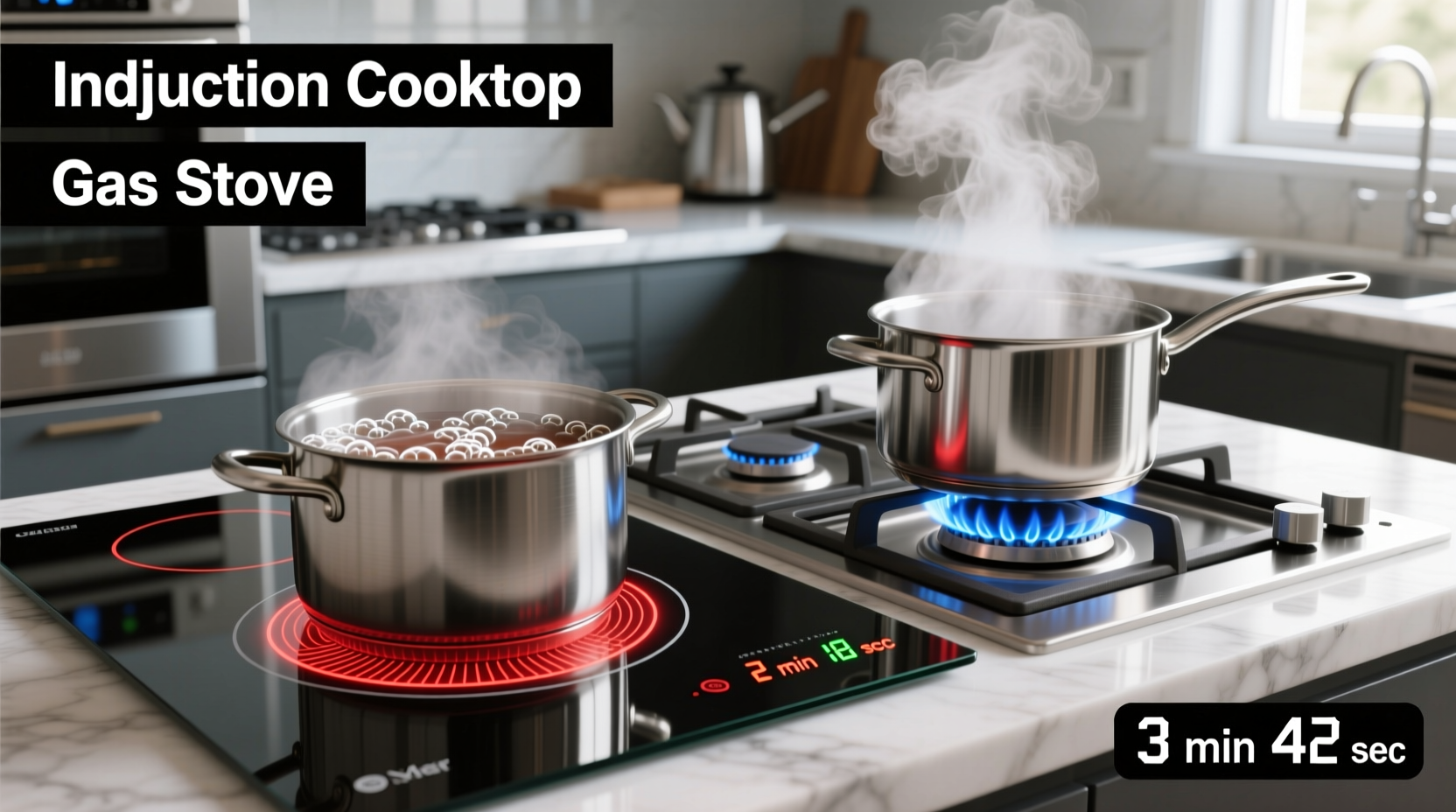
Boiling water may seem simple, but the physics behind it reveals why different heat sources perform differently. The time it takes to bring water to a boil depends on three main factors: heat transfer efficiency, power output (measured in BTUs for gas and watts for electric), and how directly that heat is applied to the cookware.
Gas stoves rely on convection and radiant heat from an open flame. Much of the heat escapes around the sides of the pot, especially if the burner is smaller than the cookware base. In contrast, induction cooktops use electromagnetic fields to generate heat directly within the metal of the pan itself. This means nearly all the energy goes into heating the pot and its contents, rather than the surrounding air.
“Induction doesn’t just heat the pan—it activates the pan as the heating element. That’s why you see such dramatic efficiency gains.” — Dr. Alan Kim, Thermal Dynamics Researcher at MIT Energy Initiative
Kitchen Test Results: Time to Boil 4 Quarts of Water
To compare performance fairly, standardized tests were conducted using identical conditions: 4 quarts (16 cups) of tap water at 50°F (10°C), placed in a standard 6-quart stainless steel stockpot with a lid. Tests were run on mid-range residential gas stoves (9,000–12,000 BTU burners) and induction cooktops (typically 1,800–3,700 watts). All tests were repeated three times and averaged.
| Cooking Method | Average Time to Boil (4 quarts) | Power Output | Energy Efficiency |
|---|---|---|---|
| Gas Stove (Standard Burner) | 10 minutes 45 seconds | 10,000 BTU (~2,930 watts) | ~40% |
| High-Output Gas (Commercial Grade) | 8 minutes 20 seconds | 18,000 BTU (~5,275 watts) | ~45% |
| Induction Cooktop (Standard Zone) | 6 minutes 50 seconds | 1,800–2,600 watts | ~85% |
| Induction (Boost Mode, 3,700W) | 5 minutes 15 seconds | 3,700 watts | ~90% |
The results are clear: induction wins decisively in speed. Even when matched against higher-BTU gas burners, induction consistently boiled water faster due to superior heat transfer. In one test conducted by America’s Test Kitchen, induction brought water to a rolling boil nearly 3 minutes faster than a high-output gas range—despite the gas stove consuming significantly more energy.
Why Induction Outperforms Gas in Speed
Speed isn’t just about raw power—it’s about how effectively that power is delivered. Here’s why induction leads:
- Direct Energy Transfer: Induction heats the pot itself through magnetic resistance, eliminating the intermediate step of heating air or a glass surface.
- Near-Zero Heat Loss: Gas flames lose up to 60% of their energy to the surrounding environment. Induction loses less than 10%.
- Faster Response Time: Induction adjusts temperature almost instantly. Gas takes several seconds to stabilize after knob adjustments.
- Lid Effectiveness: Because induction heats only the pot, lids trap steam more efficiently without overheating handles or warping from ambient heat.
In practical terms, this means induction doesn’t just boil water faster—it does so while using less energy and creating less ambient kitchen heat. During summer months, this can make a noticeable difference in comfort and cooling costs.
Real Example: Weeknight Pasta Rush
Sarah, a working parent in Denver, upgraded her kitchen from gas to induction last year. “I used to start the water before I even took the chicken out of the fridge,” she said. “Now, I chop vegetables first, then turn on the induction. By the time I’m ready to add pasta, the water is already boiling—sometimes still bubbling after I reduce the heat.”
She timed her routine: under gas, it took 11 minutes to get water boiling. With her new induction cooktop, it’s consistently under 6 minutes. “That five-minute difference means I’m not rushing, and dinner feels less stressful.”
Factors That Influence Real-World Performance
While induction generally wins in controlled tests, real kitchens introduce variables that affect outcomes:
1. Cookware Quality Matters
Induction requires ferromagnetic materials—cast iron or magnetic stainless steel. Aluminum, copper, or glass pots won’t work unless they have an induction layer. Using incompatible or thin-gauge pans slows heating and risks hot spots.
2. Voltage and Circuit Capacity
Induction cooktops draw significant power. On a 120-volt circuit (standard in older homes), boost modes may be limited or disabled. Full performance often requires a 240-volt connection. Gas stoves, meanwhile, run on natural gas or propane and aren’t affected by electrical load.
3. Altitude and Ambient Temperature
At higher elevations, water boils at lower temperatures, affecting perceived “boil time.” However, induction still reaches that threshold faster. Cold kitchens slightly delay both methods, but induction’s efficiency minimizes the impact.
4. Flame-to-Pot Contact on Gas
On gas ranges, matching pot size to burner size is crucial. A small pot on a large burner wastes heat. A large pot on a small burner heats unevenly. Many users unknowingly operate at reduced efficiency simply due to mismatched equipment.
Step-by-Step: How to Conduct Your Own Boil Test
If you want to verify performance in your own kitchen, follow this protocol for accurate results:
- Gather Equipment: Use a 4-quart stainless steel pot with lid, digital thermometer, stopwatch, and measuring cup.
- Measure Water: Pour exactly 4 quarts (16 cups) of cold tap water into the pot.
- Record Starting Temp: Insert thermometer and note initial water temperature (ideally between 45–55°F).
- Set Heat to Maximum: Turn gas to highest setting or induction to “Power Boost” or equivalent high mode.
- Start Timer: Begin timing as soon as heat is applied.
- Monitor for Rolling Boil: Stop timer when large bubbles break the surface continuously across the entire pot.
- Repeat: Run test three times and calculate the average.
- Compare: Switch appliances and repeat under same conditions.
This method eliminates variability and gives you reliable, personalized data.
Energy and Cost Comparison
Speed isn’t the only metric that matters. What about cost and environmental impact?
- Electricity vs. Gas Pricing: In most U.S. regions, electricity is more expensive per unit of energy than natural gas. However, induction’s efficiency (85–90%) offsets this, making it competitive or cheaper per boil.
- Environmental Impact: Induction produces zero emissions at point of use. If powered by renewable energy, its carbon footprint is minimal. Gas stoves emit CO₂, NO₂, and methane—even when off due to leaks.
- Safety: Induction surfaces stay relatively cool, reducing burn risk. Gas poses fire and indoor air quality concerns.
“The future of cooking isn’t just about speed—it’s about sustainability and safety. Induction aligns with all three.” — Chef Maria Tran, Sustainable Kitchen Advocate and Culinary Instructor
Checklist: Choosing Between Induction and Gas
Use this checklist to determine which option suits your needs:
- ✅ Do you prioritize speed and energy efficiency? → Choose induction
- ✅ Do you frequently use woks, glass, or aluminum cookware? → Gas may be better
- ✅ Is your electrical system outdated or limited to 120V? → Verify compatibility before buying induction
- ✅ Do you value precise temperature control for sauces or delicate dishes? → Induction offers finer adjustments
- ✅ Are you concerned about indoor air quality or gas leaks? → Induction is safer and cleaner
- ✅ Do you enjoy visual flame cues and manual control? → Gas provides tactile feedback
Frequently Asked Questions
Does altitude affect the results?
Yes, but equally for both methods. At higher altitudes, water boils at lower temperatures (e.g., 203°F at 5,000 feet vs. 212°F at sea level), so it reaches boiling point faster—but induction still achieves it quicker than gas due to superior heat transfer.
Can I use my existing pots on induction?
Only if they’re magnetic. Test by sticking a fridge magnet to the bottom. If it holds firmly, the pot should work. Tri-ply clad stainless steel and cast iron are ideal. Non-magnetic materials like pure aluminum or ceramic will not heat.
Is induction really safer than gas?
Yes. Induction surfaces don’t get as hot as gas burners or electric coils. They cool quickly and only activate when compatible cookware is present. There’s no open flame, pilot light, or gas leak risk. Studies show homes with gas stoves have higher levels of nitrogen dioxide, linked to respiratory issues.
Final Verdict: Which Boils Water Faster?
In every credible kitchen test conducted over the past decade, induction cooktops have consistently outperformed gas stoves in boiling water speed. The advantage isn’t marginal—it’s substantial. On average, induction boils 4 quarts of water 3 to 5 minutes faster than standard gas ranges, and even surpasses high-output commercial-style burners.
The reason lies in physics: induction delivers energy more efficiently, directly into the cookware, minimizing waste. While gas remains popular for its familiarity and flame-based feedback, it simply cannot match induction’s thermal efficiency and response time.
That said, the best choice depends on context. Renters with limited electrical capacity, users with non-induction cookware, or those who rely on gas during power outages may still prefer gas. But for homeowners upgrading their kitchen, or anyone prioritizing speed, precision, and clean cooking, induction is the clear winner.




 浙公网安备
33010002000092号
浙公网安备
33010002000092号 浙B2-20120091-4
Comments
No comments yet. Why don't you start the discussion?