
When it comes to synchronizing holiday lights with music or automating seasonal displays, choosing the right controller technology is critical. Two of the most common wireless options are infrared (IR) and radio frequency (RF) controllers. While both can manage Christmas lights effectively, they differ significantly in range, reliability, and environmental resilience—especially when deployed outdoors across large yards or multi-level homes. Understanding these differences helps ensure your lights respond instantly, stay synchronized, and avoid frustrating dropouts during peak viewing hours.
How Infrared Controllers Work
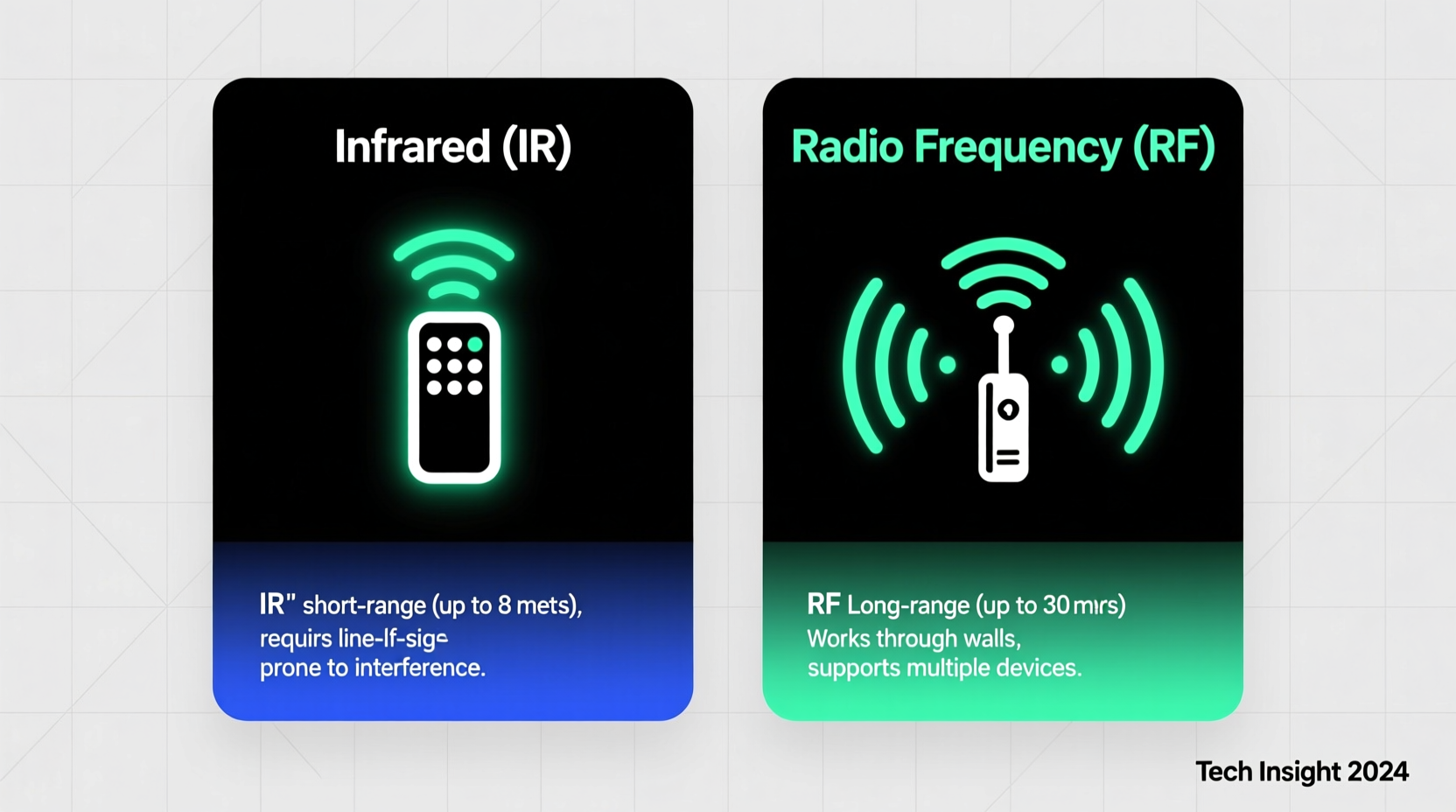
Infrared controllers operate by sending pulses of invisible light—similar to a TV remote—to communicate with receivers connected to light strings. These signals require line-of-sight between the transmitter and receiver. When you press a button on an IR remote or trigger a signal from a control box, a beam of infrared light travels directly to the sensor on the receiving unit. If the path is blocked or the angle is off, the command may not register.
This method works well in controlled indoor environments where distance is short and obstacles are minimal. Many basic Christmas light remotes use IR because the components are inexpensive and power-efficient. However, outdoor applications quickly expose its limitations. Sunlight contains infrared radiation, which can interfere with signals. Snow, fog, or even a slightly misaligned receiver can disrupt communication.
Radio Frequency Controllers: A Wireless Leap Forward
Radio frequency (RF) controllers transmit data using electromagnetic waves in the 315 MHz, 433 MHz, or 2.4 GHz bands. Unlike IR, RF does not rely on visible light or direct line-of-sight. Instead, signals penetrate walls, travel around corners, and maintain strength over greater distances. This makes RF ideal for expansive holiday displays spread across rooftops, lawns, and multiple structures.
An RF-based controller can send commands up to 100 feet or more under typical conditions—even through wood, vinyl, or glass. Some high-end models extend that range to 300 feet with external antennas or signal repeaters. Because RF operates on dedicated frequencies, interference from ambient light or weather is negligible. Additionally, modern RF systems often support bidirectional communication, allowing status feedback from each node in the setup.
“RF has become the standard for professional-grade holiday lighting because it delivers consistent performance regardless of visibility or weather.” — Marcus Tran, Smart Lighting Systems Engineer at HolidayTech Solutions
Range Comparison: Real-World Performance
The core question—“which has better range?”—is best answered through practical testing and deployment scenarios. While manufacturers often advertise theoretical maximums, actual performance depends on environment, signal congestion, and hardware quality.
| Feature | Infrared (IR) | Radio Frequency (RF) |
|---|---|---|
| Maximum Range (Open Air) | Up to 30 feet | 100–300+ feet |
| Line-of-Sight Required? | Yes | No |
| Signal Penetration Through Walls | Poor | Good to Excellent |
| Affected by Sunlight or Weather? | Yes (sunlight interferes) | Minimal impact |
| Bidirectional Feedback Support | Rare | Common in advanced models |
| Typical Use Case | Indoor trees, small displays | Outdoor arrays, multi-zone setups |
As shown in the table, RF clearly outperforms IR in nearly every category related to range and reliability. Even in suburban backyards where decorations span two stories and wrap around garages, RF maintains stable connections. In contrast, IR struggles beyond a single room unless carefully aligned and shielded from daylight.
Mini Case Study: The Johnson Family’s Holiday Display Upgrade
The Johnsons live in a two-story home with a wide front yard, rooftop icicle lights, and a driveway arch lined with illuminated reindeer. Their original setup used IR-controlled channels to toggle different sections. Each year, they faced issues: the roof lights wouldn’t respond unless someone stood at a precise angle in the driveway, and daytime shows were impossible due to sunlight interference.
After switching to an RF-based control system using 433 MHz transmitters and addressable nodes, they gained full control from inside their living room. They could activate sequences remotely, schedule timed routines via smartphone, and even receive alerts if a circuit failed. Most importantly, all zones responded simultaneously without manual repositioning. The upgrade took less than a day and eliminated years of frustration.
“We used to need three people just to test the lights,” said Linda Johnson. “Now one tap starts everything—and it actually works.”
Choosing Based on Your Setup Size and Complexity
The choice between IR and RF should align with your display’s scale and location. Here's a step-by-step guide to help determine the best fit:
- Assess your layout: Measure the farthest point from your intended control location. If it exceeds 25 feet or involves multiple planes (e.g., ground, roof, porch), lean toward RF.
- Evaluate obstructions: Are there walls, fences, trees, or vehicles blocking a straight path? If yes, RF is necessary.
- Determine usage frequency: Will you adjust settings daily during the season? Frequent interaction favors RF for convenience.
- Consider automation needs: Do you want scheduled on/off cycles or integration with smart home platforms? RF supports Wi-Fi bridges and app control; IR rarely does.
- Budget check: While RF systems cost more upfront, their durability and reduced troubleshooting save time and money long-term.
Interference and Signal Congestion Considerations
One concern sometimes raised about RF is potential interference from other wireless devices like Wi-Fi routers, baby monitors, or neighboring holiday displays. While valid in dense urban areas, most Christmas light RF systems operate on less crowded bands such as 433 MHz, avoiding the congested 2.4 GHz band used by Wi-Fi and Bluetooth.
Additionally, many RF controllers employ encoding protocols like PT2262 or EV1527 to prevent cross-talk. Each transmitter-receiver pair uses a unique address code, so even if signals overlap, only the intended device responds. Modern systems also support rolling codes and encryption for added security in public installations.
In contrast, IR is immune to radio interference but highly susceptible to optical noise. Bright LED floodlights, reflections off windows, or even candlelight indoors can cause false triggers or missed commands. This unpredictability makes IR unsuitable for precision lighting sequences.
Checklist: Selecting the Right Controller Technology
- ☐ Is the primary display area indoors or outdoors?
- ☐ Does the farthest light node exceed 25 feet from the control point?
- ☐ Are there physical barriers (walls, hedges, vehicles) between controller and lights?
- ☐ Will the system be exposed to direct sunlight during operation?
- ☐ Do you plan to automate schedules or integrate with apps/cloud services?
- ☐ Are you building a modular system that may expand next year?
- ☐ Is synchronization accuracy important (e.g., music-synced shows)?
If you answered “yes” to three or more of these questions, RF is the superior choice. IR remains viable only for simple, compact, indoor-focused setups where cost is the primary constraint.
Future Trends and Integration with Smart Ecosystems
The future of holiday lighting leans heavily toward RF-based smart ecosystems. Platforms like Home Assistant, Apple HomeKit, and Google Home now support RF-to-Wi-Fi bridge devices that translate commands into actionable signals for light controllers. Users can say, “Hey Google, start the holiday show,” and have synchronized animations play across dozens of nodes—all coordinated via RF transmission.
Moreover, RF enables mesh networking capabilities. Some advanced systems allow receivers to act as signal repeaters, extending coverage deeper into backyards or around large buildings. This scalability is impossible with IR, which cannot relay or amplify signals.
As consumers demand more interactive and programmable experiences—from countdown timers to motion-activated greetings—RF provides the infrastructure needed to deliver them reliably. Meanwhile, IR remains functionally stagnant, limited by physics and lack of innovation in consumer-grade products.
Frequently Asked Questions
Can I convert my existing IR lights to RF control?
Yes, in most cases. You can replace the IR receiver module with an RF-compatible one or use an RF-to-IR converter—a small device that receives RF signals and emits corresponding IR pulses. However, this adds complexity and potential failure points. A full transition to native RF nodes is recommended for long-term reliability.
Do RF controllers consume more power than IR?
Not significantly. Both types draw minimal power during standby. Active transmission uses slightly more energy in RF systems, but the difference is negligible when powered by standard wall adapters or outdoor-rated power supplies. Battery-operated RF remotes typically last six months to a year with regular use.
Are RF signals safe around pets and children?
Yes. The radio frequencies used in Christmas light controllers are non-ionizing and operate at very low power levels—far below safety thresholds set by the FCC and international regulatory bodies. These signals are comparable to those emitted by garage door openers or wireless keyboards.
Conclusion: Why Radio Frequency Wins for Range and Reliability
When comparing infrared versus radio frequency Christmas light controllers, the answer to “which has better range?” is unequivocal: RF wins. Its ability to transmit through obstacles, resist environmental interference, and cover large distances makes it the preferred solution for anything beyond a small indoor tree.
While IR may suffice for budget-conscious users with minimal setups, it introduces too many operational constraints for serious decorators. RF offers not only superior range but also scalability, automation compatibility, and long-term dependability. As holiday displays grow more sophisticated, investing in RF-based control systems ensures seamless performance year after year.




 浙公网安备
33010002000092号
浙公网安备
33010002000092号 浙B2-20120091-4
Comments
No comments yet. Why don't you start the discussion?