
Intermittent fasting has gained widespread attention not just for weight management, but also for its potential to enhance mental clarity and concentration. Among the most popular protocols are the 16:8 and 12:12 fasting windows—two approaches that differ in duration but share a common goal: optimizing metabolic and cognitive function. While both are sustainable for many people, the real question lies in their impact on focus. Which one actually sharpens the mind more effectively? The answer depends on individual biology, lifestyle demands, and how the body responds to prolonged periods without food.
Understanding the mechanisms behind fasting-induced cognitive enhancement is key to making an informed choice. This article compares 16:8 and 12:12 fasting regimens head-to-head, examining hormonal shifts, brain fuel sources, circadian alignment, and real-world productivity outcomes. By the end, you’ll have a clear roadmap for choosing the fasting window that best supports sustained mental performance.
The Science of Fasting and Brain Function
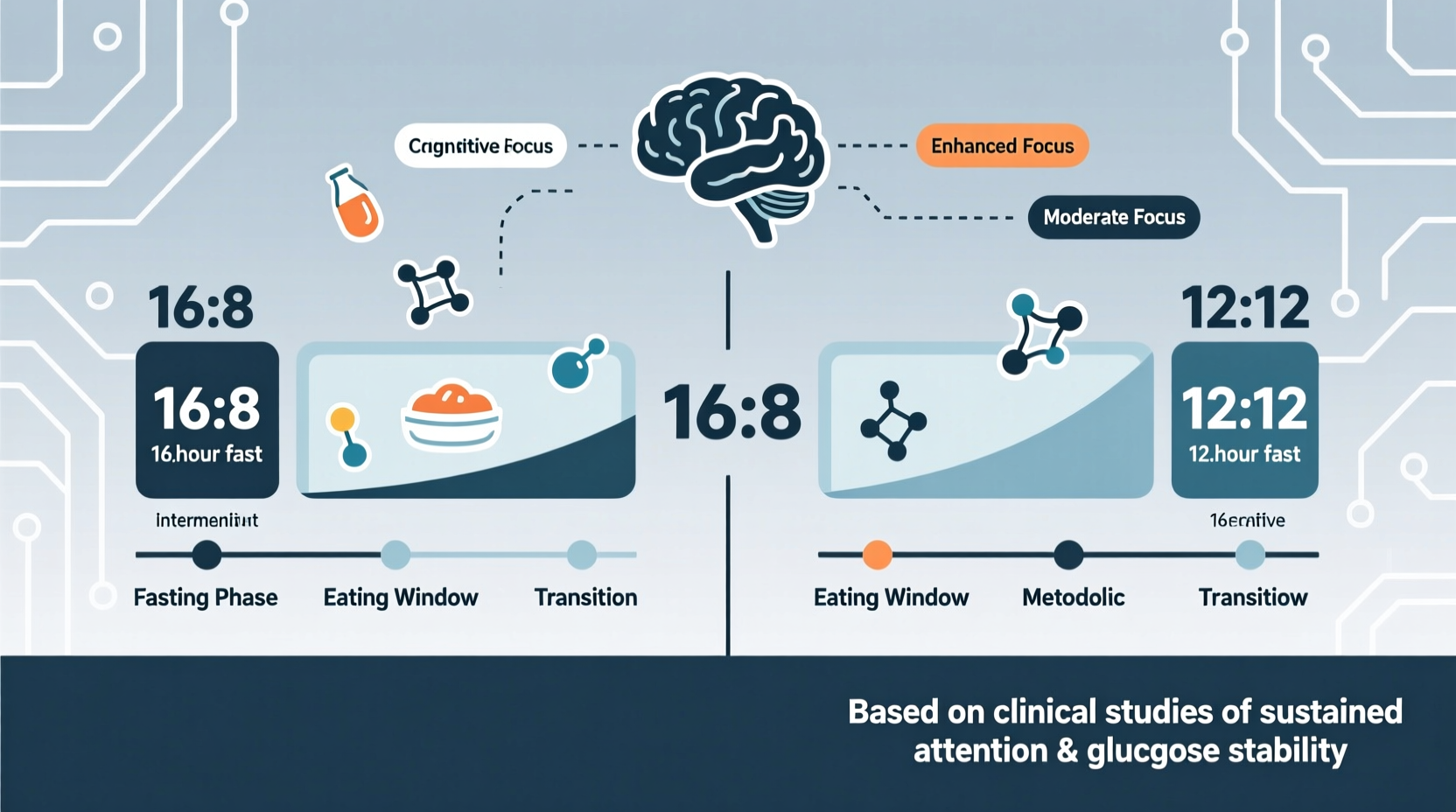
Fasting influences brain health through multiple biological pathways. One of the most significant is the shift from glucose to ketone metabolism. After about 10–12 hours without food, glycogen stores begin to deplete, prompting the liver to convert fat into ketones—molecules that serve as an efficient alternative fuel for neurons. Ketones, particularly beta-hydroxybutyrate (BHB), have been shown to improve mitochondrial efficiency and reduce oxidative stress in the brain.
In addition to fuel switching, fasting triggers increased production of brain-derived neurotrophic factor (BDNF), a protein critical for neuron growth, synaptic plasticity, and long-term memory formation. Studies indicate that BDNF levels rise during fasting states, especially after 12+ hours, potentially enhancing alertness and learning capacity.
Insulin sensitivity also improves with regular fasting. Lower baseline insulin allows for more stable blood sugar, reducing the cognitive crashes associated with post-meal glucose spikes. This stability is crucial for maintaining consistent focus throughout the day.
16:8 Fasting: Depth Over Duration?
The 16:8 method involves fasting for 16 consecutive hours each day and consuming all meals within an 8-hour window—typically skipping breakfast or dinner. For example, eating between 12 p.m. and 8 p.m., then fasting until noon the next day. This protocol pushes the body deeper into fat-burning and ketone production phases, often crossing the threshold where BDNF elevation becomes more pronounced.
Many users report heightened mental clarity in the late morning and early afternoon under 16:8, coinciding with peak ketone availability. A 2020 study published in Nutrition Research found that participants following 16:8 fasting showed improved reaction time and working memory compared to non-fasting controls, particularly during the second half of the fasting period.
However, the initial adjustment phase can include symptoms like brain fog, irritability, or low energy—especially if electrolytes are imbalanced. These side effects typically subside within 2–3 weeks as the body adapts to using fat for fuel.
One advantage of 16:8 is its compatibility with circadian biology. Aligning the eating window with daylight hours leverages natural peaks in insulin sensitivity and metabolic activity. Eating earlier in the day (e.g., 9 a.m.–5 p.m.) may offer even greater cognitive benefits than later windows, according to research from the University of Surrey.
“Extended fasting windows like 16:8 can promote neuroplasticity through elevated BDNF and reduced inflammation—key factors in maintaining sharp focus.” — Dr. Mark Mattson, Neuroscientist and Intermittent Fasting Researcher, Johns Hopkins University
12:12 Fasting: Gentle Entry Point for Cognitive Stability
The 12:12 approach splits the day evenly: 12 hours of eating followed by 12 hours of fasting. For most, this simply means finishing dinner by 7 p.m. and not eating again until 7 a.m. It’s often considered a minimal effective dose of fasting—accessible, easy to maintain, and aligned with natural sleep cycles.
While 12 hours may seem modest, it’s enough to initiate mild ketosis in metabolically flexible individuals. More importantly, it ensures a complete overnight fast, allowing insulin levels to drop significantly and autophagy—the cellular cleanup process—to begin. This contributes to neuronal maintenance and may support long-term cognitive resilience.
What sets 12:12 apart is its sustainability. Because it doesn’t require skipping meals or enduring prolonged hunger, many find it easier to maintain consistently. Consistency, in turn, leads to steady improvements in energy regulation and focus over time. Unlike 16:8, there’s rarely a “crash” period; instead, users report smoother transitions between meals and fewer mid-afternoon slumps.
A 2021 observational study in The American Journal of Clinical Nutrition noted that individuals practicing 12-hour nightly fasts had better sleep quality and reported higher daytime alertness compared to those with shorter fasting durations. Since poor sleep directly impairs executive function, this benefit alone makes 12:12 a strong contender for focus optimization.
Comparative Analysis: 16:8 vs 12:12 for Mental Performance
| Criteria | 16:8 Fasting | 12:12 Fasting |
|---|---|---|
| Ketone Production | High – likely reaches moderate ketosis | Moderate – mild ketosis possible in adapted individuals |
| BDNF Elevation | Significant – especially after 14+ hours | Mild – increases observed but less pronounced |
| Blood Sugar Stability | High – reduced insulin fluctuations | Good – improved baseline regulation |
| Adaptation Period | 2–4 weeks (may experience initial fatigue) | Minimal (often seamless transition) |
| Sustainability | Moderate – requires discipline | High – easily integrated into routine |
| Focus Outcome | Potentially sharper, laser-like focus in adapted users | Consistent, steady mental clarity without extremes |
The data suggests that while 16:8 offers stronger biochemical signals for cognitive enhancement, 12:12 provides a gentler, more reliable path to improved focus—particularly for beginners or those sensitive to dietary changes.
Real-World Application: Who Benefits From Which Window?
Consider Sarah, a 34-year-old software developer who struggled with post-lunch drowsiness and fragmented attention. After trying 12:12 fasting for two weeks—eating between 8 a.m. and 8 p.m.—she noticed better sleep and slightly improved morning concentration. But her focus still dipped around 3 p.m.
She then transitioned to 16:8, shifting her first meal to noon and last bite by 8 p.m. Within 10 days, she reported a “cleaner” mental state in the afternoon, with fewer distractions and enhanced problem-solving ability. Her energy remained stable, and she no longer reached for caffeine after lunch.
In contrast, David, a high school teacher with early morning classes, attempted 16:8 but found himself lightheaded and irritable by 9 a.m. He switched to 12:12, eating from 7 a.m. to 7 p.m., and experienced gradual improvements in mood and classroom engagement without compromising his ability to perform early in the day.
These cases illustrate a crucial point: effectiveness depends on personal schedule, stress load, and metabolic health. There is no universal “best” window—only what works best for your brain and lifestyle.
Action Plan: Choosing and Optimizing Your Fasting Strategy
Follow this step-by-step guide to determine which fasting window supports your focus goals:
- Assess your daily rhythm: Do you work best in the morning or evening? Early risers may benefit from earlier eating windows, while night owls might prefer delayed intake.
- Start with 12:12: Practice a 12-hour nightly fast for at least two weeks. Observe changes in sleep, energy, and concentration.
- Track cognitive performance: Use a journal or app to log focus levels, mental fatigue, and productivity hourly.
- Gradually extend to 16:8 (if desired): Add 30-minute increments to your fast every 3–4 days until reaching 16 hours.
- Optimize nutrition: Prioritize healthy fats, proteins, and fiber-rich vegetables during eating windows to sustain energy.
- Monitor hydration and electrolytes: Drink water with a pinch of sea salt or consume bone broth if experiencing headaches or brain fog.
- Re-evaluate after 4 weeks: Compare mental clarity, emotional stability, and overall satisfaction between protocols.
Checklist: Maximizing Focus During Intermittent Fasting
- ✅ Align eating window with daylight hours
- ✅ Stay hydrated with water, herbal tea, or electrolyte drinks
- ✅ Avoid high-sugar meals during feeding periods
- ✅ Incorporate MCT oil or black coffee during fasts for mild ketone boost
- ✅ Maintain consistent sleep schedule (7–8 hours)
- ✅ Limit stimulants like caffeine to morning hours
- ✅ Practice mindfulness or deep work blocks when mental clarity peaks
Frequently Asked Questions
Can intermittent fasting cause brain fog?
Yes, especially during the adaptation phase of 16:8 fasting. As the body switches from glucose to ketones, temporary cognitive dips may occur. These usually resolve within 2–3 weeks. Ensuring adequate sodium, potassium, and magnesium intake can minimize symptoms.
Is 12 hours of fasting enough to improve focus?
For many, yes. A 12-hour fast allows insulin to drop, promotes autophagy, and supports restorative sleep—all of which contribute to clearer thinking. While less intense than 16:8, 12:12 offers meaningful cognitive benefits with lower barriers to adherence.
Should I exercise during my fasting window for better focus?
Light to moderate exercise, such as walking or yoga, can enhance cerebral circulation and mental sharpness during fasting. However, intense workouts may impair focus in unadapted individuals. Experiment cautiously and adjust based on response.
Conclusion: Match the Method to Your Mind
The debate between 16:8 and 12:12 fasting isn’t about superiority—it’s about suitability. If you’re seeking intense mental acuity and can manage the adaptation period, 16:8 may unlock deeper focus through ketosis and elevated BDNF. But if consistency, sleep quality, and gentle energy balance are your priorities, 12:12 delivers substantial cognitive advantages with minimal disruption.
The most effective fasting window is the one you can sustain while feeling mentally sharp and emotionally balanced. Start where you are, listen to your body, and refine your approach over time. Whether you choose 12 or 16 hours, the real power lies in the discipline of routine—and the clarity it brings.




 浙公网安备
33010002000092号
浙公网安备
33010002000092号 浙B2-20120091-4
Comments
No comments yet. Why don't you start the discussion?