
Many people use the terms “introvert” and “social anxiety” interchangeably, assuming that someone who avoids parties or prefers solitude must be anxious in social settings. While there can be overlap in behavior, the underlying reasons for those behaviors are fundamentally different. One reflects a natural temperament; the other, a diagnosable mental health condition. Understanding the distinction is crucial—not only for self-awareness but also for seeking appropriate support when needed.
Introversion is a personality trait rooted in how individuals gain energy and process stimulation. Social anxiety, on the other hand, is a psychological disorder characterized by intense fear of judgment and negative evaluation in social situations. Mislabeling introversion as anxiety can lead to unnecessary concern, while mistaking anxiety for mere shyness may prevent someone from accessing vital help.
Understanding Introversion: A Natural Preference
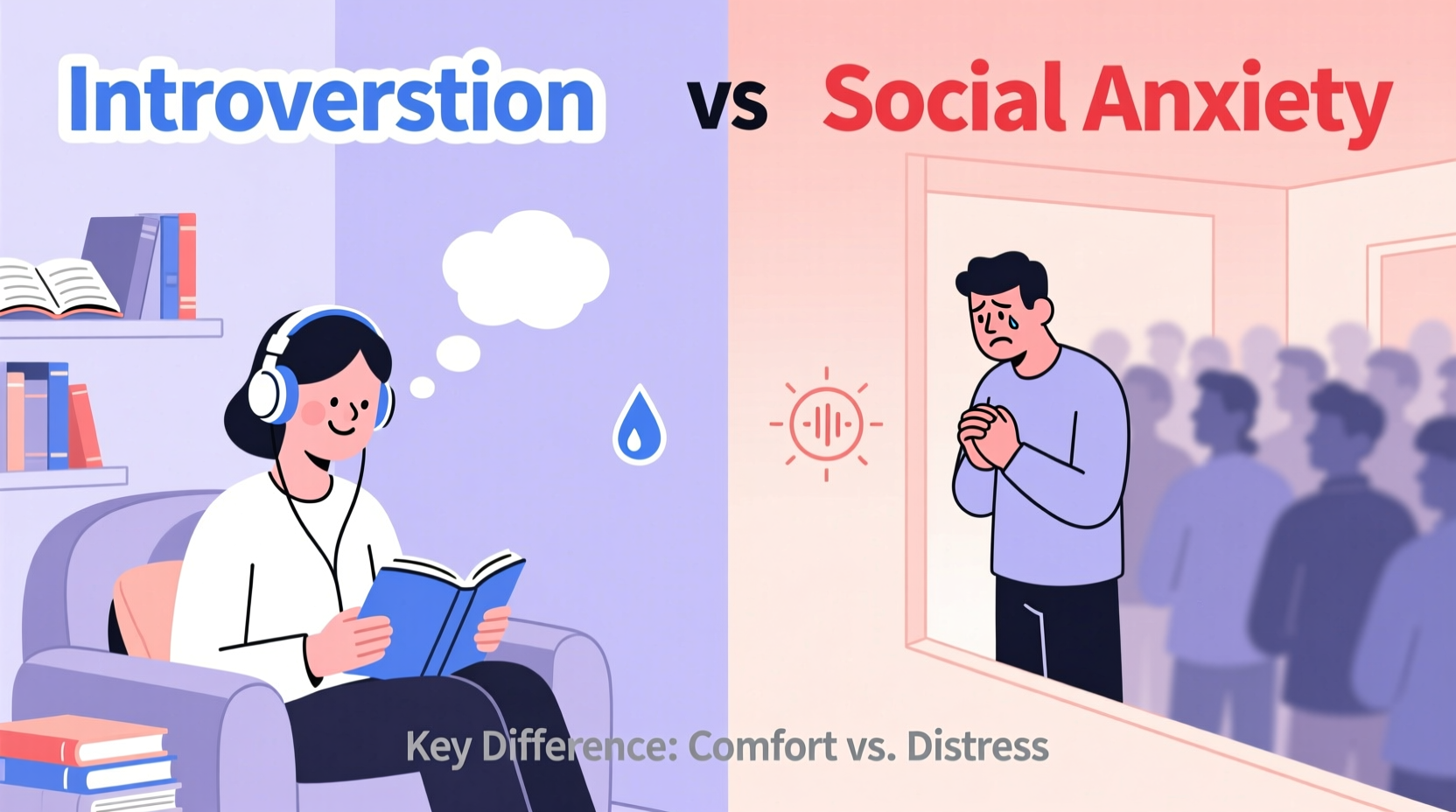
Introversion is one end of the extroversion-introversion spectrum in personality psychology. It’s not a flaw or a disorder—it’s simply a way some people are wired. Introverts tend to feel most energized when spending time alone or in small, meaningful gatherings. They often prefer deep conversations over small talk and need downtime after social interactions to recharge.
Carl Jung, who first popularized the concept of introversion and extroversion, described introverts as those whose energy flows inward. Their focus is internal—on thoughts, feelings, and reflections—rather than external stimulation. Modern psychology, including the widely used Big Five personality model, recognizes introversion as a stable and normal variation in human temperament.
Key characteristics of introversion include:
- Preference for solitary activities or one-on-one interactions
- Deep thinking and introspection
- Need for quiet environments to concentrate
- Feeling drained after prolonged socializing
- Enjoyment of hobbies that involve focus and independence (e.g., reading, writing, coding)
Importantly, introverts do not necessarily fear social interaction—they may simply choose not to engage frequently because it costs them energy. When they do socialize, many introverts feel comfortable, especially in familiar settings or with trusted individuals.
Social Anxiety Disorder: More Than Just Shyness
Social anxiety disorder (SAD), also known as social phobia, is a clinically recognized mental health condition listed in the DSM-5 (Diagnostic and Statistical Manual of Mental Disorders). It goes far beyond occasional nervousness before public speaking or meeting new people. People with social anxiety experience persistent, intense fear of being watched, judged, or embarrassed in everyday social situations.
This fear is often disproportionate to the actual threat and can interfere significantly with work, school, relationships, and daily functioning. The physical symptoms can include trembling, sweating, rapid heartbeat, nausea, and even panic attacks. Mentally, individuals may engage in excessive rumination before and after social events, replaying conversations and imagining worst-case scenarios.
According to the Anxiety & Depression Association of America (ADAA), social anxiety affects approximately 15 million adults in the U.S., typically emerging during adolescence. Unlike situational nerves, social anxiety persists for six months or longer and occurs across multiple contexts.
“Social anxiety isn’t just about being shy. It’s a chronic fear of scrutiny that can paralyze someone from doing things others take for granted.” — Dr. Ellen Hendriksen, clinical psychologist and author of *How to Be Yourself*
Common Triggers of Social Anxiety
- Speaking in meetings or classrooms
- Eating or drinking in front of others
- Using public restrooms
- Making phone calls
- Attending parties or networking events
- Initiating or maintaining conversations
The core issue is not the activity itself, but the anticipation of negative judgment. Many people with social anxiety recognize their fears are irrational but feel powerless to control them.
Key Differences Between Introversion and Social Anxiety
Because both introverts and people with social anxiety may avoid large gatherings or limit social contact, distinguishing between the two requires looking beneath the surface behavior. The motivation behind the withdrawal is what matters most.
| Aspect | Introversion | Social Anxiety |
|---|---|---|
| Motivation for Avoidance | Energy conservation; preference for low-stimulation environments | Fear of embarrassment, rejection, or negative evaluation |
| Emotional Response to Socializing | May enjoy interaction but feel tired afterward | Experiences dread, panic, or shame before, during, or after |
| Desire for Connection | Often desires meaningful relationships; chooses quality over quantity | May want connection but feels blocked by fear |
| Physical Symptoms | Rarely experiences physical distress from socializing | Commonly has blushing, sweating, shaking, or nausea |
| Self-Perception | Generally accepts solitude as part of identity | Often feels defective or inadequate; wishes to be “normal” |
| Change Over Time | Stable trait throughout life | Can improve with therapy and treatment |
This table highlights that while outcomes may look similar—such as skipping a party—the internal experience is vastly different. An introvert might decline an invitation because they’d rather read a book and recharge. Someone with social anxiety might want to go but fears saying the wrong thing, being judged, or having a panic attack in public.
Real-Life Scenario: Two People, Same Behavior, Different Causes
Consider two colleagues, Maya and Leo, who both skip the office holiday party.
Maya is an introvert. She enjoys her coworkers but finds large group events draining. She plans to send a holiday card and catch up individually over coffee in the new year. After declining the invite, she feels neutral—perhaps even relieved—and spends the evening journaling and watching a film. She doesn’t dwell on what she missed.
Leo, however, struggles with social anxiety. He wanted to attend but became overwhelmed at the thought of mingling, making small talk, or being the center of attention. In the days leading up to the event, he experienced insomnia and stomachaches. After canceling, he ruminates: “They probably think I’m rude,” or “I’ll never fit in here.” His avoidance brings temporary relief but reinforces long-term isolation.
Same action—different emotional landscape. Recognizing this difference allows for more compassionate self-understanding and targeted support.
When Introversion and Social Anxiety Coexist
It’s entirely possible to be both an introvert and have social anxiety. In fact, the quiet nature of introverts may make it easier for anxiety to go unnoticed. Because they already limit social exposure, their discomfort may be mistaken for personal preference rather than distress.
For example, an introverted college student might avoid joining clubs not because they lack interest, but because the idea of introducing themselves triggers intense fear. Without intervention, this can lead to academic underperformance, loneliness, and depression.
If you're introverted but notice signs of anxiety—such as persistent worry, physical symptoms, or avoidance that causes regret—it may be time to explore professional support. Therapy is not about forcing extroversion; it’s about removing invisible barriers that limit your choices.
Step-by-Step Guide to Self-Assessment
- Reflect on your motivations: Do you avoid social events because you’d prefer solitude, or because you fear embarrassment?
- Notice your physical reactions: Do you experience sweating, shaking, or nausea in social settings? These are red flags for anxiety.
- Assess emotional aftermath: After socializing, do you feel tired but satisfied—or ashamed and hyper-critical?
- Test your flexibility: Can you engage comfortably in low-pressure social situations (e.g., chatting with a cashier)? Introverts can; those with anxiety often cannot.
- Consider professional input: Take a validated screening tool like the Liebowitz Social Anxiety Scale or consult a licensed therapist.
What You Can Do: Strategies for Clarity and Growth
Whether you identify more with introversion, social anxiety, or both, there are practical steps to improve your relationship with social interaction.
Checklist: Know Yourself Better
- ✅ Identify which social situations drain you—and why
- ✅ Notice if avoidance brings relief or regret
- ✅ Track physical symptoms in social settings
- ✅ Evaluate whether your preferences are consistent or fear-driven
- ✅ Seek feedback from trusted friends about how you come across
- ✅ Explore therapy if anxiety interferes with goals or happiness
Cognitive Behavioral Therapy (CBT) is particularly effective for social anxiety, helping individuals challenge distorted thoughts and gradually face feared situations. Medications like SSRIs may also be prescribed in moderate to severe cases.
For introverts, the goal isn’t change—it’s acceptance and balance. Creating boundaries, scheduling recharging time, and choosing social engagements mindfully can lead to a fulfilling social life on your own terms.
Frequently Asked Questions
Can an extrovert have social anxiety?
Yes. Extroverts draw energy from social interaction but can still suffer from social anxiety. They may push themselves to socialize despite inner fear, leading to burnout or emotional exhaustion. Their outgoing behavior can mask deep-seated anxiety, making diagnosis more difficult.
Is social anxiety just extreme shyness?
No. While shyness is a mild, temporary discomfort around others, social anxiety is persistent, impairing, and accompanied by significant physical and cognitive symptoms. Shyness doesn’t usually require treatment; social anxiety often does.
Can introversion turn into social anxiety?
Introversion itself doesn’t cause anxiety, but长期 isolation or negative societal messages about being “too quiet” can contribute to low self-esteem or fear of judgment. Environment and upbringing play a role in whether introverted traits become entangled with anxiety.
Conclusion: Honor Your Nature, Address What Holds You Back
Understanding the difference between introversion and social anxiety empowers you to respond appropriately to your needs. If you’re an introvert, embrace your reflective nature as a strength. If you’re struggling with social anxiety, know that help is available and recovery is possible. And if you’re somewhere in between, clarity can guide your next steps.
You don’t have to be loud to be valuable. You don’t have to be everywhere to belong. But you also shouldn’t let fear dictate your choices. Whether through self-reflection, journaling, or professional support, take the time to understand what drives your social behavior. That awareness is the first step toward living authentically and confidently—exactly as you are.




 浙公网安备
33010002000092号
浙公网安备
33010002000092号 浙B2-20120091-4
Comments
No comments yet. Why don't you start the discussion?