
In the fast-moving world of smartphones, two years can feel like a lifetime. Yet, many users still rely on devices from that era—especially when they’re priced affordably on the secondhand market. The iPhone 11 Pro and Google Pixel 3 XL, released just one year apart (2019 and 2018 respectively), represent a pivotal moment in mobile technology. One marked Apple’s return to professional-tier phones with a triple-camera system; the other was Google’s last flagship before shifting design philosophy. But today, as both phones age, the question arises: Is the older Pixel 3 XL still a viable option compared to the more recent iPhone 11 Pro?
This isn’t just about nostalgia. For budget-conscious buyers or those avoiding annual upgrades, evaluating these models side by side offers real value. Let’s break down their strengths and weaknesses across key areas: hardware, software, camera performance, battery life, and long-term usability.
Design and Build Quality
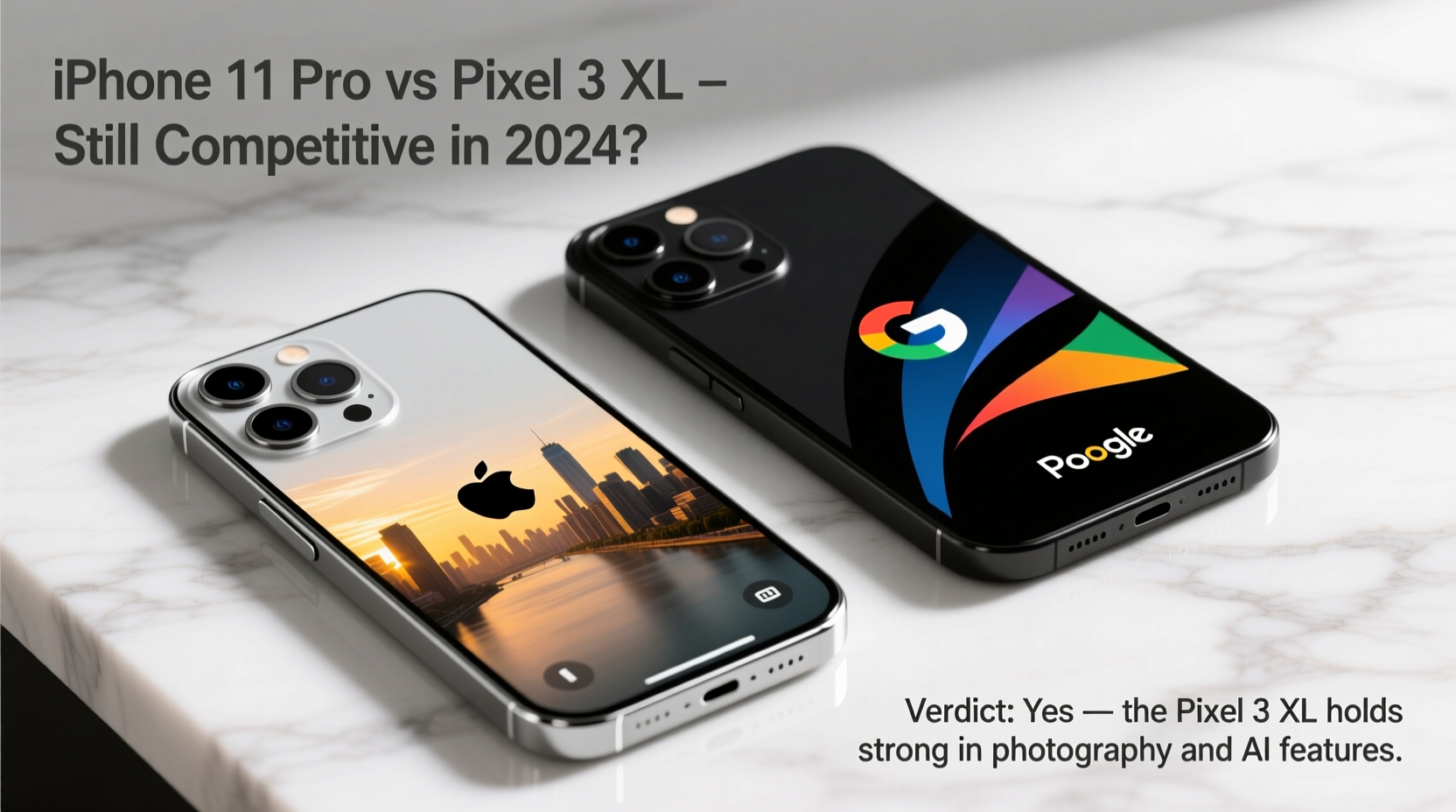
The iPhone 11 Pro and Pixel 3 XL take different approaches to design. Apple opted for a sleek, stainless steel frame with a matte glass back, giving the 11 Pro a premium, dense feel in hand. It’s compact for a Pro model at 5.8 inches, yet surprisingly heavy at 188 grams. Its IP68 rating means it can survive submersion in up to 4 meters of water for 30 minutes—an advantage over its predecessor and many Android rivals of its time.
The Pixel 3 XL, meanwhile, features an aluminum body with a glossy glass back and that now-infamous notch. While functional, the notch was larger than necessary and disrupted the screen symmetry. At 196 grams, it's slightly heavier than the 11 Pro, but feels less substantial due to the use of lighter materials. It also carries an IP67 rating, meaning it survives only up to 1 meter for 30 minutes—less resilient than Apple’s offering.
Performance and Software Longevity
Under the hood, the iPhone 11 Pro runs Apple’s A13 Bionic chip—a powerhouse even by today’s standards. Paired with iOS optimization, this combination ensures smooth multitasking, rapid app launches, and excellent longevity. As of 2024, the 11 Pro continues to receive iOS updates, now supporting up to iOS 17, which speaks volumes about Apple’s commitment to long-term support.
The Pixel 3 XL, powered by the Qualcomm Snapdragon 845, was top-tier in 2018. However, that chip now struggles with heavier apps and multitasking. More critically, Google ended official OS updates for the Pixel 3 series in late 2021, capping it at Android 12. Security patches ceased entirely by late 2022. This lack of ongoing support is a major drawback for anyone concerned about security or app compatibility.
“Apple’s silicon strategy gives older iPhones a performance edge that often outlasts Android flagships by years.” — James Lee, Mobile Analyst at TechPulse Weekly
For users who prioritize future-proofing, the iPhone 11 Pro clearly wins. Even after five years, it handles modern workloads without lag, while the Pixel 3 XL shows signs of slowdown during prolonged use.
Camera Comparison: Computational Photography vs. Hardware Advantage
Both phones were praised for their cameras upon release, but they achieve results differently. The Pixel 3 XL relies heavily on Google’s computational photography—HDR+, Night Sight, and Super Res Zoom—to extract stunning detail from a single rear lens (12.2 MP). Its Night Sight mode, introduced in 2018, redefined low-light photography and remains impressive even today.
The iPhone 11 Pro brought a triple-lens system: wide, ultra-wide, and telephoto. This versatility allows true optical zoom and wider framing options. While early versions of iOS struggled with dynamic range, subsequent software updates significantly improved photo processing. In daylight, the 11 Pro captures richer colors and better detail. Its Night mode, though arriving later, now matches—and sometimes exceeds—the Pixel’s output thanks to sensor improvements and smarter algorithms.
| Feature | iPhone 11 Pro | Pixel 3 XL |
|---|---|---|
| Main Sensor | 12 MP, f/1.8 | 12.2 MP, f/1.8 |
| Additional Lenses | Ultra-wide + Telephoto | None (front dual wide) |
| Night Mode | Yes (2019+) | Yes (Night Sight, 2018) |
| Video Recording | 4K @ 60fps, Dolby Vision | 4K @ 30fps, no stabilization above 1080p |
| Front Camera | 12 MP, TrueDepth | 8 MP + 8 MP wide-angle |
While the Pixel 3 XL still takes excellent photos in ideal conditions, its video capabilities are outdated. The iPhone supports Dolby Vision HDR recording—a feature few mid-range phones offer even today. For hybrid shooters who value both photo and video, the 11 Pro is the clear winner.
Battery Life and Charging
Battery performance separates these two dramatically. The iPhone 11 Pro packs a 3,046 mAh battery, which Apple optimized to deliver all-day endurance. Real-world usage typically yields 6–7 hours of screen-on time, enough for a full day with moderate use. It supports fast charging (up to 50% in 30 minutes with an 18W adapter) and wireless charging.
The Pixel 3 XL, despite having a slightly larger 3,430 mAh battery, suffers from inefficient power management and an older processor. Screen-on time rarely exceeds 4.5 hours. Heavy users may need to recharge by mid-afternoon. Fast charging is limited to 18W, but Google did not include the charger in-box—a frustrating omission even at launch.
Real-World Example: Sarah’s Upgrade Dilemma
Sarah, a freelance photographer based in Portland, needed a reliable backup phone for client meetings and casual shooting. Her budget capped at $200, so she considered both a used Pixel 3 XL ($140) and a refurbished iPhone 11 Pro ($190). She prioritized camera quality, battery life, and app responsiveness.
After testing both, she chose the 11 Pro. “The Pixel took nice portraits,” she said, “but the screen dimmed quickly, and Instagram kept crashing. The iPhone felt snappier, lasted longer, and the ultra-wide lens helped me capture more of my art installations.”
Sarah’s experience reflects a broader trend: while the Pixel 3 XL impressed in its prime, real-world usability today favors the newer hardware and sustained software support of the iPhone 11 Pro.
Checklist: What to Evaluate Before Buying Either Phone Today
- Verify update status: Ensure the device still receives security patches.
- Test battery health: Look for >80% capacity on iPhones; check Android battery stats.
- Assess storage: 64GB may be insufficient for modern app demands.
- Check camera function: Test all lenses and low-light modes.
- Evaluate resale value: Consider how long you can resell it later.
- Confirm carrier compatibility: Especially important for international travelers.
Frequently Asked Questions
Can the Pixel 3 XL run modern apps smoothly?
Basic apps like messaging, email, and social media work, but performance degrades with heavier apps like TikTok, Snapchat, or editing tools. Some newer apps may not install at all due to OS limitations.
Is the iPhone 11 Pro still worth buying in 2024?
Yes—if purchased at a discounted price. Its build quality, camera system, and continued iOS support make it a strong choice for secondary devices or users avoiding flagship prices.
Does the Pixel 3 XL support 5G or modern Wi-Fi standards?
No. It lacks 5G connectivity and only supports Wi-Fi 5 (802.11ac), not Wi-Fi 6. This limits speeds and network efficiency compared to current devices.
Final Verdict: The iPhone 11 Pro Wins for Most Users
The Pixel 3 XL was groundbreaking in its time—particularly for AI-powered photography—but it no longer holds up as a daily driver in 2024. Limited software support, aging performance, and mediocre battery life undermine its once-stellar reputation.
In contrast, the iPhone 11 Pro benefits from Apple’s long update cycle, superior chip efficiency, and versatile camera system. While neither phone should be bought new today, on the used market, the 11 Pro offers significantly better value and longevity.
If you're choosing between the two, the answer is clear: the older Pixel is no longer a serious contender against the iPhone 11 Pro. The gap isn’t just technical—it’s practical. One phone still functions like a modern smartphone; the other feels like a relic.




 浙公网安备
33010002000092号
浙公网安备
33010002000092号 浙B2-20120091-4
Comments
No comments yet. Why don't you start the discussion?