
The jump from an iPhone 12 to a newer Pro Max model isn’t just about screen size or battery life—it’s often driven by one thing: the camera. Apple markets its Pro Max devices as the ultimate photography tool in your pocket, but if you’re already using an iPhone 12, is the upgrade truly justified? The answer depends on how you use your phone, what kind of photos you take, and whether advanced features translate into tangible benefits for your everyday experience.
This comparison focuses on real-world performance, not just specs on paper. We’ll examine low-light capabilities, zoom range, video quality, computational photography, and usability—then help you decide whether spending hundreds more on a Pro Max delivers meaningful improvements.
Camera Hardware: What Changed Between iPhone 12 and Pro Max?
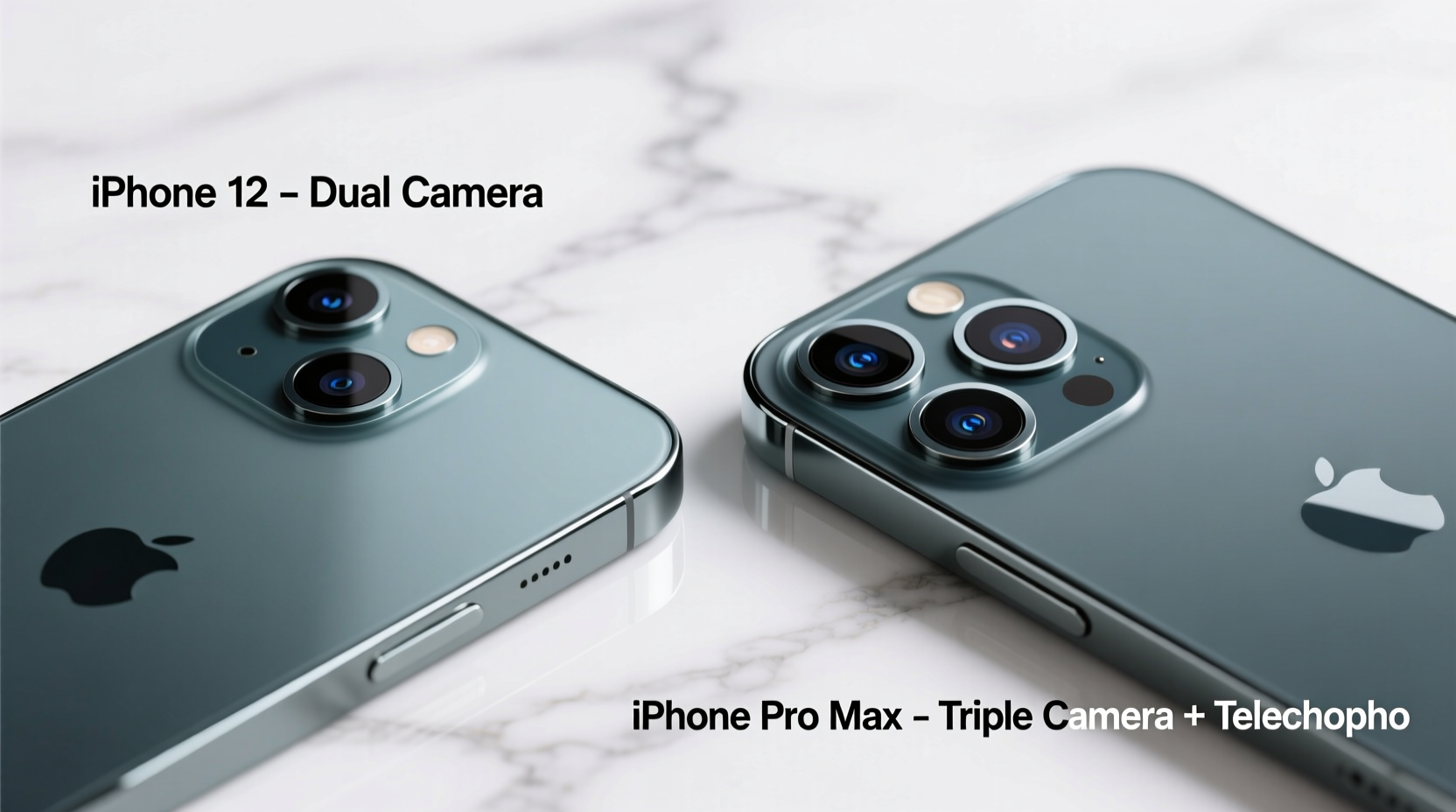
The iPhone 12, released in 2020, featured a dual-camera system: a 12MP main sensor and a 12MP ultra-wide lens. It supported Night mode, Deep Fusion, and Smart HDR 3—solid for its time. However, the latest Pro Max models (such as the iPhone 14 Pro Max or iPhone 15 Pro Max) bring significant hardware upgrades that go beyond megapixels.
- Larger main sensor: The Pro Max uses a 48MP primary sensor with sensor-shift stabilization, capturing far more light and detail.
- Telephoto lens: iPhone 12 lacks optical zoom beyond 2x digital. Pro Max includes a 3x telephoto lens (or up to 5x on newer models), enabling lossless zoom for portraits and distant subjects.
- Sensor advancements: Larger pixels, improved autofocus, and better dynamic range make a noticeable difference in challenging lighting.
- LIDAR scanner (on Pro models): Enhances portrait mode depth detection and low-light focusing accuracy.
Photo Quality: Real-World Performance Comparison
In daylight, both phones produce excellent results. The iPhone 12 captures vibrant colors, accurate skin tones, and good dynamic range. But under pressure—backlit scenes, fast action, or indoor lighting—the Pro Max pulls ahead thanks to superior computational photography and larger sensors.
Night mode on the iPhone 12 works well, but it often struggles with noise and shadow detail when shooting handheld. The Pro Max, with longer exposure times and sensor-shift stabilization, produces cleaner, brighter night shots with less grain and better color fidelity.
“Smartphone photography isn't just about hardware anymore—it's about how software interprets light. The Pro Max doesn’t just take pictures; it reconstructs scenes.” — David Lin, Mobile Imaging Analyst at DXOMARK
Portrait mode is another area where the gap widens. While the iPhone 12 can simulate depth using software, the Pro Max combines multiple lenses and LIDAR data to create more accurate edge detection and natural bokeh effects—even with pets or moving subjects.
Zoom and Flexibility: Can You Frame Better Shots?
If you’ve ever tried to photograph a stage performance, a sports game, or a distant landmark, you know digital zoom quickly degrades image quality. The iPhone 12 relies entirely on cropping and AI enhancement beyond 2x magnification. In contrast, the Pro Max offers true optical zoom:
| Feature | iPhone 12 | iPhone 14/15 Pro Max |
|---|---|---|
| Main Lens | 12MP, f/1.6 | 48MP, f/1.78 (adaptive) |
| Ultra-Wide | 12MP, f/2.4 | 12MP, f/2.2 |
| Telephoto Lens | None | 12MP, 3x or 5x optical zoom |
| Digital Zoom Limit | Up to 10x (quality drops sharply) | Up to 15x (usable up to 10x with 48MP fusion) |
| Night Mode Zoom | No support | Available at 2x and 3x |
The absence of a dedicated telephoto lens on the iPhone 12 limits creative flexibility. Whether you're shooting architecture, wildlife, or candid street photography, being able to zoom optically without walking forward changes how you compose images.
Video Capabilities: Beyond Photo Stillness
For creators, vloggers, or anyone who records meaningful moments, video quality matters just as much as stills. The iPhone 12 supports 4K at 60fps and Dolby Vision HDR recording—a strong foundation. However, the Pro Max introduces critical enhancements:
- Cinematic Mode: Now available in 4K HDR at 30fps, allowing professional-grade depth transitions during recording.
- Action Mode: Superior stabilization for shaky handheld footage, ideal for walking shots or outdoor adventures.
- ProRes Recording: Available only on Pro models, this format preserves maximum detail for editing workflows.
- Mic optimization: Directional audio capture improves clarity when filming interviews or performances.
If you edit videos on your phone or export them for social media, the Pro Max gives you more headroom in post-production. Highlights are recoverable, shadows retain texture, and color grading is more flexible due to higher bitrates and dynamic range.
Mini Case Study: Concert Photography
Sophia, a music blogger, used her iPhone 12 to cover local gigs. She loved the convenience but found her photos too dark or blurry, especially when artists moved across stage. After upgrading to an iPhone 15 Pro Max, she noticed immediate improvements:
- She could zoom to 5x optically and still capture sharp faces in mid-performance.
- Night mode activated automatically and produced clear shots even under red and blue stage lights.
- Videos stayed stable while she moved through the crowd, thanks to Action Mode.
“I used to rely on DSLRs for concerts,” she said. “Now I leave them at home. The Pro Max handles 90% of my needs—and looks great on Instagram.”
Is the Upgrade Worth the Cost?
The price difference between an iPhone 12 (available secondhand around $300–$400) and a new Pro Max ($1,099+) can exceed $700. That’s a major investment. So who actually benefits?
✅ Who Should Upgrade
- Photography enthusiasts: Those who care about composition, zoom, and low-light detail will appreciate the Pro Max’s tools.
- Content creators: Vloggers, influencers, or small business owners needing high-quality visuals without carrying extra gear.
- Frequent travelers: Better zoom and stabilization mean fewer missed moments abroad.
❌ Who Might Not Need To
- Occasional shooters: If you mostly take casual family photos or screenshots, the iPhone 12 remains perfectly capable.
- Budget-conscious users: The marginal gains may not justify the expense.
- Those happy with editing apps: Many enhance iPhone 12 photos sufficiently via third-party software like Lightroom or Snapseed.
FAQ
Does the Pro Max camera make a difference in daylight?
Marginally. Both phones take excellent daytime photos. The Pro Max offers slightly better dynamic range and color accuracy, but differences are subtle unless viewed at full resolution.
Can the iPhone 12 use Cinematic Mode?
No. Cinematic Mode was introduced with the iPhone 13 Pro and later models. It requires both hardware (LiDAR, faster processor) and software integration unavailable on the iPhone 12.
Do Pro Max cameras age better over time?
Yes. Higher-end sensors and ongoing software updates mean Pro Max models remain competitive longer. An iPhone 12 from 2020 shows its age in low light compared to current flagships, while a 2-year-old Pro Max still outperforms most mid-range smartphones.
Final Verdict: Value vs. Performance
The iPhone 12 camera is still good—remarkably so for a four-year-old device. For average users, it continues to deliver reliable, attractive photos. But the Pro Max isn’t designed for averages. It’s built for those who push their phones to do more: capturing fleeting moments in near-darkness, filming cinematic videos, or isolating subjects with precision.
The extra money buys not just better hardware, but greater creative freedom. You gain confidence that your phone won’t miss a shot because of poor lighting or distance. Over time, these small advantages compound into a noticeably better user experience.
If photography plays a central role in how you use your phone—if you share visuals regularly, document experiences, or simply want the best possible results without thinking too hard—the Pro Max camera is worth the premium. For everyone else, the iPhone 12 holds up remarkably well, proving that sometimes, good enough really is good enough.




 浙公网安备
33010002000092号
浙公网安备
33010002000092号 浙B2-20120091-4
Comments
No comments yet. Why don't you start the discussion?