
For millions of iPhone XR owners, the arrival of the iPhone 12 Mini presented a compelling promise: a modern, compact flagship experience in a form factor reminiscent of Apple’s beloved smaller phones. But with both devices now available at various price points—especially on the refurbished or resale market—the question remains: is upgrading from the XR to the 12 Mini truly worth it?
The answer depends on what you value most: raw performance, future software support, camera quality, or simply a fresh design. While both phones are built around Apple’s ecosystem strengths, they represent two distinct generations of smartphone evolution. Let’s break down the key differences and real-world implications to help you make an informed decision.
Design and Build: A Leap Forward in Materials
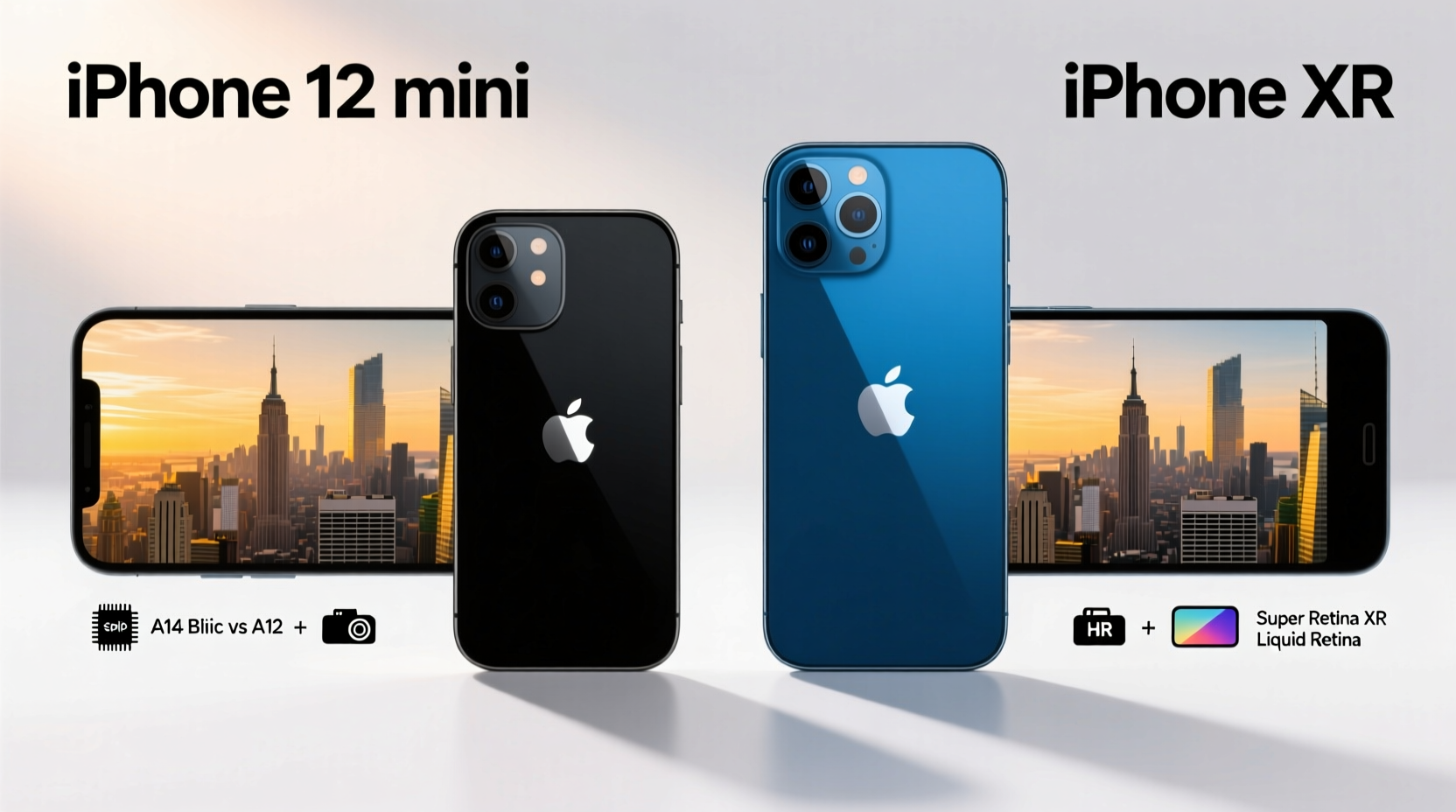
The iPhone XR, released in 2018, features an aerospace-grade aluminum frame and a glass back designed for wireless charging. It was Apple’s first budget-friendly phone with Face ID and a nearly edge-to-edge display. However, its thick bezels and single-glass rear made it feel slightly outdated even by late 2020 standards.
In contrast, the iPhone 12 Mini (2020) inherits the flat-edged design language of the iPhone 4 and 5, using a Ceramic Shield front cover and surgical-grade aluminum edges. This not only improves drop resistance but also gives the device a more premium, tactile feel. At 135 grams, the 12 Mini is lighter than the XR (194g), despite being slightly taller and narrower.
Display Technology: From LCD to OLED
This is one of the most significant upgrades. The iPhone XR uses a 6.1-inch Liquid Retina LCD panel with a resolution of 1792x828 pixels (~326 ppi). While perfectly functional, LCDs generally lack the deep blacks, infinite contrast ratios, and vibrant color accuracy of OLED displays.
The iPhone 12 Mini steps up with a 5.4-inch Super Retina XDR OLED display at 2340x1080 pixels (~476 ppi). The difference is immediately visible: richer colors, deeper blacks, and better outdoor visibility due to higher peak brightness (up to 1200 nits HDR). For media consumption, reading, or night-time use, the OLED screen reduces eye strain and enhances immersion.
“OLED isn’t just about aesthetics—it improves usability through better contrast and dynamic range, especially in low-light environments.” — David Kim, Display Analyst at TechInsight Group
Performance and Software Longevity
The iPhone XR runs on the A12 Bionic chip, which was powerful in 2018 and still handles daily tasks well today. However, as iOS becomes more demanding, users report occasional lag in app switching, camera processing, and augmented reality functions.
The iPhone 12 Mini comes equipped with the A14 Bionic—the first 5nm processor in any smartphone. Benchmarks show it’s approximately 40% faster in CPU tasks and 50% faster in GPU performance. More importantly, Apple typically supports iPhones with software updates for five to six years. Given that the XR launched in 2018, it may stop receiving major iOS updates by 2024. The 12 Mini, launching in 2020, is likely supported until at least 2026.
This extended support window means better security, access to new features, and compatibility with future apps—critical for long-term ownership.
Camera Comparison: Subtle Improvements, Real Impact
Both phones feature a single 12MP wide-angle rear camera, but the hardware and computational photography have evolved significantly.
The XR’s camera performs admirably in daylight but struggles in low light, producing noisier images with less detail. Night mode wasn’t introduced until later models, so the XR lacks this crucial feature entirely.
The 12 Mini includes Night mode, Deep Fusion, and Smart HDR 3. These technologies work together to enhance texture, reduce noise, and balance exposure—especially in dim lighting. In practical terms, this means clearer indoor shots, better shadow recovery, and more natural skin tones.
Front cameras also differ: the 12 Mini supports Night mode selfies and Dolby Vision video recording (up to 4K at 30fps), while the XR maxes out at 1080p HD.
| Feature | iPhone XR | iPhone 12 Mini |
|---|---|---|
| Processor | A12 Bionic | A14 Bionic |
| Display Type | LCD | OLED |
| Resolution | 1792x828 | 2340x1080 |
| Rear Camera | 12MP (no Night mode) | 12MP (with Night mode) |
| Front Camera Video | 1080p HD | Dolby Vision 4K |
| Battery Life (Video Playback) | Up to 16 hours | Up to 15 hours |
| Water Resistance | IP67 (1m for 30 min) | IP68 (6m for 30 min) |
| 5G Support | No | Yes (mmWave & sub-6GHz) |
Battery and Charging: Trade-offs in Miniaturization
The iPhone XR offers solid battery life—Apple rated it up to 16 hours of video playback. Real-world usage often sees a full day on a single charge, even with moderate to heavy use.
The 12 Mini, despite its smaller size, manages around 10–12 hours of screen-on time. Its battery capacity is significantly smaller (~8.57Wh vs ~10.35Wh), and 5G connectivity can drain power quickly unless managed. However, it supports faster wired and MagSafe wireless charging—a convenience the XR lacks.
If you're someone who charges multiple times a day or relies heavily on mobile data, the XR might still outperform the 12 Mini in endurance. But if you prioritize fast charging and don’t mind topping up midday, the 12 Mini adapts well to modern charging habits.
Mini Case Study: Sarah’s Upgrade Decision
Sarah had used her iPhone XR since 2019. By late 2022, she noticed apps taking longer to load, frequent crashes in newer games, and diminishing camera quality compared to friends’ phones. She considered buying a used 12 Mini for $450.
After testing both side-by-side, she found the 12 Mini’s OLED screen made reading e-books and streaming videos noticeably sharper. The improved low-light photos were a game-changer for her weekend hikes. Although the battery didn’t last quite as long, the ability to fast-charge during short breaks made up for it.
Most importantly, knowing she’d receive iOS updates for several more years gave her peace of mind. She upgraded—and hasn’t looked back.
Checklist: Should You Upgrade?
- ✅ Need better low-light photos? → 12 Mini wins with Night mode
- ✅ Want a crisper, brighter display? → OLED makes a visible difference
- ✅ Planning to keep your phone beyond 2025? → 12 Mini has longer software support
- ✅ Value 5G connectivity? → Only available on 12 Mini
- ✅ Prioritize all-day battery without charging? → XR may be better suited
- ✅ Prefer a lighter, more compact build? → 12 Mini excels here
Frequently Asked Questions
Is the iPhone 12 Mini faster than the XR?
Yes. The A14 Bionic in the 12 Mini is significantly faster than the XR’s A12 chip, offering smoother multitasking, better gaming performance, and improved machine learning capabilities for camera and voice processing.
Does the 12 Mini have better water resistance?
Yes. The 12 Mini has an IP68 rating (up to 6 meters for 30 minutes), compared to the XR’s IP67 (1 meter for 30 minutes). This makes the 12 Mini more resilient in wet conditions.
Can I expect longer battery life on the 12 Mini?
No—actually, the opposite. Despite efficiency improvements in the A14 chip, the 12 Mini’s small battery limits overall endurance. Heavy users will likely need to charge midday, whereas the XR often lasts a full 24-hour cycle.
Conclusion: Who Should Upgrade?
The iPhone 12 Mini is not merely a smaller version of the XR—it represents a generational leap in materials, display technology, performance, and future readiness. If you value a modern design, superior screen quality, advanced camera features, and longer software support, the upgrade is absolutely justified.
However, if your current XR still meets your needs, delivers solid battery life, and you’re sensitive to cost, holding onto it a bit longer remains a reasonable choice—especially given iOS’s excellent backward compatibility.
Ultimately, the 12 Mini shines for those who appreciate compact flagship experiences and want to stay current with Apple’s innovation curve. It proves that small phones can still pack big advancements.




 浙公网安备
33010002000092号
浙公网安备
33010002000092号 浙B2-20120091-4
Comments
No comments yet. Why don't you start the discussion?