
The jump from the iPhone XS Max to the iPhone 12 Pro Max represents nearly three years of technological evolution in Apple’s flagship lineup. For users still clinging to the XS Max—widely regarded as one of the best OLED displays Apple ever shipped—the question isn’t just about new features, but whether the display upgrade alone justifies the switch. The answer depends on how deeply you value brightness, HDR performance, long-term viewing comfort, and subtle but impactful refinements in color science and durability.
Display Technology: OLED Evolution Between Generations
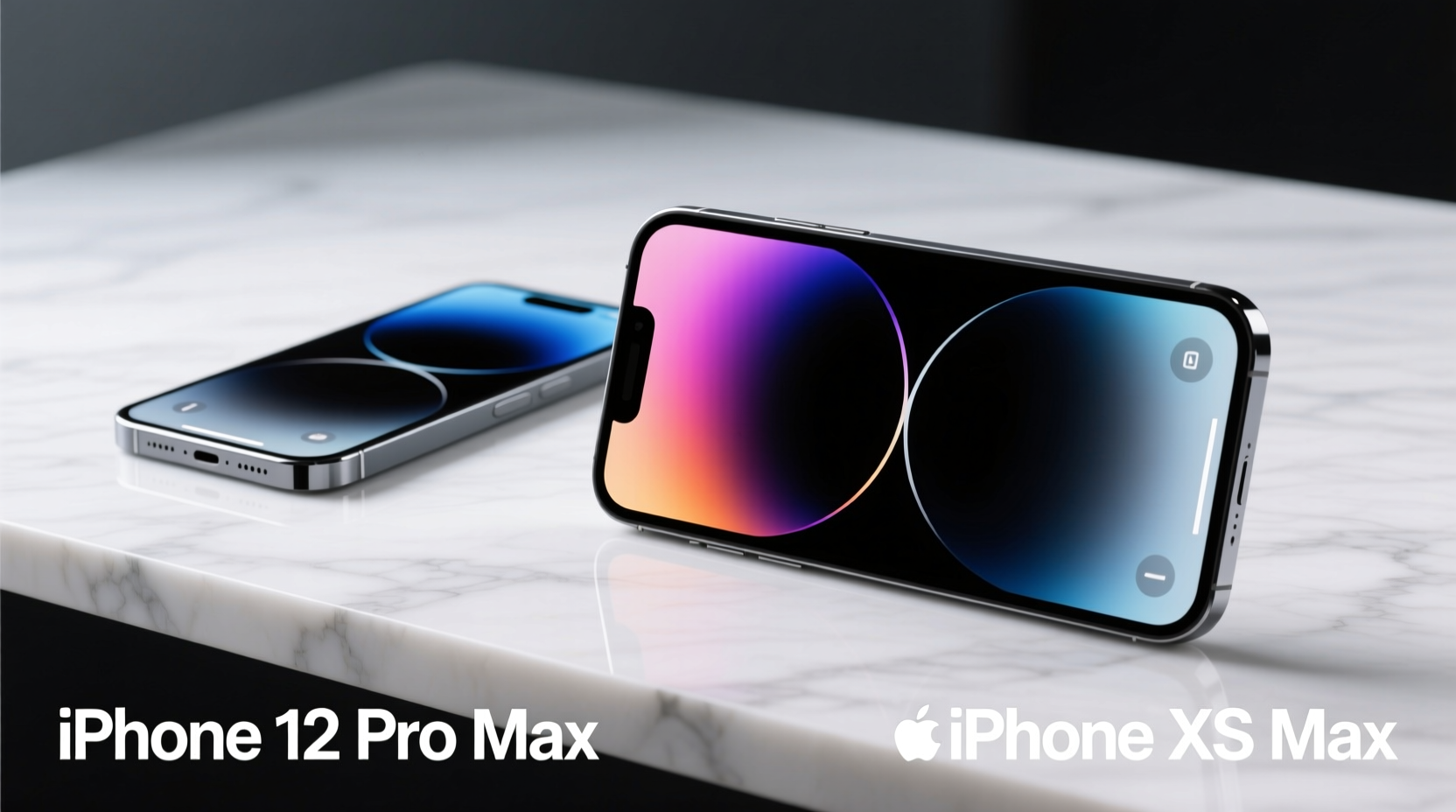
Both the iPhone XS Max (2018) and the iPhone 12 Pro Max (2020) use OLED panels, a significant leap over earlier LCD iPhones. However, Apple has refined its OLED implementation with each generation. The 12 Pro Max benefits from improved manufacturing processes, tighter pixel arrangements, and better integration with the device’s overall system architecture.
The most noticeable change lies in peak brightness. The XS Max reaches up to 625 nits under typical conditions and peaks around 720 nits in HDR scenarios. In contrast, the 12 Pro Max achieves a sustained maximum of 800 nits and an impressive 1200 nits in HDR mode—crucial when watching Dolby Vision content or using your phone outdoors on a sunny day.
This increased luminance doesn't come at the cost of battery life thanks to more efficient panel drivers and iOS optimizations. Additionally, the 12 Pro Max maintains more consistent brightness across the entire screen, reducing hotspots common in earlier OLED models.
Color Accuracy and Calibration: A Step Closer to Professional Standards
Apple has steadily improved color fidelity across its Pro line. The 12 Pro Max features enhanced factory calibration, wider support for P3 color gamut, and tighter control over gamma curves. Independent tests by DisplayMate show that the 12 Pro Max achieves near-reference-grade color accuracy out of the box, with Delta-E values consistently below 1.0—essentially indistinguishable from perfect color reproduction to the human eye.
In comparison, while the XS Max was excellent for its time, it shows slight greenish tints in dark gray gradients and less consistency at lower brightness levels. These differences are subtle but become apparent when editing photos or comparing side-by-side with professional monitors.
“Modern iPhone displays like the 12 Pro Max are now calibrated to match industry standards used in post-production studios.” — Dr. Lisa Chen, Display Technologist at MIT Media Lab
For creatives who rely on accurate previews of their work—photographers, designers, videographers—this level of precision means fewer surprises when moving from mobile preview to final output.
Screen Protection and Durability: Ceramic Shield Makes a Difference
One often-overlooked aspect of display quality is longevity. The iPhone 12 Pro Max introduced Apple’s Ceramic Shield front cover, which integrates nano-ceramic crystals into the glass matrix. According to Apple, this results in four times better drop performance compared to previous models, including the XS Max.
While both phones feature oleophobic coatings to resist fingerprints, the 12 Pro Max’s coating is also more durable and lasts longer before degrading—a small but meaningful improvement for daily usability.
| Feature | iPhone XS Max | iPhone 12 Pro Max |
|---|---|---|
| Panel Type | OLED | Super Retina XDR OLED |
| Peak Brightness (HDR) | 720 nits | 1200 nits |
| Typical Brightness | 625 nits | 800 nits |
| Resolution | 2688 x 1242 | 2778 x 1284 |
| Pixel Density | 458 ppi | 460 ppi |
| Front Glass | Ion-X Glass | Ceramic Shield |
| HDR Support | Dolby Vision, HDR10 | Dolby Vision, HDR10, HLG |
Real-World Viewing Experience: Where the Upgrade Shines
Consider Sarah, a travel photographer based in Lisbon, who upgraded from an XS Max to a 12 Pro Max after two years of heavy field use. Her primary motivation wasn’t camera improvements, but screen reliability and clarity during outdoor shoots.
She found that reviewing RAW image thumbnails on the 12 Pro Max was significantly more reliable due to better contrast and reduced glare. “I used to carry a loupe just to check focus on bright days,” she said. “Now I can trust what I see on-screen even under direct sunlight.”
Additionally, streaming services like Netflix and Apple TV+ deliver richer HDR experiences on the 12 Pro Max. Shadows retain detail, highlights sparkle without blooming, and skin tones appear natural—even in challenging lighting scenes. This is partly due to smarter tone mapping powered by the A14 Bionic chip, which dynamically adjusts HDR metadata frame by frame.
Do You Need the Upgrade? A Practical Checklist
Not every user will benefit equally from the display improvements. Use this checklist to determine if the visual upgrade matters for your usage pattern:
- ✅ Do you spend more than an hour daily watching videos or editing media?
- ✅ Do you regularly use your phone outdoors or in brightly lit environments?
- ✅ Are you sensitive to screen flicker or eye strain during prolonged reading sessions?
- ✅ Do you value long-term durability and resistance to accidental drops?
- ✅ Do you work with visual content where color accuracy impacts your output?
If three or more apply, the 12 Pro Max offers meaningful gains. Otherwise, the XS Max remains a capable device with a beautiful display—just not state-of-the-art.
Step-by-Step: Evaluating Your Own Needs Before Upgrading
- Assess current pain points: Note situations where your XS Max screen falls short—e.g., washed-out colors in sunlight, difficulty seeing notifications outdoors.
- Compare side-by-side: Visit an Apple Store or authorized reseller to view both devices displaying the same HDR video or photo.
- Test real-world tasks: Try reading text, scrolling social media, and playing a game to evaluate smoothness and clarity.
- Evaluate battery impact: While the 12 Pro Max has a larger battery, its brighter screen may reduce gains unless auto-brightness is well-tuned.
- Weigh total package: Remember, the display is just one part of a broader upgrade including processor speed, camera systems, 5G, and software support longevity.
Frequently Asked Questions
Does the iPhone 12 Pro Max have a higher refresh rate than the XS Max?
No. Both devices operate at a standard 60Hz refresh rate. Despite rumors, Apple did not introduce ProMotion (120Hz) to the Pro Max line until the iPhone 13 Pro series. So in terms of motion smoothness, there's no advantage in scrolling or animation fluidity.
Is the screen size significantly different?
The diagonal measurement is similar—6.5 inches on the XS Max versus 6.7 inches on the 12 Pro Max—but the latter achieves this with slimmer bezels and a taller aspect ratio. The usable screen area increases slightly, especially beneficial for multitasking and immersive video.
Can I notice the resolution difference?
Barely. The pixel density increase from 458 to 460 ppi is negligible to the naked eye. Any perceived sharpness gain comes more from improved anti-aliasing, better subpixel rendering, and higher brightness rather than raw resolution.
Final Verdict: Is the Display Upgrade Worth It?
The iPhone 12 Pro Max does not revolutionize the smartphone display experience—it refines it. There’s no leap to 120Hz, no radical redesign, but instead a suite of incremental upgrades that collectively enhance real-world usability. Higher brightness, superior HDR performance, better outdoor legibility, and dramatically improved durability make the 12 Pro Max screen objectively better.
For users still satisfied with the XS Max, the display alone may not be enough to justify upgrading—especially if budget-conscious or happy with current performance. But for those who push their devices in demanding visual environments, or simply appreciate the finest mobile display Apple offers, the 12 Pro Max delivers a genuinely improved viewing experience.




 浙公网安备
33010002000092号
浙公网安备
33010002000092号 浙B2-20120091-4
Comments
No comments yet. Why don't you start the discussion?