
The smartphone market moves fast. What felt like a premium device just a few years ago can quickly become outdated. The Google Pixel 3a, released in 2019, was praised for its excellent camera and clean Android experience at an affordable price. Fast forward to 2021, and Apple introduced the iPhone 13 Mini—a compact powerhouse with flagship internals. But if you're still holding onto a Pixel 3a, is upgrading to the iPhone 13 Mini truly worth it? Or are you better off saving your money?
This comparison dives deep into real-world usability, performance longevity, camera quality, software support, and overall value to help you make an informed decision—especially if you’re someone who values practicality over brand loyalty.
Performance and Hardware: A Generational Leap
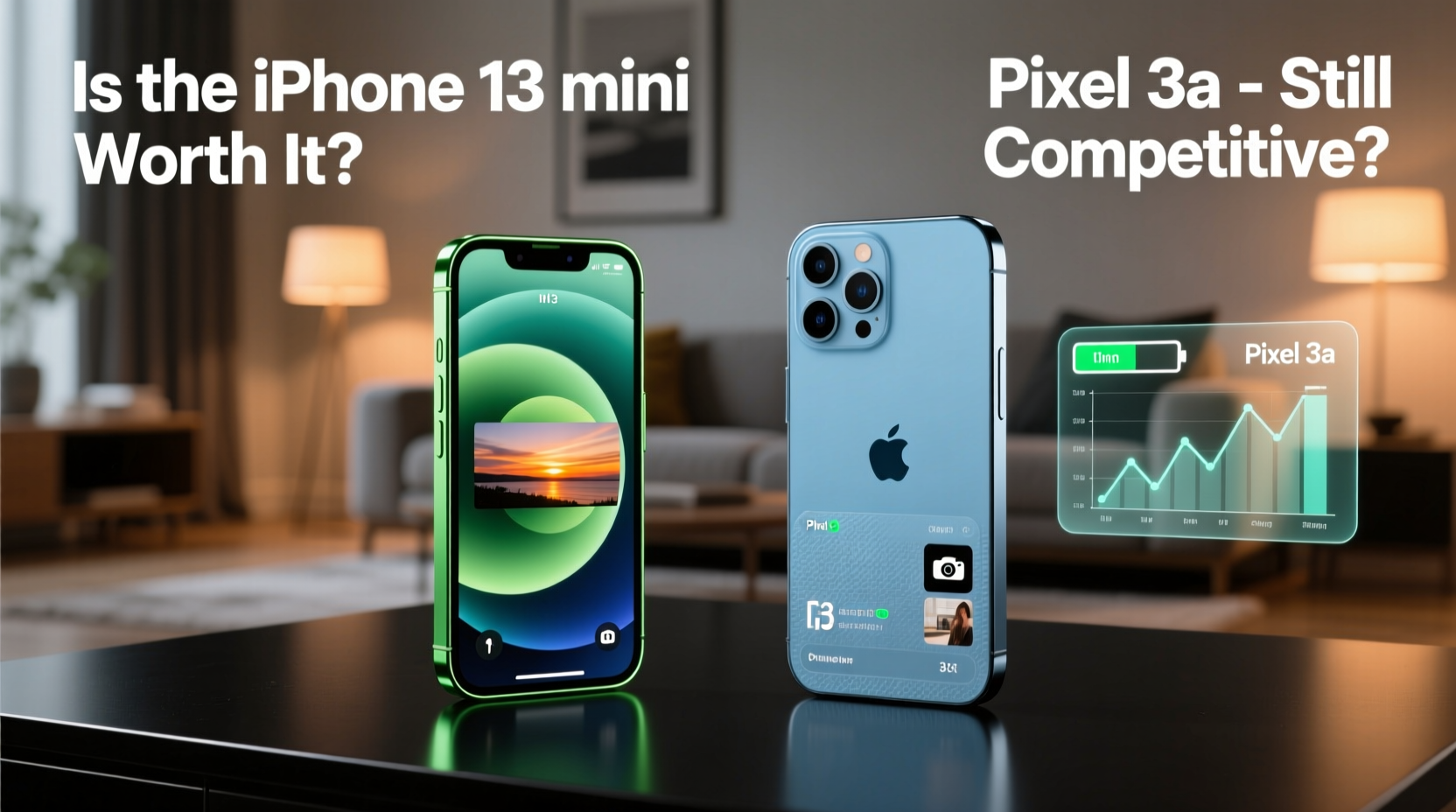
The most immediate difference between the two phones lies in their processing power. The Pixel 3a runs on the Qualcomm Snapdragon 670, a mid-tier chipset designed for budget-conscious users. It handled everyday tasks well at launch—messaging, browsing, social media—but struggled with heavier apps and multitasking over time.
In contrast, the iPhone 13 Mini features Apple’s A15 Bionic chip, one of the fastest mobile processors of its generation. Even today, it outperforms many current Android flagships in both CPU and GPU benchmarks. This means smoother animations, faster app launches, and future-proofed performance for years to come.
Beyond raw processing, the iPhone 13 Mini also benefits from 4GB of RAM (vs. 4GB on the 3a), but iOS’s memory management makes far more efficient use of it. Apps stay open longer in the background, and switching between them feels seamless. The 13 Mini also supports 5G, though this may not matter depending on your carrier and location.
Camera Comparison: Evolution vs. Excellence
The Pixel 3a was legendary for its camera. For a $399 phone, it delivered stunning photos, particularly in daylight and low light, thanks to Google’s computational photography magic. Its single 12.2MP rear sensor consistently punched above its weight class.
The iPhone 13 Mini improves on this with dual 12MP cameras: a main wide lens and an ultrawide. While Google relied heavily on software, Apple balances hardware and software optimization. In head-to-head tests, the 13 Mini captures more detail, better dynamic range, and superior video quality—especially in 4K HDR with Dolby Vision.
Low-light performance is where both shine, but differently. The Pixel 3a’s Night Sight mode was groundbreaking and still holds up surprisingly well. However, the iPhone 13 Mini’s larger sensor and sensor-shift stabilization allow for brighter, sharper night shots with less noise.
“Smartphone photography isn’t just about megapixels—it’s about consistency across lighting conditions and ease of use.” — David Lin, Mobile Photographer & Tech Reviewer
For videographers, the iPhone is clearly superior. It offers cinematic mode, extended dynamic range, and professional-grade editing tools within the native Photos app. The Pixel 3a records decent 1080p video but lacks stabilization and advanced features.
Battery Life and Daily Usability
One area where the Pixel 3a aged poorly is battery life. Its 3,000mAh battery, paired with a power-hungry OLED display and aging software optimizations, often required midday charging—even with moderate use.
The iPhone 13 Mini packs a slightly larger battery (though exact capacity is proprietary) and significantly more efficient components. Apple claims up to 17 hours of video playback, and real-world usage typically delivers 10–12 hours of screen-on time. That’s nearly double what most Pixel 3a users report today after years of battery degradation.
However, the 13 Mini charges faster and supports MagSafe accessories. It lacks a charging brick in the box but includes USB-C to Lightning cable compatibility. The Pixel 3a supported fast charging too, but only with a compatible adapter (not included).
| Feature | iPhone 13 Mini | Pixel 3a |
|---|---|---|
| Processor | Apple A15 Bionic | Snapdragon 670 |
| Rear Cameras | Dual 12MP (Wide + Ultrawide) | Single 12.2MP (Wide) |
| Front Camera | 12MP TrueDepth | 8MP |
| Battery Life (Screen-On Time) | ~10–12 hours | ~5–6 hours (current) |
| Software Support (End of Life) | Expected through 2026+ | Ended in 2022 |
| Water Resistance | IP68 | None |
| Starting Price (Launch) | $699 | $399 |
Software, Updates, and Longevity
Perhaps the most critical factor in deciding whether to upgrade is software support. The Pixel 3a received three years of OS updates and security patches, ending in late 2022. That means no official Android 13 or beyond—and increasing vulnerability to security flaws.
iOS updates are another story. The iPhone 13 Mini launched with iOS 15 and has received iOS 16 and 17, with expectations of iOS 18 and possibly 19. Apple typically supports iPhones for five to six years, meaning the 13 Mini should remain secure and functional until at least 2027.
This extended lifecycle translates directly into long-term value. Even at a higher initial cost, the iPhone 13 Mini offers more years of reliable performance, app compatibility, and security—making it potentially cheaper per year of ownership.
Real-World Example: Sarah’s Upgrade Dilemma
Sarah has used her Pixel 3a since 2019. She loves the lightweight design and stock Android interface. But lately, apps crash more frequently, the battery dies by noon, and she can’t update past Android 12. Her favorite banking app recently dropped support for older OS versions, forcing her to access it via browser.
She considered buying another budget Android phone but realized even new mid-rangers lack long-term update promises. After testing the iPhone 13 Mini at a store, she noticed how smoothly apps ran and how vibrant the OLED display looked. Despite hesitation about switching ecosystems, she upgraded—and now gets full-day battery, regular updates, and access to modern features like Face ID and iCloud sync.
Is the Upgrade Worth It? A Practical Checklist
Before making the jump from Pixel 3a to iPhone 13 Mini, ask yourself these questions:
- Am I experiencing frequent app crashes or slowdowns?
- Does my current phone struggle with basic tasks like messaging or navigation?
- Have I stopped receiving OS or security updates?
- Do I want better photo and video quality without carrying extra gear?
- Am I tired of daily charging anxiety?
- Do I plan to keep my next phone for 3+ years?
If you answered “yes” to three or more, the upgrade likely makes sense. The iPhone 13 Mini isn’t just newer—it’s built for sustained performance and peace of mind.
Frequently Asked Questions
Can I transfer my data from Pixel 3a to iPhone 13 Mini easily?
Yes. Apple provides the “Move to iOS” app on the Google Play Store, which securely transfers contacts, messages, photos, calendars, and free apps during setup. Some third-party apps may require manual reinstallation or account sign-in.
Is the iPhone 13 Mini too small by today’s standards?
At 5.18 inches, it’s smaller than most flagship phones, but that’s intentional. Many users prefer compact devices for one-handed use and pocketability. If you liked the size of the Pixel 3a, you’ll likely appreciate the 13 Mini’s form factor.
Will the iPhone 13 Mini feel like a big jump in price?
Compared to the $399 Pixel 3a, the $699 starting price of the 13 Mini is significant. However, consider total cost of ownership. Spending $300 more upfront could save you from needing another upgrade in 18 months due to obsolescence.
Final Verdict: Future-Proofing Over Frugality
The iPhone 13 Mini isn’t just a newer version of the Pixel 3a—it represents a different philosophy. Where the 3a offered great value at launch, the 13 Mini delivers lasting utility. Its superior processor, longer software support, better cameras, and improved battery life address nearly every pain point of aging smartphones.
For users clinging to a Pixel 3a out of frugality, it’s worth reconsidering what “value” means. A phone that lags, dies early, and can’t run modern apps isn’t saving money—it’s costing time, convenience, and functionality.




 浙公网安备
33010002000092号
浙公网安备
33010002000092号 浙B2-20120091-4
Comments
No comments yet. Why don't you start the discussion?