
When Apple releases a new iPhone, the question isn’t whether the device is powerful—it almost always is. The real question for existing owners is whether the upgrade justifies the cost. For users still on the iPhone 12 Pro Max, deciding whether to move to the iPhone 13 Pro Max requires more than just comparing spec sheets. It’s about real-world benefits, longevity, and how those improvements affect daily use.
The jump from the 12 Pro Max to the 13 Pro Max isn’t revolutionary like going from Touch ID to Face ID or LCD to OLED. But it’s layered with meaningful refinements—especially in display, camera, battery life, and performance efficiency. Whether these changes are “worth it” depends heavily on your usage patterns, budget, and expectations.
Performance: A7 Bionic vs A15 Bionic – Real Gains?
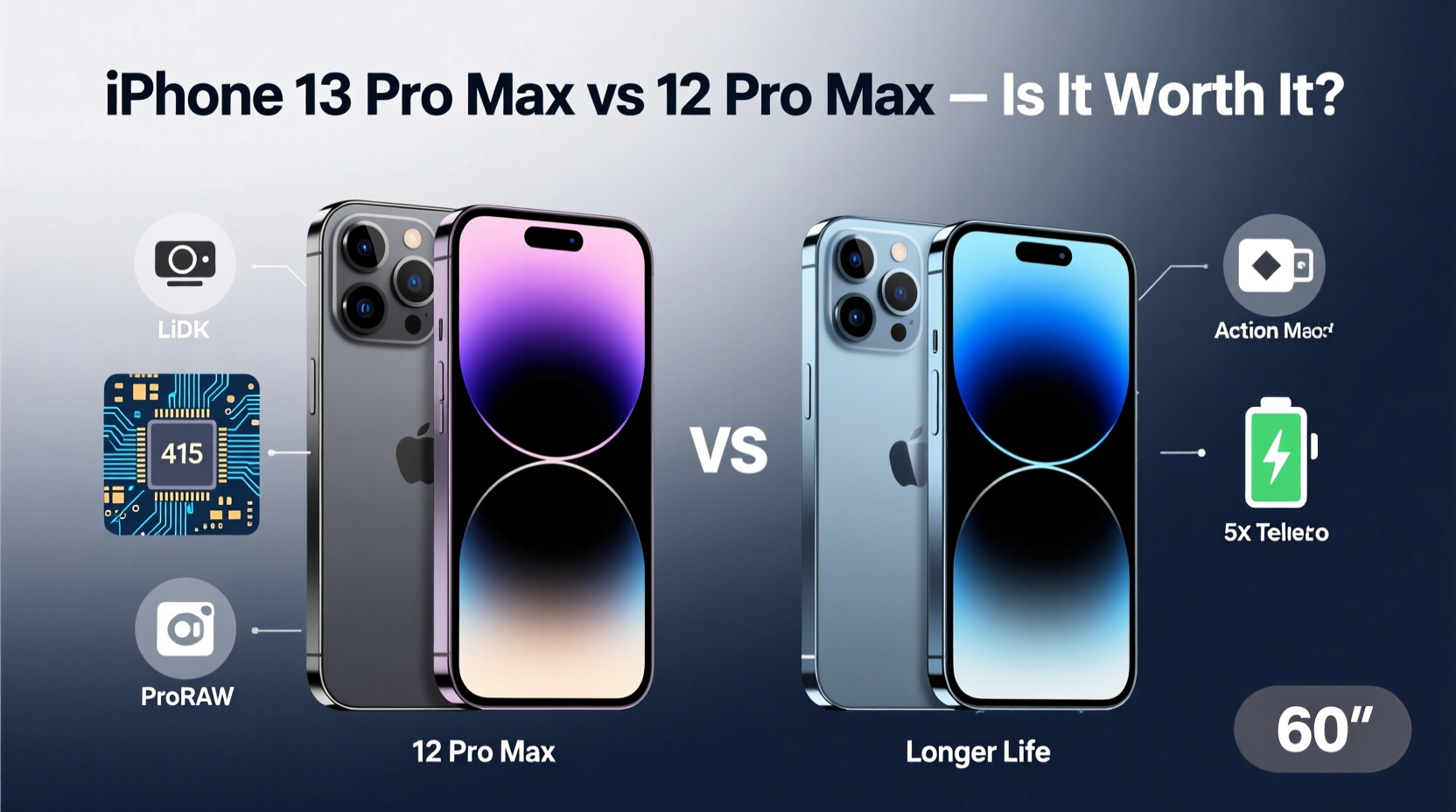
The iPhone 12 Pro Max runs on Apple’s A14 Bionic chip, which was already blazing fast at launch. The iPhone 13 Pro Max upgrades to the A15 Bionic, built on a more advanced 5nm process with improved transistor density. On paper, the A15 delivers up to 10–15% better CPU performance and around 20% better GPU performance, especially under sustained loads.
In practical terms, both phones handle everyday tasks effortlessly—browsing, messaging, streaming, and even gaming. However, the A15’s edge becomes apparent in high-demand scenarios: 4K video editing, augmented reality apps, and extended gaming sessions where thermal throttling can impact older chips.
Apple also optimized the A15 for power efficiency. This means not only faster processing but longer battery life under similar usage—a subtle yet critical advantage for power users.
Display Evolution: ProMotion and Brighter Screens
One of the most significant upgrades in the iPhone 13 Pro Max is the introduction of ProMotion technology—a 120Hz adaptive refresh rate display. The iPhone 12 Pro Max, while excellent, is limited to a standard 60Hz refresh rate.
A higher refresh rate makes scrolling, animations, and interactions feel noticeably smoother. More importantly, the ProMotion system intelligently scales between 10Hz and 120Hz based on content, preserving battery without sacrificing fluidity.
| Feature | iPhone 12 Pro Max | iPhone 13 Pro Max |
|---|---|---|
| Refresh Rate | 60Hz | 120Hz (Adaptive) |
| Prominent Display | No | Yes (ProMotion) |
| Brightness (Peak HDR) | 1200 nits | 1000 nits (typical), 1200 nits (HDR) |
| Always-On Display | No | Yes (iOS 16+) |
The 13 Pro Max also features improved outdoor visibility and reduced glare thanks to Apple’s Ceramic Shield and updated oleophobic coating. While both screens are Super Retina XDR displays, the 13 Pro Max feels more modern and responsive, particularly when navigating through dense UIs or playing fast-paced games.
“Once you experience a 120Hz display, going back to 60Hz feels sluggish—even if technically capable.” — David Kim, Mobile UX Designer at TechFlow Labs
Camera Upgrades: Beyond Megapixels
The camera system sees some of the most tangible improvements. Both models feature triple-lens setups: wide, ultra-wide, and telephoto. But the 13 Pro Max brings hardware and software enhancements that change how photos are captured and processed.
- Larger sensor on main camera: Captures 2.9x more light, improving low-light performance.
- Sensor-shift stabilization: Now standard across all Pro models, offering superior shake reduction.
- Cinematic Mode: Records depth-mapped video with automatic focus transitions—ideal for storytelling.
- Photographic Styles: Allows non-destructive tuning of color and tone preferences across shots.
In real-world testing, the 13 Pro Max produces sharper night mode images, more natural skin tones, and better dynamic range in high-contrast scenes. Portrait mode has also improved, with finer edge detection and hair detail.
Mini Case Study: Travel Photographer’s Experience
Mark T., a travel photographer based in Vancouver, upgraded from the 12 Pro Max to the 13 Pro Max before a month-long trip through Southeast Asia. He noted that the larger sensor made a visible difference in early morning jungle shoots where lighting was inconsistent. “I used to carry a small mirrorless camera,” he said. “Now I rely 80% on the iPhone, especially with Night Mode and Smart HDR 4. The ability to shoot ProRes video directly is a game-changer for quick edits.”
Battery Life: Where the 13 Pro Max Truly Shines
Despite having nearly identical physical sizes, the iPhone 13 Pro Max offers significantly better battery life. Apple claims up to 28 hours of video playback, compared to 20 hours on the 12 Pro Max—an 40% increase in real-world endurance.
This improvement comes from a combination of factors: a physically larger battery, the energy-efficient A15 chip, and iOS optimizations for background activity. Users report consistently getting through a full day of heavy use—including navigation, photography, and streaming—without needing a recharge.
For professionals, travelers, or anyone who hates midday charging anxiety, this leap alone could justify the upgrade.
Design and Durability: Subtle Changes, Same Build
Externally, the two phones are nearly identical. Both feature stainless steel frames, flat edges, Ceramic Shield front glass, and IP68 water resistance. The 13 Pro Max is slightly heavier (240g vs 228g) due to internal battery and component changes, but the difference is negligible in hand.
The notch is 20% smaller on the 13 Pro Max, freeing up a bit more screen space. While not transformative, it’s a welcome refinement. Additionally, the rear camera array is now diagonally aligned, making it easier to distinguish from the previous model.
Is the Upgrade Worth It? A Decision Checklist
Before spending $1,000+ on an upgrade, consider this checklist to determine if the iPhone 13 Pro Max is right for you:
- Are you still satisfied with your 12 Pro Max? If yes, the upgrade may be unnecessary unless specific features matter to you.
- Do you value smooth scrolling and responsiveness? The 120Hz ProMotion display is a quality-of-life upgrade many users grow to depend on.
- Do you record video often? Cinematic Mode and ProRes support make the 13 Pro Max far more capable for creators.
- Do you struggle with battery life? If you charge midday regularly, the 13 Pro Max’s endurance will be immediately noticeable.
- Are you planning to keep your phone for 3+ years? The A15 chip will likely receive iOS updates longer and perform better in future apps.
Frequently Asked Questions
Can the iPhone 13 Pro Max last longer than the 12 Pro Max?
Yes. Thanks to a larger battery, more efficient chipset, and better thermal management, the 13 Pro Max typically lasts 6–8 hours longer on a single charge under mixed use.
Does the 13 Pro Max support Wi-Fi 6E?
No. Both the 12 Pro Max and 13 Pro Max support Wi-Fi 6, but not the extended 6E band. That feature arrived with the iPhone 14 series.
Is the camera upgrade worth it for casual users?
If you mostly take daylight photos and share them socially, the difference may be subtle. However, if you frequently shoot in low light or want better video features, the upgrade pays off.
Conclusion: Who Should Upgrade?
The iPhone 13 Pro Max isn’t a radical reinvention, but it refines nearly every aspect of the 12 Pro Max experience. For users who prioritize battery life, display smoothness, and camera versatility, the upgrade is absolutely worthwhile—especially if you plan to keep the device for several years.
However, if your 12 Pro Max still performs well and you don’t need ProMotion, Cinematic Mode, or extended battery, waiting for the iPhone 14 or even 15 might offer better long-term value.




 浙公网安备
33010002000092号
浙公网安备
33010002000092号 浙B2-20120091-4
Comments
No comments yet. Why don't you start the discussion?