
Choosing between the iPhone 13 Pro and the Galaxy S21 isn’t just about brand loyalty or operating systems—it often comes down to one decisive factor: the camera. Both devices launched within months of each other and represented flagship photography power at the time. But if you're holding onto an S21 or considering stepping up from an older iPhone, the question remains: does the iPhone 13 Pro’s camera deliver enough improvement to justify the switch?
This isn't just a specs race. It's about real-world results—how photos look in dim lighting, how videos hold up when zoomed, and whether computational photography enhances or over-processes your memories. Let’s break down every aspect of their imaging capabilities with practical insights, not marketing jargon.
Sensor Specs and Hardware Differences
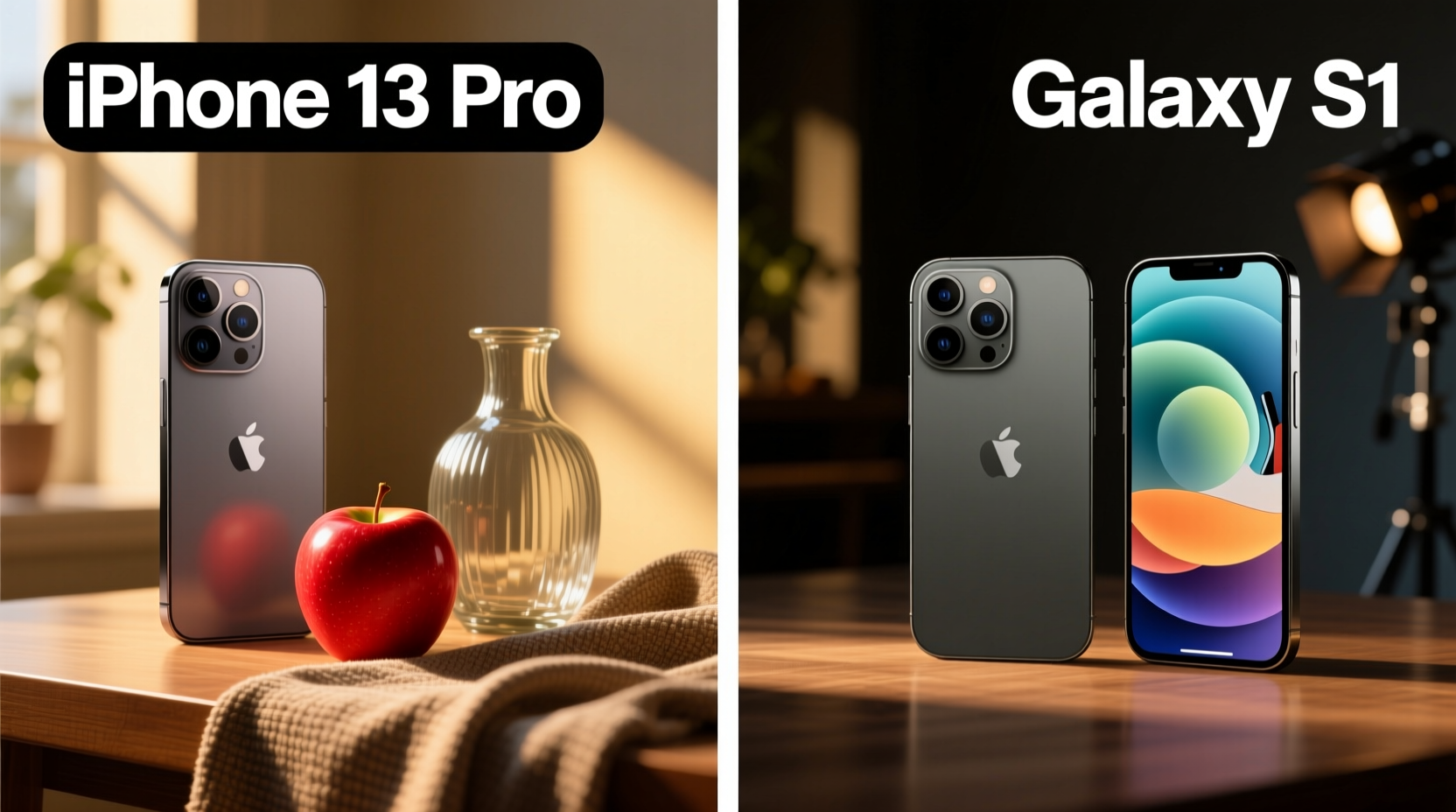
At first glance, the numbers suggest a close competition. The Galaxy S21 features a triple-camera setup: a 12MP main sensor, a 64MP telephoto lens, and a 12MP ultra-wide. Samsung leans on high-resolution capture and versatile zooming, especially with its 3x hybrid zoom and up to 30x digital zoom.
The iPhone 13 Pro counters with three 12MP sensors as well—a main, ultra-wide, and telephoto—but Apple focuses on sensor size and pixel efficiency rather than megapixel count. Its main sensor is larger than the S21’s, capturing 2.2x more light. The telephoto lens offers a modest 3x optical zoom, matching Samsung’s hybrid result but with better consistency due to superior stabilization.
Apple also introduced Sensor-Shift Optical Image Stabilization (OIS) on the main camera—an advanced system that moves the sensor instead of the lens. This allows for sharper handheld shots and smoother video, particularly noticeable in motion or low light.
Photo Quality in Real-World Conditions
In daylight, both phones produce excellent images. Colors are vibrant on the S21, sometimes leaning toward oversaturation, especially greens and skies. The iPhone 13 Pro opts for a more natural tone, preserving accurate skin tones and subtle gradients.
Where the gap widens is in mixed or low-light environments. The iPhone’s Night mode activates earlier and produces cleaner, more balanced results. Shadows retain detail without excessive noise, and highlights don’t blow out as easily. The S21 can struggle with color accuracy after dark, introducing cooler tints or graininess in indoor settings.
“Apple’s computational photography pipeline has matured to the point where it anticipates lighting challenges before you even press the shutter.” — David Lin, Mobile Imaging Analyst at DXOMARK
Portrait mode performance also differs. The iPhone uses LiDAR data to map depth more accurately, resulting in cleaner edge detection around hair and complex shapes. The S21 relies on software algorithms, which occasionally misjudge backgrounds, especially in busy scenes.
Video Capabilities: A Clear Advantage for iPhone
If you shoot video regularly, the iPhone 13 Pro holds a definitive lead. It supports Dolby Vision HDR recording at 4K up to 60fps—a feature absent on the S21. This means richer contrast, better color grading, and professional-level dynamic range straight out of the phone.
The S21 records in 8-bit 4K, while the iPhone captures 10-bit footage, allowing for greater flexibility in post-production. For casual users, this might seem technical, but the visual difference is clear: smoother gradients, fewer banding artifacts, and truer-to-life colors.
Stabilization is another win for Apple. The combination of sensor-shift OIS and cinematic mode stabilization makes walking shots remarkably smooth. The S21’s stabilization is good, but under rapid movement or panning, it shows more jitter and correction artifacts.
| Feature | iPhone 13 Pro | Galaxy S21 |
|---|---|---|
| Main Sensor Size | 1/1.65” | 1/1.76” |
| Night Mode (Main) | Yes, with LiDAR assist | Yes |
| Optical Zoom | 3x | 3x (hybrid) |
| Video Bit Depth | 10-bit HDR | 8-bit |
| Dolby Vision Support | Yes | No |
| Front Camera Resolution | 12MP | 10MP |
Software and User Experience
Camera apps reflect their ecosystems. The S21’s interface is packed with modes: Single Take, Director’s View, AI-powered scene optimization. These can be helpful for experimentation, but they often feel cluttered. The automatic enhancements—like sharpening or saturation boosts—can’t always be disabled, leading to inconsistent outputs.
The iPhone 13 Pro takes a minimalist approach. The interface is clean, intuitive, and fast to launch. More importantly, Apple gives users greater control through third-party apps and ProRes support. Photographers using tools like Halide or ProCamera can fine-tune ISO, shutter speed, and focus manually—something Android restricts on many models.
One standout feature exclusive to the iPhone 13 Pro is Photographic Styles. Unlike filters, this lets you set a preferred color and tone profile (e.g., rich contrast, warm, cool) that applies in real time while preserving raw data. It’s a subtle but powerful way to maintain creative consistency across shots.
Mini Case Study: Travel Photography in Istanbul
Alex, a travel blogger, used the Galaxy S21 for two years before upgrading to the iPhone 13 Pro for a trip to Istanbul. Shooting inside the Hagia Sophia—dimly lit with golden mosaics and stained glass—he noticed immediate differences. The S21 struggled to balance exposure, often darkening shadows or washing out highlights. White balance fluctuated between shots.
With the iPhone, the same scenes were captured with consistent warmth and clarity. Night mode activated automatically, and the wider sensor captured more ambient light without raising ISO too high. In video, the 10-bit HDR preserved the intricate details of ancient frescoes in a way his previous footage couldn’t match.
“I didn’t realize how much I was missing until I saw side-by-side comparisons,” Alex said. “The iPhone doesn’t just take photos—it preserves the atmosphere of a place.”
Is the Upgrade Worth It?
For current S21 owners, the decision hinges on priorities. If you primarily share quick snaps on social media and value zoom reach or flashy features like AR doodles, the S21 still performs admirably. But if you care about image consistency, dynamic range, and long-term versatility—especially in video—the iPhone 13 Pro delivers tangible improvements.
The upgrade is most compelling for creators, vloggers, or anyone who edits photos and videos. The ability to shoot in ProRes, use Log encoding, and leverage Dolby Vision opens doors that Android still hasn’t fully unlocked.
- Better low-light performance – Noticeable in nightscapes and indoor dining shots.
- Superior video pipeline – Essential for content creators.
- More natural color science – Less post-processing needed.
- Better depth mapping – Especially for portraits and macro shots.
Action Checklist: Before You Upgrade
- Evaluate your current phone’s camera limitations—what specifically bothers you?
- Test sample photos and videos from both devices in conditions you typically shoot.
- Consider ecosystem fit—do you prefer iOS editing tools like iMovie and Photos?
- Check trade-in values to assess cost versus benefit.
- Determine if video features like Dolby Vision matter to your workflow.
Frequently Asked Questions
Does the iPhone 13 Pro have better zoom than the S21?
The iPhone 13 Pro offers 3x optical zoom compared to the S21’s 3x hybrid zoom. While the maximum zoom level is similar, the iPhone maintains better clarity and stability at 3x due to its superior optics and sensor-shift stabilization. Beyond 3x, both phones rely on digital zoom, where the iPhone continues to edge out with less noise and better processing.
Can the Galaxy S21 compete in portrait mode?
It can, but inconsistently. The S21 uses dual-pixel autofocus and software-based depth estimation, which works well in ideal lighting. However, in backlit or cluttered scenes, it often blurs parts of the subject or fails to separate foreground from background cleanly. The iPhone’s LiDAR scanner provides faster, more accurate depth maps, resulting in more reliable bokeh effects.
Is Night mode significantly better on the iPhone?
Yes. The iPhone 13 Pro’s larger sensor and earlier Night mode activation mean it captures brighter, more detailed low-light images with less noise. It also applies more natural color correction, whereas the S21 sometimes shifts toward cooler or unnatural tones in darkness.
Final Verdict: Who Should Upgrade?
The camera on the iPhone 13 Pro isn’t just incrementally better—it redefines what a smartphone can do in challenging conditions. If you value reliability, color accuracy, and future-proof video formats, the upgrade from the Galaxy S21 is absolutely worth it.
However, if you’re satisfied with your S21’s output and don’t edit heavily or shoot in low light often, the difference may not justify the cost. But for those pushing the limits of mobile photography, the iPhone 13 Pro offers a more refined, capable, and professional-grade experience.




 浙公网安备
33010002000092号
浙公网安备
33010002000092号 浙B2-20120091-4
Comments
No comments yet. Why don't you start the discussion?