
The battle between the iPhone 14 Pro Max and the Samsung Galaxy S23 Ultra isn’t just about flagship specs—it’s a clash of philosophies. Apple emphasizes ecosystem cohesion, long-term software support, and refined design. Samsung pushes hardware innovation, customization, and versatility. For years, Apple held a firm lead in premium smartphone dominance. But with the S23 Ultra, Samsung has closed the gap in ways that challenge even the most loyal iPhone users. So, is Samsung finally better than Apple?
Design and Build Quality: Refinement vs Flexibility
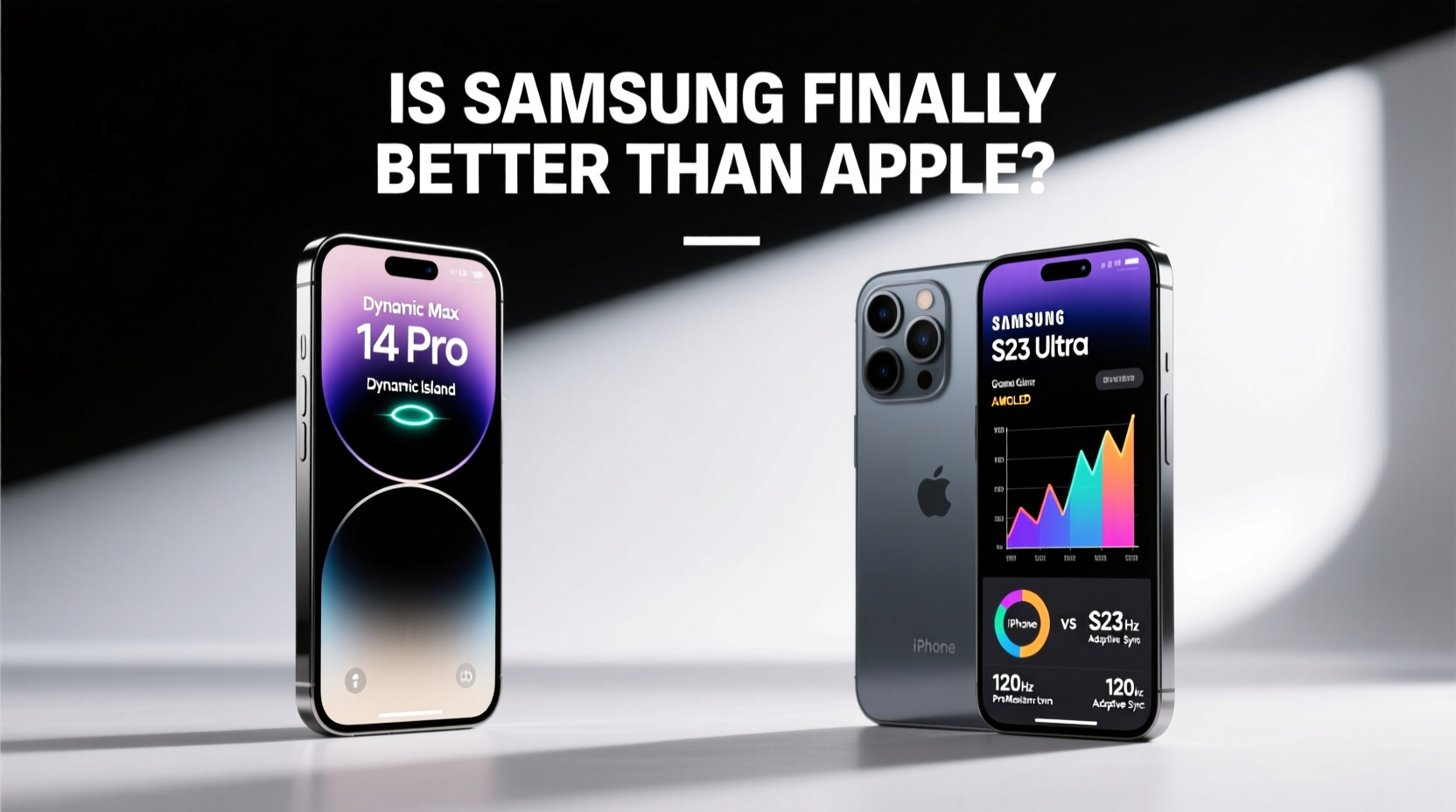
The iPhone 14 Pro Max continues Apple’s tradition of minimalist elegance. Its surgical-grade stainless steel frame, flat edges, and Ceramic Shield front offer durability and a distinct tactile feel. The device feels dense and premium—almost like a piece of jewelry. However, its weight (240g) can be fatiguing during prolonged use.
In contrast, the S23 Ultra adopts a more functional approach. It uses Armor Aluminum and Gorilla Glass Victus 2 on both front and back, wrapped in a slightly curved, boxier silhouette. At 234g, it’s marginally lighter but larger in footprint. What sets it apart is the integrated S Pen—a feature absent from any iPhone. This transforms the device into a productivity tool, ideal for note-taking, sketching, or precise navigation.
Display: Brightness Meets Adaptability
Both phones feature top-tier displays, but they serve different purposes. The iPhone 14 Pro Max introduced the ProMotion 120Hz display with dynamic refresh rates (down to 1Hz), enhancing battery efficiency. Its peak brightness reaches 2000 nits outdoors—making it the brightest Apple has ever shipped. True Tone and accurate color reproduction make it ideal for creatives.
The S23 Ultra counters with a 6.8-inch QHD+ Dynamic AMOLED 2X panel, also 120Hz with adaptive refresh rates (1–120Hz). It peaks at 1750 nits—still exceptional—and offers superior resolution. Samsung’s display tuning favors vibrancy, which some users prefer for media consumption. Additionally, the flatter screen reduces accidental touches when using the S Pen.
“The S23 Ultra’s display gives photographers and video editors more screen real estate without sacrificing clarity.” — David Lin, Mobile Display Analyst at DisplayMate
Performance and Software: iOS Stability vs Android Power
Under the hood, the iPhone 14 Pro Max runs on Apple’s A16 Bionic chip—a 4nm processor designed for efficiency and machine learning tasks. Paired with 6GB RAM and iOS 16 (upgradable to iOS 17), it delivers seamless multitasking, unmatched app optimization, and industry-leading longevity. Apps launch instantly, and background processes are tightly managed.
Samsung equips the S23 Ultra with the Snapdragon 8 Gen 2 for Galaxy—a customized chipset built specifically for Samsung with enhanced GPU and AI performance. Despite having 8GB or 12GB RAM options, Android’s memory management doesn’t always translate to smoother operation compared to iOS. However, One UI 5.1 (and later 6.0) offers deep customization, split-screen multitasking, DeX desktop mode, and true file system access—features iOS still limits.
| Feature | iPhone 14 Pro Max | S23 Ultra |
|---|---|---|
| Processor | A16 Bionic | Snapdragon 8 Gen 2 (for Galaxy) |
| RAM | 6GB | 8GB / 12GB |
| Storage Options | 128GB – 1TB | 256GB – 1TB (expandable via microSD in some regions) |
| OS | iOS 16 (up to iOS 17+) | Android 13 (One UI 5.1, upgradable) |
| Expected OS Updates | 5–6 years | 4 major Android updates, 5 years security |
Camera System: Computational Mastery vs Versatility
The iPhone 14 Pro Max features a triple-camera array: 48MP main (with pixel binning), 12MP ultrawide, and 12MP telephoto (3x optical zoom). Its strength lies in consistency—natural color science, excellent dynamic range, and best-in-class video recording (up to 4K HDR at 60fps with ProRes support).
The S23 Ultra goes all-in on zoom and flexibility. It includes a 200MP main sensor (adaptive pixel binning to 12MP), 12MP ultrawide, and dual telephoto lenses: 3x and 10x periscope zoom (100x digital). This enables unparalleled reach for distant subjects. While early Samsung photos leaned oversaturated, recent firmware updates have improved realism. Video now supports 8K at 30fps, though thermal throttling can limit sustained recording.
Real-World Example: Travel Photographer’s Dilemma
Maya, a travel photographer based in Iceland, used the iPhone 14 Pro Max for two years. She praised its low-light performance and seamless iCloud syncing across her Mac and iPad. But during a recent trip to the highlands, she borrowed an S23 Ultra. Capturing distant puffins nesting on cliffs was effortless thanks to the 10x zoom. She didn’t need a separate compact camera. While she missed iOS’s video stabilization, the photo flexibility convinced her to consider switching.
Battery Life and Charging: Endurance vs Convenience
The S23 Ultra packs a 5,000mAh battery, consistently lasting 1.5 days under moderate use. Fast charging reaches 50% in 30 minutes (with a 45W charger sold separately). It also supports wireless and reverse wireless charging.
The iPhone 14 Pro Max, with its 4,323mAh battery, typically lasts a full day with heavy use. It supports 20W fast charging (slower than Samsung), MagSafe, and Qi wireless. While efficient, it lacks the rapid recharge capability of its rival.
- S23 Ultra: ~1.5-day battery, 45W fast charge (adapter not included)
- iPhone 14 Pro Max: ~1-day battery, 20W fast charge, MagSafe ecosystem
Expert Insight: The Ecosystem Factor
“Apple wins on ecosystem integration. If you own a Mac, iPad, or Apple Watch, the iPhone just works. Samsung is catching up with Quick Share and Phone Link, but it’s not seamless yet.” — Leila Hassan, Tech Editor at Mobile Horizon
This remains Apple’s strongest advantage. Handoff, AirDrop, iMessage, FaceTime, and Continuity Camera create a frictionless experience that Android struggles to match. Samsung’s ecosystem—while growing with Galaxy Buds, Watches, and Tabs—is still fragmented compared to Apple’s unified control.
Checklist: Which Phone Should You Choose?
Use this checklist to decide based on your priorities:
- I rely heavily on Apple devices (Mac, iPad, Watch): → iPhone 14 Pro Max
- I want maximum zoom and photo flexibility: → S23 Ultra
- I use my phone for notes, drawing, or productivity: → S23 Ultra (S Pen included)
- I prioritize long-term software updates: → iPhone (5–6 years vs Samsung’s 4–5)
- I value fast charging and longer battery life: → S23 Ultra
- I record professional-quality video: → iPhone 14 Pro Max
- I prefer customizable software and split-screen apps: → S23 Ultra
Frequently Asked Questions
Is the S23 Ultra worth switching from iPhone?
Yes, if you value hardware innovation, zoom photography, S Pen functionality, or faster charging. However, leaving the Apple ecosystem means losing seamless integration with other Apple devices and services like iMessage encryption and FaceTime grid view.
Does the iPhone 14 Pro Max still outperform the S23 Ultra in daily use?
In raw speed and app responsiveness, both feel equally fast. However, the iPhone maintains smoother long-term performance due to iOS optimization. Over three years, iPhones tend to degrade less in fluidity than Android counterparts.
Can the S23 Ultra replace a tablet or laptop?
With Samsung DeX, external monitor support, and the S Pen, the S23 Ultra can function as a light productivity device. Paired with a keyboard and monitor, it handles emails, documents, and presentations surprisingly well—something no iPhone can replicate natively.
Conclusion: Has Samsung Finally Surpassed Apple?
The answer depends on what “better” means to you. If you define it by hardware innovation, camera versatility, battery life, and productivity tools, then yes—Samsung has surpassed Apple with the S23 Ultra. It offers features the iPhone simply doesn’t, and its performance is on par in nearly every category.
But if you value ecosystem synergy, long-term software support, video quality, and a polished, consistent user experience, the iPhone 14 Pro Max remains the safer, more integrated choice.
Samsung hasn’t just caught up—they’ve redefined what a flagship phone can do. Apple, meanwhile, continues refining its vision with unmatched polish. The competition is closer than ever. For consumers, that’s the real victory.




 浙公网安备
33010002000092号
浙公网安备
33010002000092号 浙B2-20120091-4
Comments
No comments yet. Why don't you start the discussion?