
For millions still using the Galaxy S10, the question isn't whether smartphones have evolved—it's whether the evolution justifies the cost of upgrading. The iPhone 14 Pro, released five years after Samsung’s flagship from 2019, represents a generational leap in mobile technology. But does that translate into real-world benefits for someone coming from a device as capable as the S10? Let’s dissect the differences not just on paper, but in daily use—covering performance, camera quality, software support, battery life, and overall value.
Performance: A Quantum Leap in Processing Power
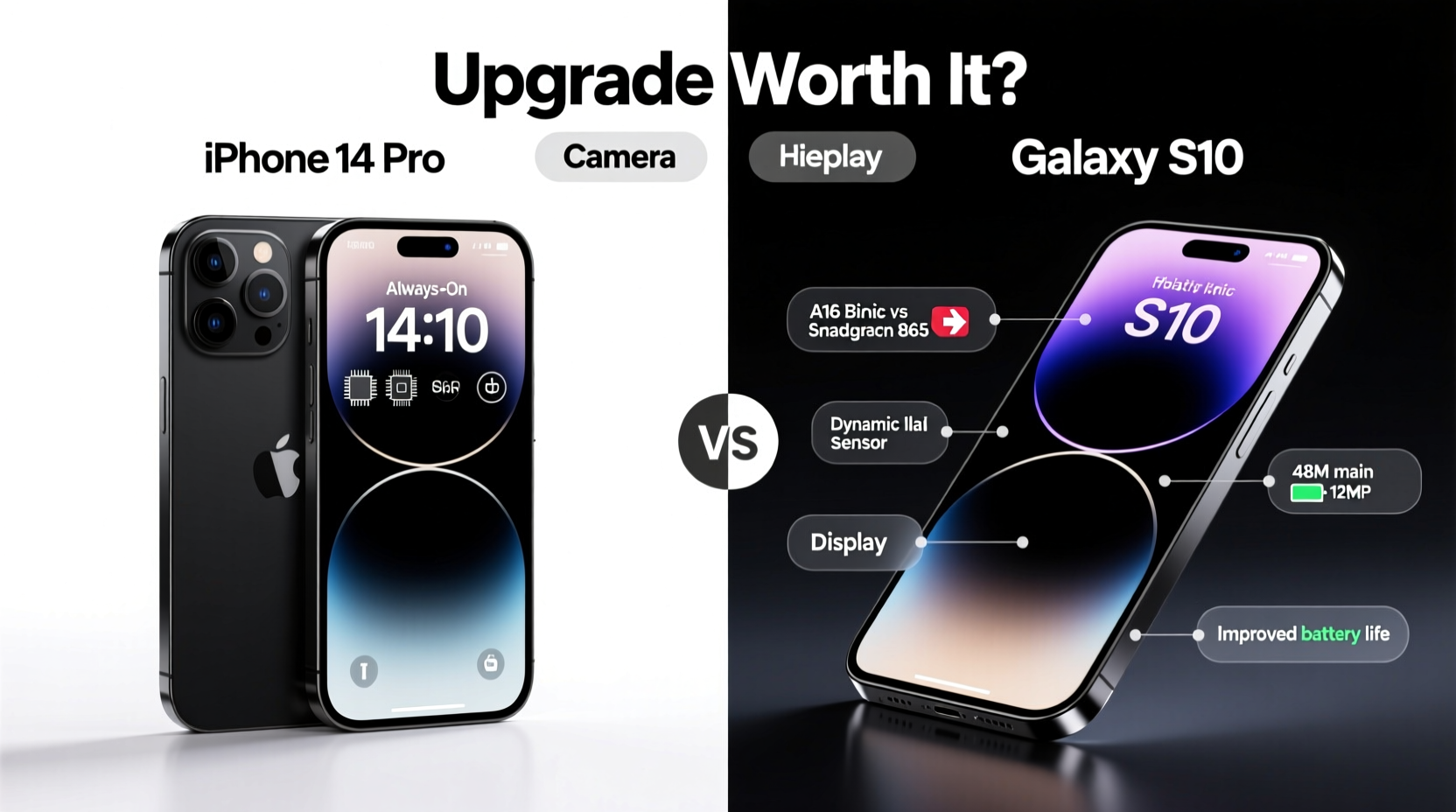
The Galaxy S10 was powered by either the Qualcomm Snapdragon 855 or Exynos 9820, depending on region—both solid chips for their time. In contrast, the iPhone 14 Pro runs on Apple’s A16 Bionic chip, built on a 4nm process with significantly higher transistor density, efficiency, and AI capabilities.
In practical terms, this means the iPhone 14 Pro handles multitasking, gaming, and photo/video editing with ease, even under sustained loads. Apps launch faster, animations are smoother, and background processes are managed more efficiently thanks to iOS’s memory management architecture.
Benchmarks tell part of the story: the A16 scores around 7,500 on Geekbench 6 single-core, compared to the S10’s ~3,500. That’s more than double the CPU performance. GPU gains are similarly dramatic, making modern games like *Genshin Impact* playable at high settings on the iPhone 14 Pro—something the S10 struggles with even at medium settings today.
Camera Comparison: Night Mode, Computational Photography, and Video
The Galaxy S10 featured a triple rear setup: 12MP main, 12MP telephoto, and 16MP ultra-wide. It was praised in its day for color accuracy and low-light detail. But the iPhone 14 Pro introduces a 48MP main sensor (with pixel binning), a new Photonic Engine, and advanced computational photography features like Smart HDR 5 and Deep Fusion.
Night mode is now standard across all lenses on the iPhone 14 Pro, while the S10 only supports it on the main camera—and with noticeably noisier results. The dynamic range in challenging lighting (backlit scenes, sunsets) is far superior on the iPhone, capturing more shadow detail and highlight preservation.
“Smartphone photography has shifted from hardware to software intelligence. The iPhone 14 Pro doesn’t just take photos—it interprets them.” — Lena Park, Mobile Imaging Analyst at TechLens
Video recording is another area where the gap widens. The iPhone 14 Pro supports 4K Dolby Vision HDR at 60fps, cinematic mode in 4K, and advanced stabilization. The S10 maxes out at 4K 30fps without HDR, and stabilization feels less refined. For content creators or casual videographers, this difference is immediately noticeable.
Battery Life and Charging: Efficiency Meets Longevity
The Galaxy S10 came with a 3,400mAh battery—modest by today’s standards. After years of charging cycles, most surviving units now offer reduced capacity, often lasting just a full day under light use. Fast charging topped out at 15W, with optional wireless and reverse wireless charging.
The iPhone 14 Pro packs a larger battery (approx. 3,200–3,300mAh) but benefits from extreme power efficiency in the A16 chip and iOS optimization. Apple claims up to 23 hours of video playback; real-world usage typically sees 8–10 hours of screen-on time. This consistently outperforms the aging S10, which rarely exceeds 5–6 hours today.
| Feature | Galaxy S10 | iPhone 14 Pro |
|---|---|---|
| Battery Capacity | 3,400 mAh | ~3,200 mAh |
| Fast Charging | 15W wired | 20W+ (MagSafe compatible) |
| Wireless Charging | Yes (Qi & proprietary) | Yes (Qi & MagSafe) |
| Expected Daily Use (2024) | 5–6 hrs screen time | 8–10 hrs screen time |
| Software Optimization | Basic adaptive battery | Advanced power management + on-device AI |
While raw capacity favors the S10 slightly, system-level efficiency gives the iPhone 14 Pro a clear edge in endurance—especially important for users who rely on their phones throughout the workday.
Software Support and Long-Term Value
This is perhaps the most critical factor when deciding whether an upgrade is “worth it.” The Galaxy S10 launched with Android 9 and received three major OS updates, topping out at Android 12. Security patches officially ended in 2022. While some custom ROMs extend usability, most S10 owners are now exposed to unpatched vulnerabilities.
In contrast, the iPhone 14 Pro shipped with iOS 16 and is expected to receive updates through at least 2028—six years of support. Apple typically provides five to six years of OS and security updates, ensuring access to new features, app compatibility, and protection against emerging threats.
If you're using your phone for banking, remote work, or connected services, running outdated software increases risk. The iPhone 14 Pro receives regular privacy enhancements, such as Lockdown Mode and improved tracking prevention in Safari—features absent on older Android devices.
Real-World Upgrade Experience: A Mini Case Study
Consider Mark, a freelance photographer who used his Galaxy S10 daily from 2019 to early 2024. By 2023, he noticed frequent app crashes, slow gallery loading, and poor performance in Adobe Lightroom. His battery died by mid-afternoon, forcing him to carry a power bank. He upgraded to the iPhone 14 Pro primarily for camera quality and reliability.
Within a week, Mark reported dramatic improvements: RAW photo processing in Lightroom completed in seconds instead of minutes, Live Text in the Camera app helped extract information from business cards instantly, and he could shoot, edit, and upload 4K videos directly from his phone. Most importantly, he regained confidence in his device’s responsiveness—a subtle but crucial shift in daily workflow.
Was it worth it? For Mark, yes—not because the iPhone brand is superior, but because the technological gap had grown too wide for his professional needs.
Checklist: Should You Upgrade?
Ask yourself these questions before making the switch:
- Do apps regularly freeze or crash on your current device?
- Is your battery life insufficient for a full day of moderate use?
- Have you stopped receiving official software or security updates?
- Do you want better photo and video quality, especially in low light?
- Are newer apps (e.g., AI tools, AR experiences) incompatible with your phone?
- Do you plan to keep your next phone for 4+ years?
If you answered “yes” to three or more, upgrading is likely justified—not as a luxury, but as a productivity and security investment.
Frequently Asked Questions
Can the Galaxy S10 still handle everyday tasks in 2024?
Yes, for basic use—calls, messaging, light browsing, and older apps. However, newer web standards, complex social media apps, and streaming platforms may feel sluggish. Security risks also increase without updates.
Is switching from Android to iOS difficult?
Apple provides the Move to iOS app, which transfers contacts, messages, photos, and more seamlessly. Most cloud-based accounts (Google, Microsoft, etc.) sync easily. The biggest adjustment is navigation gestures and app ecosystem habits, which most users adapt to within a week.
Does the iPhone 14 Pro justify its higher price over refurbished flagships?
At launch, the iPhone 14 Pro was premium-priced, but its long software support, strong resale value, and consistent performance make it competitive with high-end Android alternatives—even refurbished ones. When factoring in longevity, the total cost of ownership can be lower.
Final Verdict: Is Upgrading Worth It?
The answer depends on your needs, but objectively, the iPhone 14 Pro offers a transformative experience over the Galaxy S10. We’re not just talking about a sharper display or a faster processor—we’re talking about a device designed for the next five years of mobile computing, not the last.
From enhanced security and extended software support to vastly superior cameras and energy efficiency, the upgrade addresses real pain points faced by long-term S10 users. It’s not merely a new phone; it’s a tool that keeps pace with evolving digital demands.
If you’ve been holding onto your Galaxy S10 out of loyalty or frugality, consider this: technology stagnation has a hidden cost—time lost to lag, missed moments due to poor photos, and vulnerability from outdated software. Investing in a modern device isn’t indulgence. It’s practicality.




 浙公网安备
33010002000092号
浙公网安备
33010002000092号 浙B2-20120091-4
Comments
No comments yet. Why don't you start the discussion?