
In September 2013, Apple made a bold move by releasing two distinct iPhone models simultaneously: the premium iPhone 5s and the more colorful, plastic-bodied iPhone 5c. At the time, the decision sparked debate—was the 5c a true successor to the iPhone 5, or just a repackaged version with a new shell? Nearly a decade later, with iOS updates long discontinued and app requirements evolving, it’s worth revisiting whether the 5s’ upgrades justified its higher price—and if either device holds any value in 2024.
This isn’t just a nostalgic look back. For collectors, budget-conscious users, or those relying on older devices for secondary tasks, understanding the differences between these models can inform practical decisions about repair, resale, or even emergency backup use.
The Core Differences: Hardware and Design
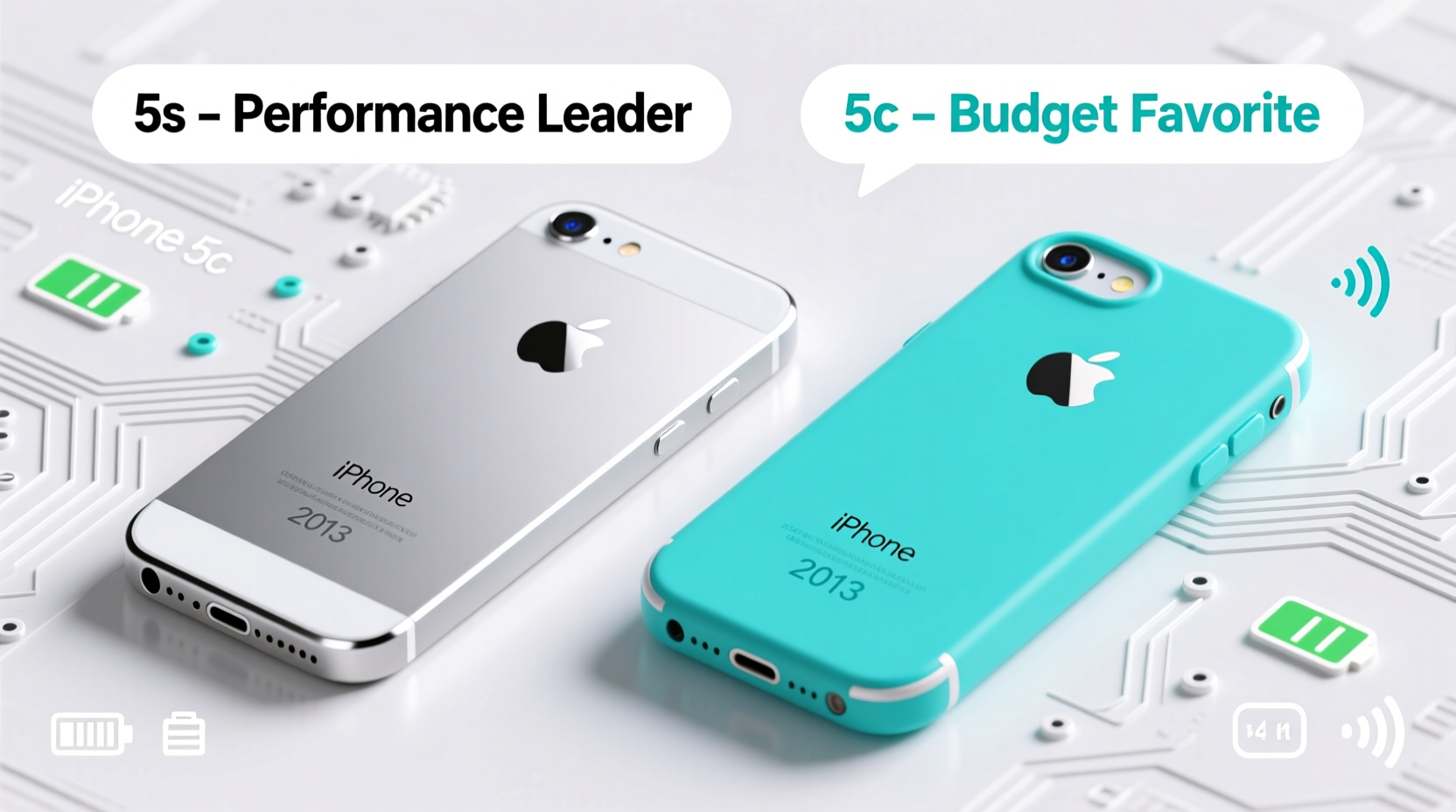
At first glance, the iPhone 5c and 5s shared nearly identical dimensions and screen specs: both featured 4-inch Retina displays with 1136x640 resolution. However, their internal components and design philosophies diverged sharply.
| Feature | iPhone 5c | iPhone 5s |
|---|---|---|
| Processor | A6 chip | A7 chip (64-bit architecture) |
| RAM | 1GB | 1GB |
| Camera | 8MP rear, f/2.4 aperture | 8MP rear, f/2.2 aperture + True Tone flash |
| Fingerprint Sensor | No | Yes (Touch ID) |
| Materials | Polycarbonate (plastic) unibody | Aluminum body with chamfered edges |
| Colors | White, Blue, Green, Pink, Yellow | Silver, Gold, Space Gray |
| M7 Motion Coprocessor | No | Yes |
The iPhone 5s was clearly positioned as the flagship. The A7 chip wasn’t just faster—it introduced 64-bit computing to mobile devices, future-proofing the phone for several years. Touch ID, though basic by today’s standards, set a precedent for biometric security across the industry.
Performance Gap: Why the 5s Was Worth the Upgrade
In 2013, the difference between the A6 and A7 processors was immediately noticeable. Apps launched faster, multitasking was smoother, and games ran at higher frame rates. But the real advantage emerged over time: software support.
Apple typically supports iPhones with iOS updates for around five to six years. The iPhone 5s received updates up to iOS 12.5.7, released in January 2023—nearly a decade after its launch. In contrast, the 5c stopped receiving major updates after iOS 10, effectively ending its functional lifespan much earlier.
“Hardware determines initial performance, but sustained software support defines a phone’s real longevity.” — David Kim, Mobile Analyst at TechInsight Group
The inclusion of the M7 motion coprocessor in the 5s also gave it an edge in fitness tracking and background sensor processing. While seemingly minor, this allowed apps like Nike+ and HealthKit to function more efficiently—a feature absent in the 5c.
Is the iPhone 5c Still Usable in 2024?
As of 2024, the iPhone 5c cannot connect reliably to most modern services. It lacks support for current versions of Safari, Google, Facebook, and banking apps—all of which require iOS 11 or higher. Even basic web browsing is hindered by outdated JavaScript engines and lack of TLS 1.2+ encryption support.
Some users attempt to repurpose the 5c as a music player, camera, or dedicated e-reader. While technically possible, limitations persist:
- Battery life has likely degraded significantly after 10+ years.
- Storage maxes out at 32GB, insufficient for large photo libraries or offline media.
- No iCloud syncing beyond legacy services.
- Wi-Fi and Bluetooth are limited to older standards (802.11n, Bluetooth 4.0).
In short, the 5c is no longer viable as a daily driver or even a reliable secondary device.
Real-World Example: Can the 5s Serve as a Backup Phone Today?
Consider Mark, a photographer who keeps an iPhone 5s powered off in his gear bag since 2016. In early 2024, his primary phone died during a trip. He revived the 5s, charged it, and found it could still make calls, send SMS, and access basic maps via offline mode. However, he couldn’t use WhatsApp (no app update since 2018), Uber, or Google Maps navigation. He managed to get through the day using voice calls and pre-downloaded directions—but only because he had prepared ahead.
This scenario illustrates that while the 5s retains minimal functionality, its usefulness depends heavily on pre-planning and acceptance of severe limitations.
Step-by-Step: How to Maximize an Old iPhone's Utility in 2024
If you’re determined to extract value from an old iPhone 5s or 5c, follow this timeline to optimize its role:
- Power On & Assess Battery Health: Charge fully and check if it holds charge. If it dies within hours, the battery is likely dead.
- Update to Latest Supported iOS: For 5s, install iOS 12.5.7. For 5c, max is iOS 10.3.4.
- Erase All Content: Reset the device to avoid login issues from expired sessions.
- Set Up as New (Skip Apple ID if Needed): Avoid activation lock complications.
- Install Minimal Essential Apps: Notes, Camera, Voice Memos, Offline Maps (downloaded in advance).
- Use in Airplane Mode + Wi-Fi Only: Prevents carrier issues and conserves battery.
- Store in Climate-Controlled Environment: Heat and cold accelerate battery decay.
Checklist: Is Your iPhone 5s or 5c Still Practical?
Before deciding to keep or discard your device, answer these questions:
- ✅ Can it hold a charge for at least 4 hours under light use?
- ✅ Does it boot consistently without freezing or restarting?
- ✅ Can you access critical functions (calls, messages, camera)?
- ✅ Are essential apps (maps, weather, notes) functional?
- ✅ Is storage sufficient for your intended use?
- ✅ Do you have a charger compatible with Lightning (and possibly 30-pin adapter)?
If three or more answers are “no,” the device is likely obsolete for practical purposes.
Frequently Asked Questions
Can I still use WhatsApp on an iPhone 5c in 2024?
No. WhatsApp dropped support for iOS 10 and earlier in 2020. Since the 5c cannot upgrade beyond iOS 10.3.4, it cannot run current versions of WhatsApp.
Does the iPhone 5s support FaceTime Audio?
Yes, the 5s supports FaceTime Audio and video over Wi-Fi. However, newer end-to-end encryption features may not be available due to outdated protocols.
Can I sell my iPhone 5s or 5c today?
Possibly, but don’t expect much. In 2024, working units sell for $20–$50 USD, mostly to collectors or parts recyclers. Devices with cracked screens or battery issues may be worth only $5–$10.
Final Verdict: Were the Upgrades Worth It?
Unequivocally, yes—the iPhone 5s was worth the upgrade over the 5c. Not only did it offer better hardware and Touch ID, but its extended software support added years of usability. By 2017, the 5c was already struggling with modern apps, while the 5s remained functional into 2023 for basic tasks.
That said, neither phone is truly “good” in 2024. They lack security updates, modern app compatibility, and performance for everyday needs. Their relevance now lies in historical interest, educational use, or as emergency fallbacks—if maintained properly.
If you’re holding onto one out of sentiment, consider preserving it as a collector’s item. Remove the SIM card, disable Find My iPhone (if possible), and store it in a dry place with partial charge. For anyone seeking affordable smartphone access today, even entry-level Android devices or refurbished iPhones from 2017 onward offer vastly superior experiences.




 浙公网安备
33010002000092号
浙公网安备
33010002000092号 浙B2-20120091-4
Comments
No comments yet. Why don't you start the discussion?