
For millions of iPhone users still clinging to an iPhone 6 Plus, the question isn’t whether newer models exist—it’s whether upgrading to an iPhone 7 or 8 actually makes financial and practical sense. After all, Apple releases new devices every year, but not every upgrade delivers meaningful improvements. If your 6 Plus still powers through daily tasks, is it time to invest in a newer model—or can you wait longer without missing out?
This breakdown compares the iPhone 6 Plus, iPhone 7, and iPhone 8 across critical categories: design, performance, camera quality, battery life, software support, and real-world usability. The goal is clear: help you decide if spending money on an upgrade delivers tangible benefits or just incremental changes.
Design and Build Quality: From Aluminum to Glass
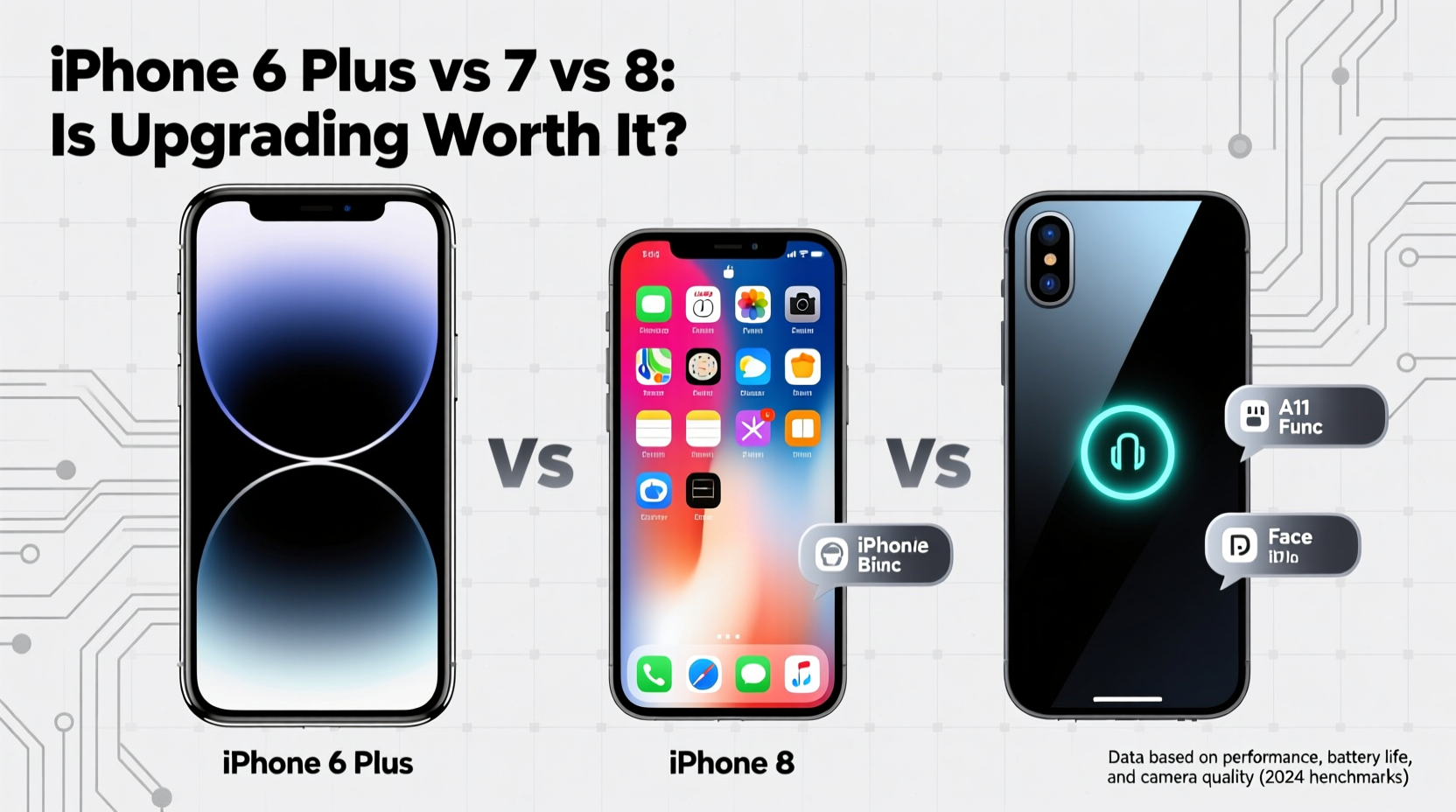
The evolution from the iPhone 6 Plus to the iPhone 8 represents a quiet revolution in materials and durability. The 6 Plus introduced a sleek aluminum unibody, but its thin edges made it prone to bending—infamously dubbed \"Bendgate.\" While functional, its design prioritized aesthetics over resilience.
The iPhone 7 refined that foundation with water and dust resistance (rated IP67), a significant leap for everyday protection. It also removed the headphone jack—a controversial move at the time but one that cleared space for internal improvements. The build felt more solid, with tighter seams and improved button feedback.
The iPhone 8 took another step forward by reintroducing glass on the back, enabling wireless charging for the first time in the mainstream iPhone line. This made it compatible with Qi chargers, a convenience feature that remains relevant today. While the glass makes it more fragile than the 6 Plus or 7, it also gives the device a premium feel and better antenna performance.
Performance: A Quantum Leap in Speed and Efficiency
Under the hood, the differences between these models are dramatic. The iPhone 6 Plus runs on the A8 chip, which was impressive in 2014 but now struggles with modern apps and multitasking. Many users report app reloads, slow Safari performance, and delays in launching frequently used tools like Maps or Camera.
The iPhone 7 brought the A10 Fusion chip—an architecture that doubled CPU performance and quadrupled graphics power over the A8. This means smoother animations, faster app launches, and better gaming performance. Even today, the A10 holds up surprisingly well for basic to moderate usage.
The iPhone 8 upgraded further with the A11 Bionic chip, introducing a neural engine designed for machine learning tasks. This translates into faster Face ID processing (though the 8 uses Touch ID), improved photo processing, and enhanced AR capabilities. In real-world use, the difference between the 6 Plus and 8 is night and day: apps open instantly, background processes don’t slow the system, and iOS updates install without issues.
“Upgrading from an A8 to an A11 chip isn’t just about speed—it’s about future-proofing your device for at least three more years of reliable service.” — David Lin, Mobile Hardware Analyst
Camera Comparison: More Than Just Megapixels
Photography has evolved significantly across these generations. The iPhone 6 Plus features an 8MP rear camera with basic autofocus and no optical image stabilization (OIS) in the standard model. Low-light photos often appear grainy, and video recording maxes out at 1080p.
The iPhone 7 introduced a 12MP sensor with OIS, wider color capture (P3), and better low-light performance. Its f/1.8 aperture lets in more light, resulting in clearer night shots and richer colors. Front-facing video also improved, supporting 720p HD at 30fps.
The iPhone 8 retained the same 12MP rear camera as the 7 but leveraged the A11 chip’s image signal processor for smarter HDR, better noise reduction, and enhanced portrait lighting effects in software. While not a hardware leap, computational photography made the 8’s camera noticeably sharper and more consistent, especially in mixed lighting.
| Feature | iPhone 6 Plus | iPhone 7 | iPhone 8 |
|---|---|---|---|
| Processor | A8 | A10 Fusion | A11 Bionic |
| Rear Camera | 8MP, no OIS | 12MP, OIS | 12MP, OIS + improved ISP |
| Water Resistance | No | IP67 | IP67 |
| Battery Life (Video Playback) | 14 hours | 14 hours | 13 hours |
| Charging | Lightspeed only | Lightspeed only | Lightspeed + Wireless (Qi) |
| iOS Support (Latest) | iOS 12 (max) | iOS 16 | iOS 17 |
Software Support and Longevity
One of the most compelling reasons to upgrade is ongoing software support. The iPhone 6 Plus stopped receiving major iOS updates after iOS 12. That means no security patches, no new features, and incompatibility with many modern apps that require iOS 13 or higher.
In contrast, the iPhone 7 supports up to iOS 16, and the iPhone 8 goes all the way to iOS 17—Apple’s latest operating system at time of writing. This extra support window ensures access to critical security fixes, new privacy tools, and updated versions of apps like WhatsApp, Google Maps, and banking platforms that may drop support for older systems.
If you rely on your phone for work, travel, or managing personal data, staying on an unsupported OS poses real risks. Outdated software increases vulnerability to malware and limits integration with smart home devices, wearables, and cloud services.
Real-World Example: Sarah’s Upgrade Dilemma
Sarah had been using her iPhone 6 Plus since 2015. By 2022, she noticed her banking app wouldn’t update, her camera lagged when scanning QR codes, and her battery died by midday. She considered buying a refurbished iPhone 7 for $120 but hesitated—was it worth it?
After researching, she opted for a used iPhone 8 at $160. The difference was immediate: her phone stayed secure with iOS 17, her maps loaded faster, and she could finally use wireless charging at her office. Two years later, she hasn’t needed another upgrade—and estimates she saved hundreds by avoiding annual flagship purchases.
Is Upgrading Really Worth the Money?
The answer depends on your current needs and how long you plan to keep the device.
If your iPhone 6 Plus still works but feels sluggish, and you don’t want to spend $800+ on a new iPhone, stepping up to a used or refurbished iPhone 7 or 8 is a smart middle ground. You gain:
- Significantly faster performance
- Modern camera capabilities
- Essential water resistance
- Years of continued software updates
- Wireless charging (on iPhone 8)
However, if you're deeply satisfied with your 6 Plus and only use your phone for calls, texts, and occasional web browsing, upgrading might not be urgent. But recognize that as apps evolve and iOS moves forward, your device will eventually become unusable—not because it breaks, but because it can't run the software you need.
Upgrade Checklist: Are You Ready?
- Does your iPhone 6 Plus struggle to open apps or freeze frequently? → Yes = Upgrade recommended
- Have you stopped receiving iOS updates? → Yes = Security risk; consider upgrade
- Do you want wireless charging or better low-light photos? → Yes = iPhone 8 ideal
- Is your battery dying before lunchtime? → Yes = Newer models offer better longevity
- Are you paying for cloud storage due to limited capacity? → Consider models with 64GB or 128GB options
Frequently Asked Questions
Can the iPhone 6 Plus still be used in 2024?
Technically, yes—but with major limitations. It runs only up to iOS 12, meaning no new features, poor app compatibility, and growing security risks. Basic functions like calling and texting still work, but modern mobile experiences are severely restricted.
Is the iPhone 8 worth buying in 2024?
For budget-conscious users, absolutely. Refurbished or secondhand iPhone 8 units are available for under $200 and support iOS 17, offering strong performance for everyday tasks. Battery replacement can extend its life even further.
What’s the main advantage of iPhone 8 over iPhone 7?
The A11 chip provides better long-term software support and slightly improved camera processing. Most importantly, the iPhone 8 supports wireless charging thanks to its glass back—a convenience feature the iPhone 7 lacks.
Final Thoughts: Smart Upgrades Over Impulse Buys
Upgrading from an iPhone 6 Plus to a 7 or 8 isn’t about chasing the latest trend—it’s about reclaiming reliability, security, and usability. The cost of a modest upgrade pales in comparison to the frustration of a device that can’t keep up.
The iPhone 8, in particular, strikes an excellent balance between price, performance, and future readiness. For less than the cost of a single meal at a high-end restaurant, you can extend your smartphone’s useful life by several years.




 浙公网安备
33010002000092号
浙公网安备
33010002000092号 浙B2-20120091-4
Comments
No comments yet. Why don't you start the discussion?