
For users still relying on the iPhone 7 Plus, the question of whether to upgrade to the iPhone 8 Plus isn’t just about new features—it’s about value, longevity, and real-world improvements. Both phones are part of Apple’s legacy lineup, but the 8 Plus brought meaningful upgrades that may or may not justify the cost for every user. Understanding the differences in hardware, software support, and daily usability helps clarify if making the switch is truly worthwhile.
Design and Build Quality: A Noticeable Step Forward
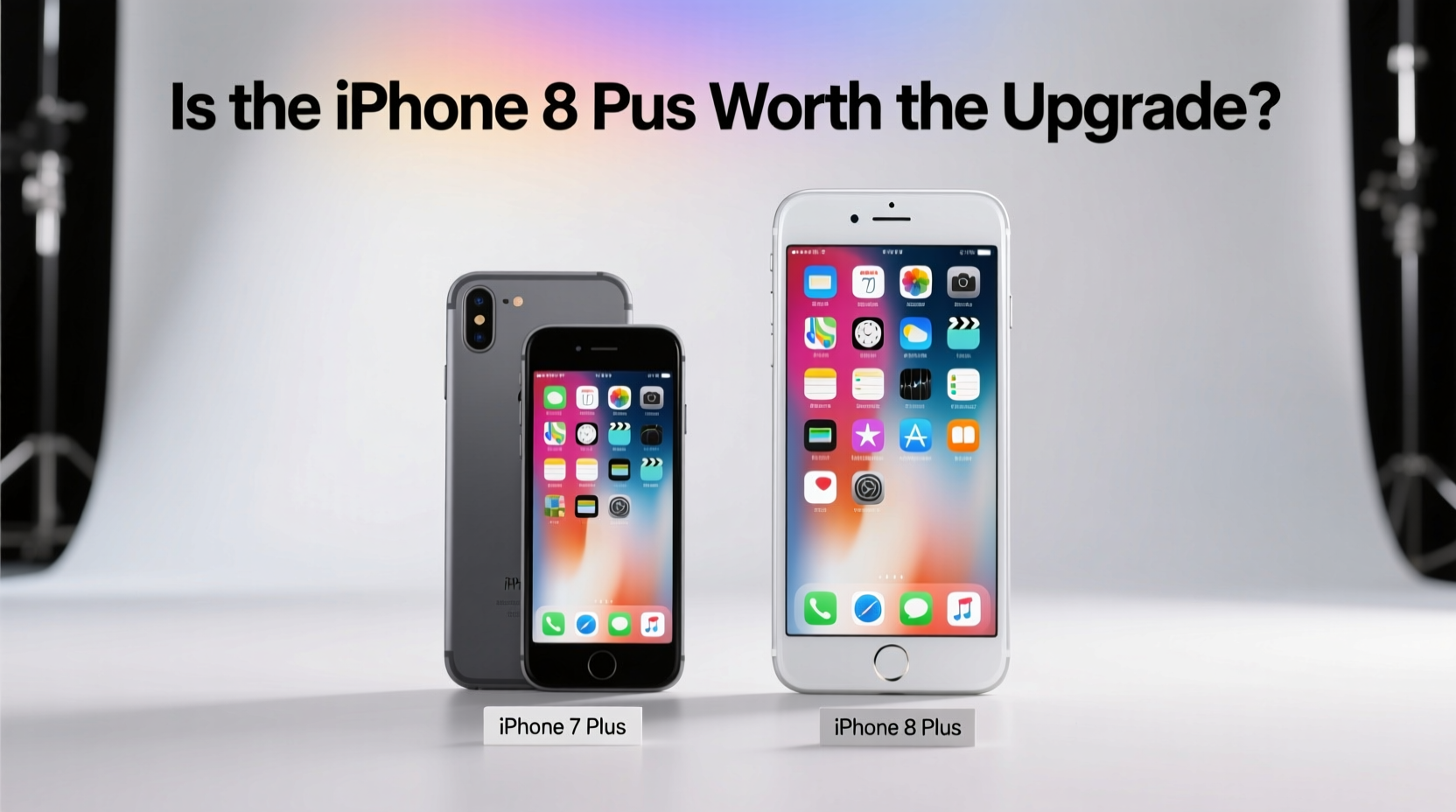
The most immediate difference between the two models lies in their construction. The iPhone 7 Plus features an aluminum body with a glossy finish on the front and matte or color-coated back. While durable, it’s prone to scratches and lacks water resistance beyond basic splash protection (rated IP67).
In contrast, the iPhone 8 Plus introduced a glass back for the first time since the iPhone 4. This wasn't just aesthetic—Apple did it to enable wireless charging, a feature absent on the 7 Plus. The glass is strengthened with ion-exchange processes and paired with a more refined aerospace-grade aluminum frame. It retains the same IP67 rating, meaning both can survive brief submersion in up to 1 meter of water for 30 minutes.
Despite nearly identical dimensions and weight, the 8 Plus feels slightly more premium due to its glass back and tighter build tolerances. However, that glass is also more susceptible to cracking when dropped, so many users opt for protective cases—ironically covering up the very feature Apple highlighted.
Performance: The A11 Bionic Makes a Difference
Beneath the surface, the biggest leap comes from the chipset. The iPhone 7 Plus runs on the A10 Fusion chip, which was groundbreaking in 2016. By 2017 standards, however, it began showing limitations in multitasking and graphics-heavy applications.
The iPhone 8 Plus launched with the A11 Bionic chip—an entirely new architecture featuring a six-core CPU (two high-performance cores and four efficiency cores) and a custom three-core GPU. Apple claimed a 25% improvement in CPU performance and a 30% boost in graphics over the A10.
In practical terms, this means smoother app launches, faster photo processing, better AR (augmented reality) experiences, and improved responsiveness under heavy loads. For users running iOS 16 or later, the A11’s extra headroom ensures longer software support and better compatibility with modern apps.
“Even two years after launch, the A11 Bionic kept the 8 Plus feeling snappy in ways the 7 Plus couldn’t match.” — David Lin, Mobile Performance Analyst at TechPulse
Camera Comparison: Subtle But Meaningful Gains
Both phones feature dual 12MP rear cameras: one wide-angle and one telephoto, enabling 2x optical zoom and Portrait Mode. On paper, they look identical—but the 8 Plus benefits from key internal upgrades.
- Larger and faster sensors: Improved low-light performance and reduced shutter lag.
- Smart HDR (via software updates): Though not available at launch, iOS updates brought early forms of Smart HDR to the 8 Plus, enhancing dynamic range.
- Better image signal processor (ISP): Part of the A11 chip, allowing for more advanced noise reduction and real-time depth mapping.
In daylight, photos from both devices are nearly indistinguishable. But in dim conditions, the 8 Plus consistently captures brighter images with less grain and more accurate colors. Portrait Mode also sees refinements, with sharper edge detection and more natural bokeh effects.
The front-facing camera remains a 7MP sensor on both, though the 8 Plus benefits from better tonal balance and faster autofocus thanks to the upgraded ISP.
Detailed Feature Comparison
| Feature | iPhone 7 Plus | iPhone 8 Plus |
|---|---|---|
| Release Year | 2016 | 2017 |
| Chipset | A10 Fusion | A11 Bionic |
| Rear Cameras | Dual 12MP (f/1.8 + f/2.8) | Dual 12MP (f/1.8 + f/2.8), improved sensors |
| Front Camera | 7MP (f/2.2) | 7MP (f/2.2), better processing |
| Display | 5.5\" Retina HD LCD | 5.5\" Retina HD LCD, True Tone support |
| Wireless Charging | No | Yes (Qi-compatible) |
| Water Resistance | IP67 | IP67 |
| Storage Options | 32GB, 128GB, 256GB | 64GB, 256GB |
| iOS Support Expectation | Up to iOS 16 (ended) | Up to iOS 17 (likely final) |
Real-World Example: Sarah’s Upgrade Decision
Sarah had used her iPhone 7 Plus since 2017. By 2022, she noticed apps taking longer to load, occasional crashes in messaging apps, and her battery draining faster—even after a replacement. She considered upgrading but hesitated due to cost.
After testing an 8 Plus at a friend’s house, she noticed immediate improvements: apps opened quicker, photos loaded faster in her library, and FaceTime calls were noticeably smoother. Most importantly, her device stayed cooler during extended use.
She decided to upgrade—and found a certified refurbished 8 Plus for $220. Within weeks, she reported “feeling like I have a new phone again.” The addition of wireless charging, while not essential, became a small luxury she now uses nightly.
Software Support and Longevity
This is where the 8 Plus pulls ahead decisively. Apple typically supports iPhones for five to six years after release with OS updates and security patches.
The iPhone 7 Plus received updates through iOS 16, ending major support in 2022. The iPhone 8 Plus, benefiting from its newer chip, was supported through iOS 17, released in 2023. While neither will receive iOS 18, the 8 Plus enjoyed one additional year of official updates—a crucial advantage for security, app compatibility, and feature access.
If you rely on banking apps, productivity tools, or communication platforms that require the latest OS versions, that extra year of support could be the deciding factor.
Step-by-Step: Should You Upgrade?
- Assess your current phone’s condition. Is the battery health below 80%? Are you experiencing slowdowns or frequent app crashes?
- Evaluate your usage needs. Do you take lots of photos, use AR apps, or multitask heavily? These benefit from the A11 chip.
- Check software requirements. Are essential apps starting to drop support for iOS 16 or earlier?
- Consider future-proofing. Even if you don’t need the upgrade now, will you in the next 12–18 months?
- Weigh the cost. Refurbished 8 Plus units start around $200–$250. Is that worth the performance and software gains?
Frequently Asked Questions
Can the iPhone 8 Plus still run modern apps smoothly?
Yes, for most everyday tasks—social media, email, streaming, and even light gaming—the 8 Plus performs reliably. However, demanding games or professional photo editing apps may show limitations compared to newer models.
Is the camera upgrade significant enough to justify switching?
If you frequently shoot in low light or value consistent photo quality, yes. The improvements are subtle but cumulative—better focus speed, reduced noise, and smarter HDR make a tangible difference over time.
Does the 8 Plus support fast charging?
Technically, yes—but only with a compatible USB-C to Lightning cable and a 18W+ power adapter, which are not included in the box. Out of the box, it charges at the same speed as the 7 Plus.
Final Verdict: Is the Upgrade Worth It?
For users still on the iPhone 7 Plus who are experiencing performance issues, battery degradation, or app incompatibility, the jump to the 8 Plus is absolutely justified—especially at current market prices. The combination of the A11 Bionic, wireless charging, improved cameras, and an extra year of iOS support delivers real, measurable benefits.
However, if your 7 Plus is still running smoothly and you’re not dependent on cutting-edge features, the upgrade may feel incremental rather than transformative. In that case, consider saving for a newer model like the iPhone SE (3rd gen) or an iPhone 11 or later, which offer far greater longevity.




 浙公网安备
33010002000092号
浙公网安备
33010002000092号 浙B2-20120091-4
Comments
No comments yet. Why don't you start the discussion?