
For users clinging to an iPhone 7 Plus in 2024, the question isn’t just about hardware—it’s about relevance. Apple’s ecosystem moves fast, and software support, app compatibility, and user experience evolve with each passing year. The iPhone XR, released in 2018, sits four years newer than the 2016 iPhone 7 Plus. But does that gap still translate into a meaningful upgrade today? With both devices now considered legacy models, it’s essential to assess whether moving from the 7 Plus to the XR offers tangible benefits or if it's merely a lateral shift in aging technology.
Performance and Hardware: A Generational Leap
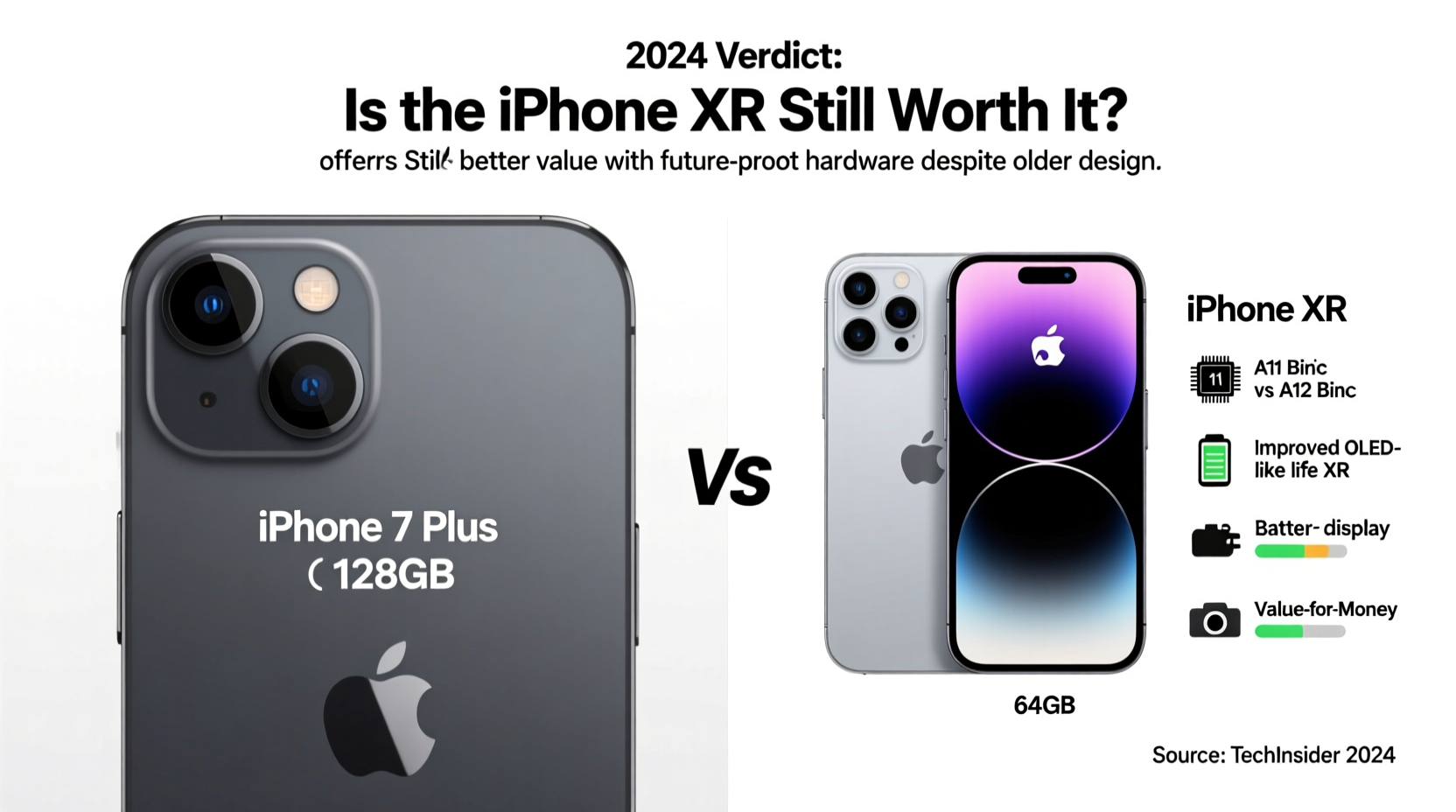
The most immediate difference between the two phones lies in their processors. The iPhone 7 Plus runs on the A10 Fusion chip, while the XR features the A12 Bionic—two full generations ahead. This may sound modest, but in real-world usage, the impact is significant. Apps launch faster, multitasking is smoother, and iOS updates are more reliably supported on the XR.
iOS 17, released in 2023, dropped support for all devices using the A10 chip and older. That means the iPhone 7 Plus is capped at iOS 16, missing out on critical security patches, new features like StandBy mode, improved autocorrect, and enhanced privacy tools. The iPhone XR, however, supports iOS 17 and is likely to receive iOS 18 in 2024, extending its functional lifespan by at least another year.
Display and Design: Modern Form Meets Function
The design language between these two phones reflects a major shift in Apple’s approach. The iPhone 7 Plus features a traditional 5.5-inch LCD screen with thick bezels and a physical home button. In contrast, the XR adopts the edge-to-edge Liquid Retina display (also LCD, but larger at 6.1 inches) with minimal bezels and Face ID.
While both use LCD technology, the XR’s screen is brighter, supports True Tone, and delivers better color accuracy. More importantly, the modern aspect ratio makes media consumption, web browsing, and navigation feel more immersive. The removal of the home button introduces gesture-based navigation, which takes a day or two to adjust to but ultimately streamlines interaction.
Build-wise, the XR uses aerospace-grade aluminum instead of the 7 Plus’s stainless steel, making it slightly lighter. It retains IP67 water resistance (same as the 7 Plus), so both can survive brief submersion, though neither is built for rugged use.
Camera Comparison: Evolution Over Revolution
The iPhone 7 Plus was one of the first iPhones to feature a dual-camera system—wide and telephoto lenses—enabling 2x optical zoom and Portrait Mode. By 2018, Apple had refined this formula significantly. The XR, despite having only a single 12MP wide lens, leverages the A12’s Neural Engine to simulate depth sensing and deliver Portrait Mode with impressive accuracy.
In daylight, both cameras produce sharp, well-balanced images. However, the XR pulls ahead in low-light conditions thanks to Smart HDR and better noise processing. Video recording also sees an upgrade: the XR supports 4K at 60fps across all resolutions, while the 7 Plus maxes out at 4K/30fps and lacks extended dynamic range for video.
| Feature | iPhone 7 Plus | iPhone XR |
|---|---|---|
| Rear Cameras | Dual: 12MP Wide + 12MP Telephoto | Single: 12MP Wide |
| Portrait Mode | Yes (dual-lens based) | Yes (software-enhanced) |
| Video Recording | 4K @ 30fps, 1080p @ 60fps | 4K @ 60fps, 1080p @ 240fps slo-mo |
| Front Camera | 7MP | 7MP with Portrait Mode |
| HDR Support | Basic HDR | Smart HDR (A12-powered) |
“Even with one lens, the XR’s computational photography closes the gap with dual-camera models in most real-world scenarios.” — David Kim, Mobile Imaging Analyst at TechPulse
Battery Life and Charging: Practical Gains
Battery degradation affects all aging phones, but assuming comparable battery health, the XR holds a clear advantage. Apple rated the XR for up to 16 hours of video playback; the 7 Plus managed about 13 hours. Real-world usage typically shows the XR lasting a full day with moderate to heavy use, whereas the 7 Plus often requires midday charging.
Both support Qi wireless charging, but the XR charges faster on compatible pads. Neither has fast charging out of the box (you’ll need a USB-C to Lightning cable and 18W+ adapter), but the XR responds better when upgraded. If you're still using the original 5W charger, switching to a higher-wattage setup will benefit the XR more noticeably.
Real Example: Sarah’s Upgrade Journey
Sarah used her iPhone 7 Plus for six years, relying on it for work emails, photo documentation, and daily communication. By late 2023, she noticed apps crashing, slow message syncing, and frequent overheating during video calls. After trading in her 7 Plus for a refurbished XR, she reported immediate improvements: FaceTime calls stayed stable, iMessage loaded group threads without lag, and her calendar syncs instantly. Most importantly, she regained confidence that her phone wouldn’t fail during client meetings.
She did miss the home button initially but adapted within a week. “It’s not flashy,” she said, “but everything just works again. I didn’t realize how much mental load came from managing a dying phone.”
Is the XR Still Worth It in 2024?
The answer depends on your expectations. If you’re seeking cutting-edge performance or plan to keep your phone beyond 2025, the XR isn’t future-proof. However, compared to the 7 Plus, it remains a practical upgrade for several reasons:
- Software Support: The XR receives updates likely through 2025; the 7 Plus does not.
- App Compatibility: Many newer apps optimize for iOS 17+, excluding older devices.
- User Experience: Smoother animations, quicker responses, and better multitasking reduce friction.
- Resale and Trade-in Value: Even secondhand, the XR holds more value than the 7 Plus.
Checklist: Before Upgrading from iPhone 7 Plus to XR
- Verify iOS version compatibility with your essential apps.
- Back up your 7 Plus via iCloud or iTunes before transferring data.
- Test the XR’s battery health if purchasing used.
- Familiarize yourself with gesture navigation (swipe up for home, swipe diagonally for Control Center).
- Enable Face ID securely and set up emergency contact.
- Transfer your Apple ID, subscriptions, and payment methods.
Frequently Asked Questions
Can the iPhone XR run iOS 18?
While not officially confirmed, historical patterns suggest the XR may receive iOS 18, as Apple typically supports devices for five major OS releases. Since the XR launched with iOS 12, iOS 18 would be its sixth—making inclusion uncertain but possible.
Is the lack of a headphone jack a dealbreaker?
Only if you refuse to use Bluetooth or Lightning headphones. The XR removes the 3.5mm jack, unlike the 7 Plus. While adapters exist, daily reliance on wired audio becomes inconvenient. Consider this carefully if you use wired earbuds frequently.
Should I wait for a newer model instead?
If budget allows, yes. An iPhone 11 or newer offers substantial gains in processor speed, camera quality, and longer software support. But if cost is a constraint, the XR still outperforms the 7 Plus meaningfully in 2024.
Final Verdict: Upgrade with Purpose
The iPhone XR is no longer a premium device, but next to the iPhone 7 Plus, it represents a legitimate step forward. It breathes new life into an outdated workflow, restores reliability, and reconnects you to the current iOS ecosystem. For users frustrated by slowdowns, update limitations, or app instability, the XR delivers noticeable improvements without demanding a flagship price.
Technology doesn’t have to be new to be useful—but it must remain functional. In that context, upgrading from a 2016 iPhone 7 Plus to a well-maintained 2018 XR isn’t just reasonable; it’s a smart move for anyone needing dependable performance without overextending financially.




 浙公网安备
33010002000092号
浙公网安备
33010002000092号 浙B2-20120091-4
Comments
No comments yet. Why don't you start the discussion?