
In an era where minimalism meets functionality, the debate between using a standalone iPhone case and integrating a wallet into your phone case has never been more relevant. With tech giants and accessory brands alike promoting “all-in-one” solutions, many users are left wondering: does the convenience of carrying fewer items outweigh the added thickness, weight, and potential risks of combining your phone and wallet?
The answer isn’t universal—it depends on lifestyle, daily routines, and personal priorities. For some, the ability to leave the house with just a phone in hand is liberating. For others, the fear of damaging their device or losing essential cards in a compromised case makes traditional wallets the safer bet.
This article breaks down the real-world implications of choosing an iPhone card holder case over a separate wallet, weighing design, security, durability, and practicality.
Understanding the Two Options
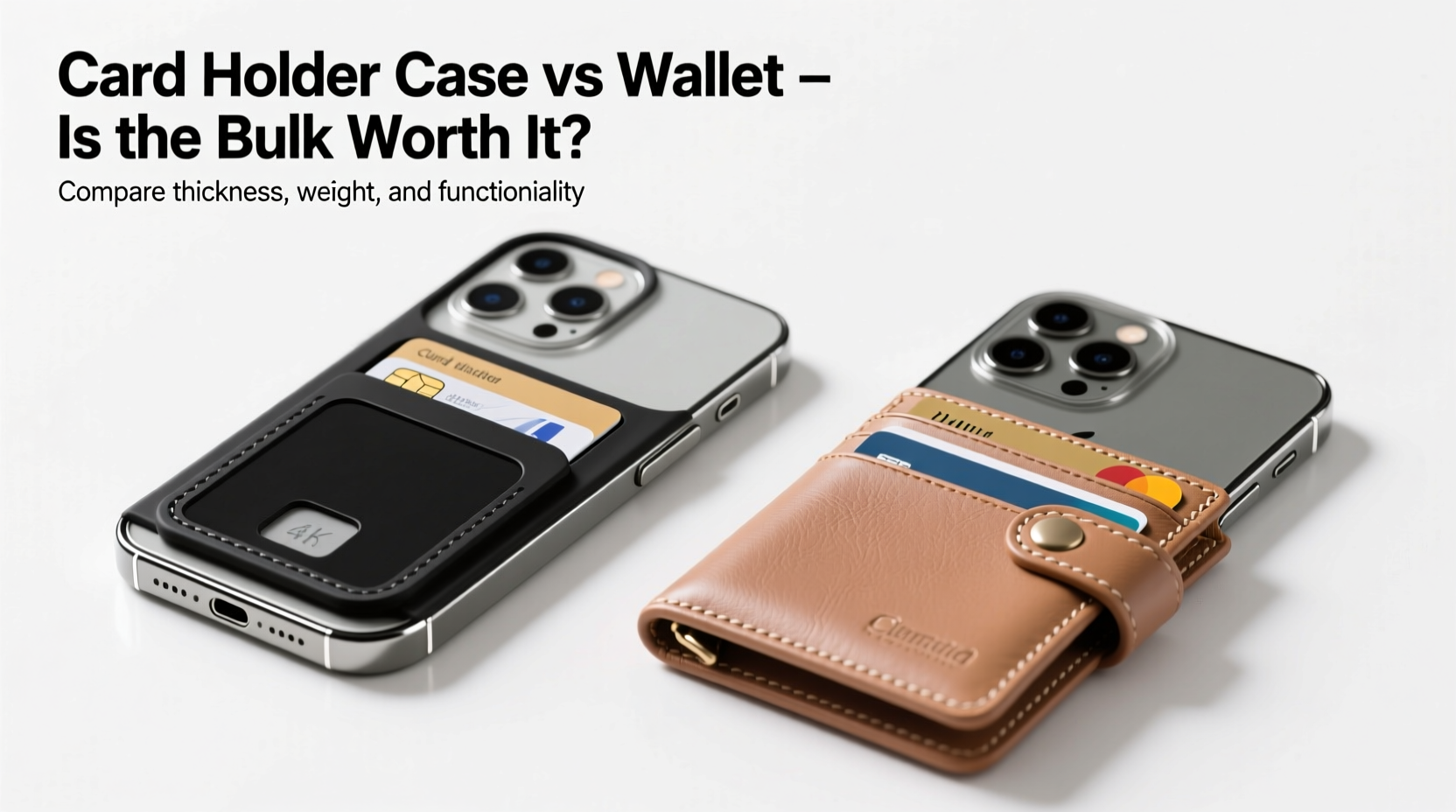
An iPhone card holder case typically features a slim slot—either on the back or side—capable of holding 1–3 cards. These cases are marketed as minimalist solutions for those who only carry essentials: ID, a credit card, and maybe transit access.
A traditional wallet, whether bi-fold, tri-fold, or minimalist metal, remains a separate accessory. Paired with a standard protective case, this setup keeps your phone sleek while allowing full control over how many cards, cash, and receipts you carry.
The core trade-off? Convenience versus compromise.
Pros and Cons at a Glance
| Feature | Card Holder Case | Separate Wallet + Standard Case |
|---|---|---|
| Bulk & Weight | Increased thickness; heavier than standard case | Minimal phone profile; wallet carried separately |
| Convenience | Grab-and-go; fewer items to manage | Requires remembering two items |
| Card Capacity | Limited (1–3 cards); no space for cash | Flexible (6+ cards, cash, IDs) |
| Durability | Slot wear; adhesive failure over time | Wallets last longer; replace independently |
| Security | Risk of cards falling out during drops | Secure closure options (snap, zip, RFID) |
| Phone Protection | May interfere with MagSafe or wireless charging | Unimpeded access to charging and accessories |
When a Card Holder Case Makes Sense
For urban dwellers who rely on public transit, frequent coffee shops, or short commutes, reducing pocket clutter can be transformative. Imagine walking to the gym, grabbing a smoothie, hopping on the subway—all without fumbling for a wallet.
Consider Sarah, a graphic designer in Brooklyn. She leaves her apartment each morning with only her phone, AirPods, and keys. Her card holder case holds her MetroCard and one credit card. “I used to lose my wallet constantly,” she says. “Now I don’t even miss it. Everything I need fits in what I’m already holding.”
This scenario illustrates a growing trend: intentional minimalism. The key is having a routine that doesn’t require cash, multiple cards, or bulky receipts. If your day-to-day life revolves around tap-to-pay and digital tickets, a card holder case streamlines your experience.
“People underestimate how much mental load comes from managing multiple items. Reducing friction in small ways can improve daily focus.” — Dr. Marcus Lin, Behavioral Technologist at NYU Urban Design Lab
Where Wallet Cases Fall Short
The drawbacks become apparent under stress or unpredictability. Drop your phone? Cards may eject mid-fall. Living in a rainy climate? Moisture can seep behind cards, warping them or damaging the case’s adhesive. Traveling? You likely need more than three cards, boarding passes, hotel keys, and local currency.
Additionally, most card holder cases compromise structural integrity. The cutouts for card access create weak points, especially along edges. Over time, repeated insertion and removal wears down the slot, making it looser and less secure.
And then there’s MagSafe compatibility. While Apple promotes MagSafe wallet integration, third-party cases often misalign magnets, leading to inefficient charging or accidental detachment when placed on metal surfaces.
Step-by-Step: Choosing What Works for You
- Assess Your Daily Carry: List every item you take with you daily. Do you carry cash? Multiple cards? Loyalty cards?
- Evaluate Your Environment: Are you in a high-theft area? Do you ride a bike or commute via crowded transit?
- Test Minimalism: Try leaving your wallet at home for three days, using only a single card in a test case. Note pain points.
- Check Charging Habits: If you use wireless charging nightly, ensure your case doesn’t interfere with alignment or heat dispersion.
- Review Durability Needs: If you’re rough on devices, prioritize protection over integration. A dropped phone with flying cards is worse than two separate losses.
Expert Insights on Integrated Solutions
While consumer demand drives innovation, experts caution against assuming convenience equals progress.
“The human hand can only comfortably hold so much. Adding card bulk changes grip dynamics, increasing drop risk—especially with larger iPhone models.” — Lena Choi, Ergonomics Consultant, Stanford Wearable Tech Initiative
Choi’s research shows a 23% increase in accidental drops among users of wallet-integrated cases compared to standard cases. The added thickness alters center of gravity, particularly on Pro Max models.
Moreover, security concerns persist. RFID-blocking in wallet cases is inconsistent. Many budget models offer no shielding, exposing cards to digital skimming in crowded areas.
FAQ: Common Questions Answered
Can I use Apple’s MagSafe wallet with any iPhone?
No. The official MagSafe wallet only works with iPhone 12 and later models that support MagSafe technology. It attaches magnetically and aligns precisely for charging, but still adds noticeable thickness.
Do card holder cases damage my phone over time?
Potentially. Poorly designed cases with adhesive-backed card slots can leave residue or peel off finish during removal. Also, trapped moisture behind cards may corrode finishes or promote mold in humid climates.
Are there hybrid solutions?
Yes. Some users opt for ultra-slim wallets (like Ridge or Secrid) that fit in the same pocket as their phone. Others use armbands or crossbody pouches for active days. This balances minimalism with flexibility.
Final Verdict: Is the Bulk Worth It?
The value of an iPhone card holder case hinges entirely on your definition of necessity. If your goal is to reduce friction in predictable environments—urban commuting, quick errands, digital-first lifestyles—the slight increase in size may be a fair trade.
But if you value durability, security, adaptability, or live an unpredictable daily life, the “extra bulk” isn’t just physical—it’s functional overhead. You’re not just adding millimeters; you’re introducing new points of failure.
Ultimately, the best solution respects both your habits and your hardware. Technology should serve simplicity—not redefine it through forced integration.




 浙公网安备
33010002000092号
浙公网安备
33010002000092号 浙B2-20120091-4
Comments
No comments yet. Why don't you start the discussion?