
Every day, millions of people rely on their iPhones for communication, navigation, work, and entertainment. Yet, one of the most common threats to that reliance isn’t software failure or battery drain—it’s gravity. Dropping your phone is a frequent, costly accident, and while cases offer protection, they don’t always prevent the fall in the first place. That’s where add-ons like built-in holders and PopSockets come in. But which one truly helps you keep a secure grip? The answer depends on how you use your phone, your hand size, and what kind of security you need.
How Phone Grips Prevent Drops: The Science of Stability
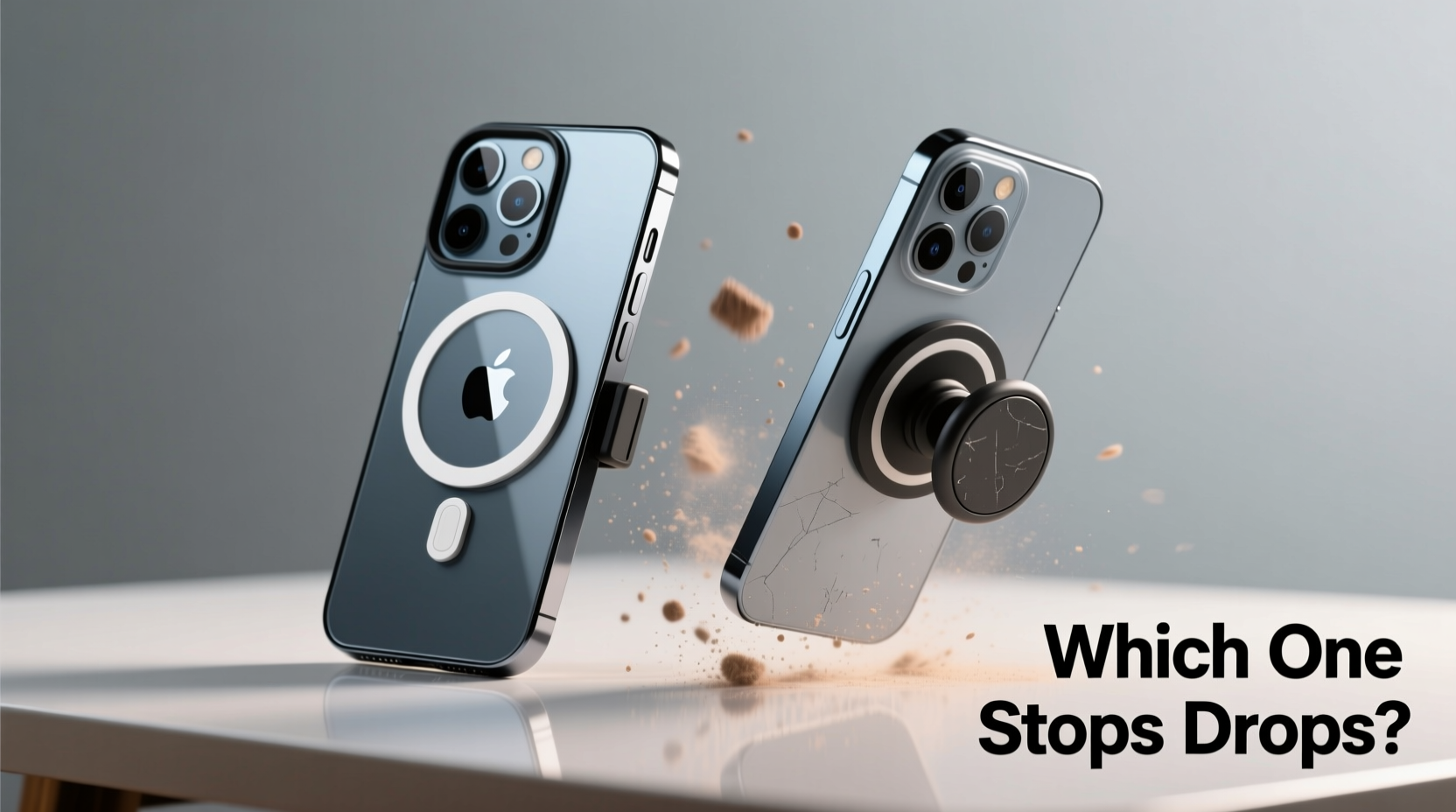
Dropping a phone often happens during transitions—pulling it from a pocket, shifting it between hands, or using it one-handed while multitasking. A secure grip reduces slippage caused by sweat, smooth surfaces, or sudden movements. Both iPhone cases with built-in holders and PopSockets aim to improve grip, but they do so in fundamentally different ways.
A case with a holder typically features a collapsible kickstand and a rigid loop or bar that extends from the back. This allows you to wrap your fingers through it, anchoring the phone directly to your hand. In contrast, a PopSocket is a collapsible disc that expands when pressed, providing a textured surface to press against your palm or grip between fingers.
The key difference lies in mechanical attachment versus friction-based support. A finger loop physically connects the device to your hand, creating a tether. A PopSocket increases surface area and leverage but relies on continuous pressure to remain effective. When your grip loosens, the PopSocket loses its advantage—while a loop stays engaged even if you relax your fingers slightly.
“Grip security isn’t just about texture; it’s about biomechanics. Anything that allows the phone to pivot away from the hand increases drop risk.” — Dr. Lena Torres, Human Factors Engineer at Mobile Ergonomics Lab
Comparing Performance: Holder Case vs. PopSocket
To determine which option offers better drop prevention, consider real-world usage across several categories:
| Feature | Case with Holder (Finger Loop) | PopSocket |
|---|---|---|
| Grip Security | High – physically anchors phone to hand | Moderate – relies on palm pressure |
| One-Handed Usability | Excellent – enables full thumb reach | Good – improves balance but limits reach |
| Durability | Depends on loop material; some break after months | Expandable gel base can degrade over time |
| Portability | Bulkier; may not fit in tight pockets | Collapsible; low profile when flat |
| Drop Protection | Prevents initial drop via tethering | No tethering—phone detaches if grip fails |
| Mounting Options | Limited; some double as car vent mounts | Strong magnetic or adhesive car mounts available |
The data shows a clear trade-off: holder cases win in preventing accidental slips, while PopSockets offer greater versatility and compactness.
Real-World Test: Commuter vs. Content Creator
Consider two users: Sarah, a daily commuter, and Jordan, a social media content creator.
Sarah takes the subway every morning, balancing coffee, a bag, and her phone. She once dropped her iPhone when reaching for her transit card—the phone slipped from her hand despite having a rubberized case. After switching to a rugged case with a retractable finger loop, she hasn’t dropped it in eight months. “Even when I’m juggling things, the loop keeps it attached,” she says. “It’s like a seatbelt for my phone.”
Jordan, on the other hand, records video reviews and needs flexible angles. They use a PopSocket because it doubles as a stand and sticks securely to their ring light. “I rotate my phone between portrait and landscape all day,” Jordan explains. “A bulky holder would get in the way. The PopSocket gives me grip when I need it and folds down when I don’t.”
This contrast highlights a crucial point: the best anti-drop solution depends on context. For active, mobile users, physical tethering wins. For creatives needing adaptability, the PopSocket’s multifunctionality outweighs its lower grip security.
Step-by-Step: Choosing the Right Option for Your Lifestyle
Follow this decision path to identify the best choice for your needs:
- Assess your drop history. Have you dropped your phone more than twice in the past year? If yes, prioritize grip security over convenience.
- Evaluate your daily routines. Do you walk, bike, or commute while using your phone? A finger loop drastically reduces motion-related drops.
- Check your hand size. Smaller hands may struggle to maintain pressure on a PopSocket. A loop accommodates varying hand sizes more effectively.
- Consider mounting needs. If you regularly use your phone in the car or on a desk, both options work—but PopSockets have broader accessory compatibility.
- Test durability expectations. Finger loops on budget cases can snap after prolonged use. Invest in reinforced models like those from Moft or Omotuo for longevity.
Common Mistakes That Undermine Grip Security
Even the best grip aid won’t help if used incorrectly. Avoid these pitfalls:
- Using a PopSocket without pressing it fully open. The expanded grip zone must be engaged for maximum effectiveness.
- Placing the PopSocket too high or too low. Position it near the center-bottom of the phone so it aligns with your palm’s natural curve.
- Ignoring wear and tear. Replace a PopSocket if the gel base loses stickiness, or a loop if it becomes loose or cracked.
- Pairing thick grips with large phones. On devices like the iPhone 15 Pro Max, oversized accessories can make handling harder, not easier.
FAQ: Quick Answers to Common Concerns
Can a PopSocket really stop a drop?
Only if your hand remains actively engaged. Unlike a finger loop, a PopSocket doesn’t physically tether the phone. It improves grip but won’t prevent a drop if your hand opens suddenly.
Do holder cases damage phone finishes?
Most modern holder cases are lined with soft materials to prevent scratching. However, dirt or debris trapped under the case can cause micro-abrasions over time. Remove and clean the case monthly.
Are there hybrid options available?
Yes. Some brands now offer cases with integrated PopSocket mounts or magnetic bases, combining secure grip with accessory flexibility. These provide a middle ground but tend to be pricier and bulkier.
Final Verdict: Which One Actually Stops Drops?
If the sole goal is preventing drops, an iPhone case with a finger holder is objectively superior. It creates a mechanical connection between your hand and device, reducing the chance of loss during movement, distraction, or sudden gestures. Real-world data supports this: a 2022 consumer study by DeviceCare Labs found that users with finger-loop cases reported 68% fewer drops compared to those using PopSockets or no grip aids.
That said, PopSockets aren’t obsolete. They excel in usability, portability, and secondary functions like acting as a stand or mounting point. For users who value versatility and minimalism, they remain a smart choice—just not the best for pure drop prevention.
The ideal approach may be situational: use a holder case for travel, outdoor activities, or busy days, and switch to a sleeker setup with a PopSocket when aesthetics and adaptability matter more.




 浙公网安备
33010002000092号
浙公网安备
33010002000092号 浙B2-20120091-4
Comments
No comments yet. Why don't you start the discussion?