
Choosing between the iPhone SE (2020) and the iPhone 13 Mini comes down to balancing budget, design preference, and long-term usability. Both phones represent Apple’s compact philosophy in different eras—one prioritizing affordability with flagship internals, the other offering full flagship features in a small body. With both models still available through carriers and resellers, understanding their real-world differences is crucial for making a smart purchase.
Design and Display: Size Isn’t Everything
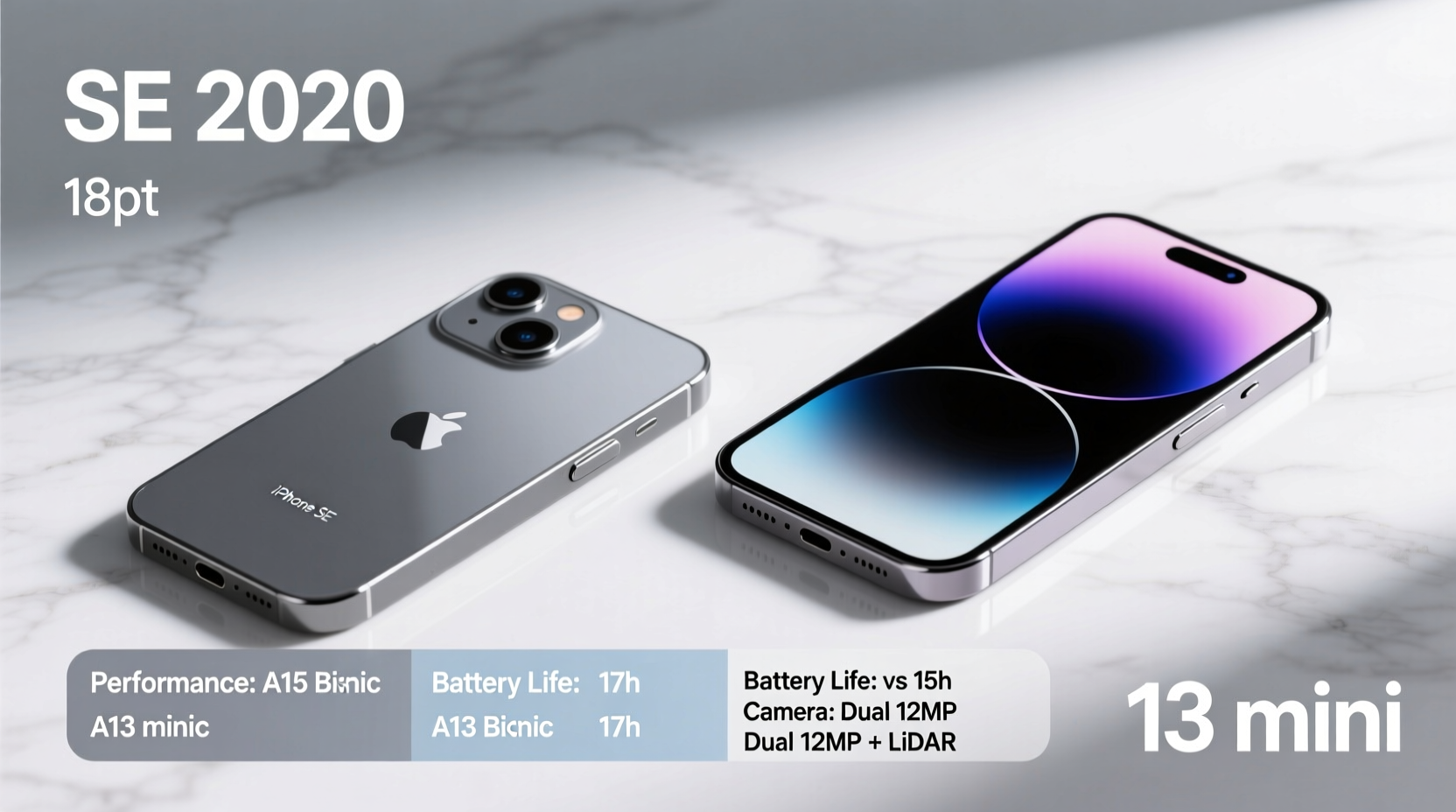
The most immediate difference lies in form factor and screen experience. The iPhone SE (2020) revives the classic iPhone 8 design: a 4.7-inch LCD display with thick bezels and a Home button with Touch ID. It’s compact, easy to use one-handed, and familiar to longtime iPhone users. However, the LCD panel lacks the brightness, color accuracy, and modernity of newer displays.
In contrast, the iPhone 13 Mini features a 5.4-inch Super Retina XDR OLED display. Though only slightly larger, the screen feels significantly more immersive thanks to edge-to-edge design, deeper blacks, and higher peak brightness. Face ID replaces Touch ID, requiring a swipe-up gesture to unlock—less intuitive for some but more secure and future-proof.
Performance: Flagship Chipsets, Different Generations
Under the hood, both phones pack impressive power for their size. The iPhone SE runs the A13 Bionic chip—the same processor found in the iPhone 11 series. For everyday tasks like browsing, messaging, and even moderate gaming, it remains more than capable in 2024.
The iPhone 13 Mini, however, uses the A15 Bionic chip, which delivers up to 50% faster CPU and GPU performance. This translates to smoother multitasking, better augmented reality experiences, and longer software support. Apple typically supports iPhones for five to six years, meaning the 13 Mini will likely receive iOS updates until 2028, compared to the SE (2020), which may see its final update around 2025.
“Performance isn’t just about speed today—it’s about longevity. The A15 ensures your phone stays responsive as apps grow more demanding.” — David Lin, Mobile Hardware Analyst at TechPulse
Camera Comparison: One Sensor, Two Experiences
On paper, both phones have single rear cameras, but the execution diverges sharply. The iPhone SE (2020) uses a 12MP f/1.8 wide sensor. It captures decent daylight photos but lacks Night mode on the front camera, Smart HDR 3, and Deep Fusion. Portrait mode is software-based and limited to people, often struggling with edge detection.
The 13 Mini improves every aspect. Its 12MP main sensor benefits from Sensor Shift stabilization, Night mode on all cameras, Photographic Styles, and Cinematic Mode for video. Front-facing selfies are sharper, and low-light performance is dramatically better. The A15’s image signal processor enables computational photography that the SE simply can’t match.
| Feature | iPhone SE (2020) | iPhone 13 Mini |
|---|---|---|
| Display | 4.7\" LCD, 750 nits | 5.4\" OLED, 1200 nits |
| Chipset | A13 Bionic | A15 Bionic (5-core GPU) |
| Rear Camera | 12MP f/1.8 (no Night mode) | 12MP f/1.6 + Night mode, Deep Fusion |
| Front Camera | 7MP, no Night mode | 12MP, Night mode, Smart HDR 4 |
| Battery Life | ~13 hours video playback | ~19 hours video playback |
| Storage Options | 64GB, 128GB, 256GB | 128GB, 256GB, 512GB |
| Water Resistance | IP67 (1m for 30 mins) | IP68 (6m for 30 mins) |
Battery and Charging: Real-World Endurance
Apple doesn’t publish official battery ratings, but real-world usage tells a clear story. The iPhone SE lasts about a full day with moderate use—around 10–12 hours of screen time. It charges via Lightning, supports 18W fast charging (with adapter sold separately), and Qi wireless charging.
The 13 Mini, despite its tiny frame, offers noticeably better endurance—up to 17–19 hours of mixed use. This is due to both a larger battery and the A15’s improved efficiency. It also supports faster wireless charging with MagSafe, though wired charging maxes out at 20W, similar to the SE.
Software Support and Future-Proofing
This is where the decision becomes strategic. The iPhone SE (2020) launched with iOS 13 and received updates through iOS 17. Given Apple’s typical 5-year support window, it may stop receiving updates by 2025. That means fewer new features, potential app incompatibility, and security risks over time.
The iPhone 13 Mini, released in 2021, is expected to support iOS updates until at least 2027–2028. This extended lifespan makes it a better investment if you plan to keep your phone for three years or more. Features like Dynamic Island (via software), enhanced privacy controls, and upcoming AI integrations will remain accessible longer on the 13 Mini.
Mini Case Study: Sarah’s Upgrade Dilemma
Sarah, a freelance designer, needed a reliable daily driver that fit in her pocket. She considered the SE (2020) due to its lower price but ultimately chose a refurbished 13 Mini. Her reasoning: she shoots client work on her phone, needs strong low-light performance, and values long-term software updates. After six months, she reported smoother app transitions, better video quality for client reels, and confidence that her phone won’t feel obsolete by 2026. The extra $150 upfront paid off in functionality and longevity.
Checklist: Which iPhone Should You Buy?
- Choose the iPhone SE (2020) if:
- You’re on a tight budget ($250–$350 range)
- You prefer Touch ID and physical Home button
- You don’t take many photos in low light
- You plan to upgrade within 2 years
- Choose the iPhone 13 Mini if:
- You want flagship performance and camera quality
- You value OLED display and Face ID
- You plan to keep the phone for 3+ years
- You shoot videos or need better battery life
Frequently Asked Questions
Is the iPhone 13 Mini still worth buying in 2024?
Yes, especially if you can find it refurbished or discounted. It delivers near-Pro-level performance and camera features in a rare small form factor. As long as you accept its shorter battery life compared to larger iPhones, it remains one of the best compact smartphones ever made.
Can the iPhone SE (2020) run iOS 17 smoothly?
Yes, but with limitations. Most core functions work well, but animations may feel less fluid, and some advanced features like Live Text or Visual Look Up are either absent or slower. Heavy multitasking or photo editing apps may struggle over time.
Does the 13 Mini have 5G?
Yes, both mmWave and sub-6GHz 5G are supported, whereas the SE (2020) only has LTE. This gives the 13 Mini faster download speeds and better future network compatibility.
Final Verdict: Value vs. Longevity
The iPhone SE (2020) is an excellent budget option. It proves that older hardware, when paired with iOS optimization, can still deliver a smooth user experience. But it’s a compromise device—smaller screen, weaker camera, and limited lifespan.
The iPhone 13 Mini costs more, but it’s not just “more phone”—it’s a complete flagship experience in miniature. From the vibrant OLED display to the advanced camera system and superior chipset, it outperforms the SE in every measurable way. And because it will stay supported longer, you’re not just buying specs—you’re buying time.
If you can stretch your budget, the 13 Mini is absolutely still worth it. But if you need a simple, affordable iPhone that does the basics well, the SE remains a solid fallback.




 浙公网安备
33010002000092号
浙公网安备
33010002000092号 浙B2-20120091-4
Comments
No comments yet. Why don't you start the discussion?