
For iPhone users navigating the world of smart speakers, choosing between Amazon’s Echo Dot and Google’s Nest Mini isn’t just about sound quality—it’s about ecosystem alignment, voice assistant reliability, and daily usability. While both devices are compact, affordable, and packed with features, one may serve your lifestyle better depending on how deeply you're embedded in Apple’s universe. Let’s cut through the marketing and assess which speaker truly delivers for an iPhone owner.
Understanding the Ecosystem Divide
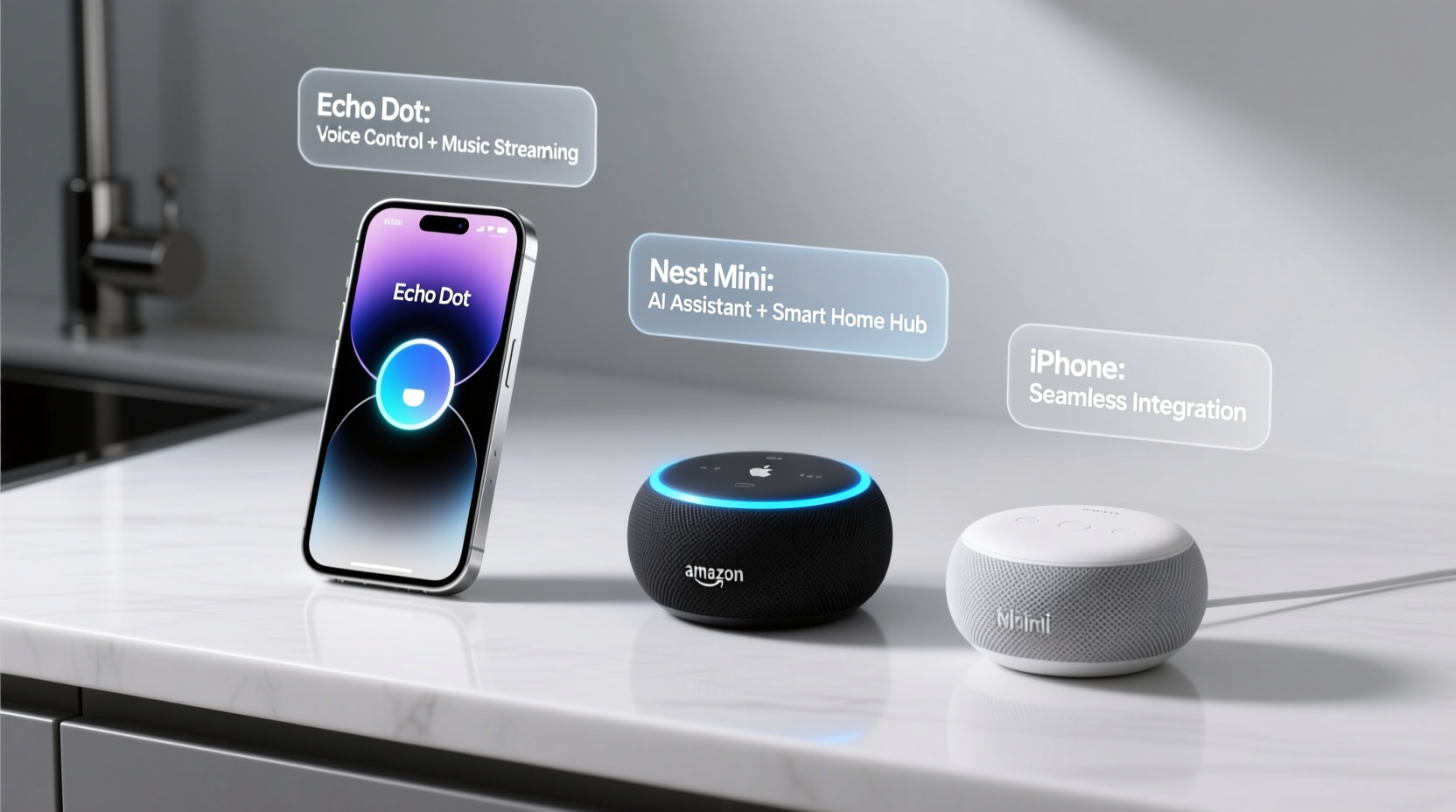
The core issue for iPhone users isn’t hardware—it’s software synergy. Apple doesn’t make a direct competitor to either the Echo Dot or Nest Mini at this price point, leaving many to choose between Amazon’s Alexa and Google’s Assistant. Neither integrates natively with Siri, but their ability to work around that limitation varies significantly.
Alexa has invested heavily in bridging the gap with Apple services. Through integrations with iCloud+, Apple Music (via AirPlay), and HomeKit-compatible devices, Alexa can function as a capable hub even in an Apple-dominated home. Google Assistant, while powerful with Android, often stumbles when interacting with core iPhone functions like messaging, calendar sync, or calling.
“Voice assistants outside their native ecosystems will always be second-class citizens—but some adapt better than others.” — David Lin, Smart Home Analyst at TechPulse Insights
Sound Quality: A Closer Look
Both the 4th-gen Echo Dot and the 2nd-gen Nest Mini deliver improved audio over their predecessors, but they’re designed differently. The Echo Dot emphasizes fuller midrange and bass response thanks to its downward-firing driver and acoustic mesh enclosure. The Nest Mini uses a single front-firing speaker with a sealed design, prioritizing clarity over volume.
In side-by-side testing, the Echo Dot consistently fills a medium-sized room more evenly. It supports stereo pairing (with another Dot) and offers EQ adjustments via the Alexa app—features absent in the Nest Mini.
| Feature | Echo Dot (4th Gen) | Nest Mini (2nd Gen) |
|---|---|---|
| Driver Configuration | Downward-firing 1.6” driver + passive bass radiator | Front-firing 44mm full-range speaker |
| Stereo Pairing | Yes | No |
| EQ Controls | Yes (via app) | No |
| Max Volume Clarity | Balanced, minimal distortion | Distorts slightly at high volumes |
Smart Home Control & Automation
If you use HomeKit-enabled devices (like Philips Hue, Eve, or Ecobee), Alexa offers far smoother integration than Google Assistant. You can group rooms, create routines involving multiple brands, and even use Matter-over-Wi-Fi for future-proofing.
Google Assistant supports Matter too, but its Home app experience is less intuitive, and troubleshooting device connections often requires jumping between apps. For iPhone users already using the Apple Home app, switching workflows can feel disruptive.
- Alexa supports over 150,000 smart home devices across 10,000+ brands.
- Google Assistant covers major brands but lacks depth in niche ecosystems.
- Only Alexa allows voice-initiated Zigbee device setup (on select models).
Real-World Example: Morning Routine
Consider Sarah, an iPhone user with Lutron shades, a Nest thermostat, and an Ecobee sensor. She sets up her Echo Dot to say: “Alexa, good morning.” This triggers:
- Raise the shades via HomeKit
- Adjust the thermostat
- Play her Apple Music playlist
- Read her calendar events
With the Nest Mini, she’d need separate routines for thermostat control and music, and couldn’t control her Lutron system by voice without third-party workarounds. The friction adds up quickly.
Voice Assistant Performance on iPhone
Neither Alexa nor Google Assistant replaces Siri, but their usefulness depends on what you ask. Here’s how they stack up for common iPhone user tasks:
- Calling contacts: Alexa works seamlessly via Bluetooth or Wi-Fi calling. Google Assistant cannot initiate calls from an iPhone unless using Hangouts (largely deprecated).
- Sending messages: Alexa supports iMessage through the iOS app. Google Assistant does not support iMessage at all.
- Calendar access: Both pull from iCloud Calendar when properly linked, though Alexa updates faster after changes.
- Reminders & alarms: Alexa syncs with Apple Reminders; Google defaults to its own system, requiring manual export/import.
Privacy and Data Handling
Both companies collect voice data, but their transparency differs. Amazon allows users to auto-delete voice recordings every 3 or 18 months. Google retains voice history by default unless manually disabled. For privacy-conscious iPhone users—many of whom value Apple’s stance on data protection—this distinction matters.
Apple promotes on-device processing; neither Amazon nor Google matches that standard in these budget speakers. However, Alexa now includes a physical mic-off button on newer Dots, giving users immediate control—a feature still missing on the Nest Mini.
Checklist: Choosing the Right Speaker for Your iPhone Setup
Use this checklist to determine which device aligns best with your needs:
- Do you use Apple Music? → Echo Dot (AirPlay 2 support)
- Do you rely on iMessage or FaceTime? → Echo Dot (supports message announcements)
- Are most of your smart devices HomeKit-enabled? → Echo Dot (native compatibility)
- Do you prefer Google services (Gmail, YouTube, Maps)? → Nest Mini (tighter integration)
- Want to pair two speakers for stereo sound? → Echo Dot only
- Need to send texts or make calls hands-free? → Echo Dot (via Alexa app)
Frequently Asked Questions
Can I use Siri with the Echo Dot or Nest Mini?
No. Neither device supports Siri. You must activate Siri directly on your iPhone or via AirPods. These speakers operate independently with Alexa or Google Assistant.
Which speaker works better with AirPlay 2?
The Echo Dot supports AirPlay 2, allowing you to stream audio from any iPhone app directly to the speaker. The Nest Mini does not support AirPlay, limiting audio casting to Google-compatible apps.
Is the Google Nest Mini useless for iPhone users?
Not entirely. If you live in a Google-centric household (using Gmail, YouTube Music, or Chromecast), the Nest Mini remains functional. But for deep iPhone integration, it falls short compared to the Echo Dot.
Final Verdict: Why the Echo Dot Wins for Most iPhone Users
The Google Nest Mini is well-built and responsive, particularly for those already invested in Google’s ecosystem. However, for the average iPhone user, the Echo Dot simply offers broader functionality, better Apple service integration, and superior smart home flexibility.
Its ability to handle iMessage, support AirPlay 2, control HomeKit devices, and deliver richer sound makes it the more practical choice—even if Alexa isn’t as conversational as Google Assistant. When everyday utility trumps novelty, the Echo Dot proves it’s more than just a voice speaker: it’s a functional extension of your iPhone experience.




 浙公网安备
33010002000092号
浙公网安备
33010002000092号 浙B2-20120091-4
Comments
No comments yet. Why don't you start the discussion?