
For millions of iPhone users clinging to their iPhone 7 Plus, the question isn’t just about specs—it’s about value. When your phone still powers through daily tasks and holds a charge reasonably well, is upgrading to an iPhone XR truly necessary? Or could the 7 Plus, with its familiar design and reliable performance, actually be the smarter long-term choice?
The iPhone 7 Plus launched in 2016 as Apple’s first dual-camera smartphone and quickly became a favorite for its balance of power, camera quality, and battery life. The iPhone XR followed in 2018 with a modernized design, Face ID, and Apple’s then-new A12 Bionic chip. On paper, the XR wins. But real-world usage tells a more nuanced story.
Design and Build: Familiarity vs. Modernity
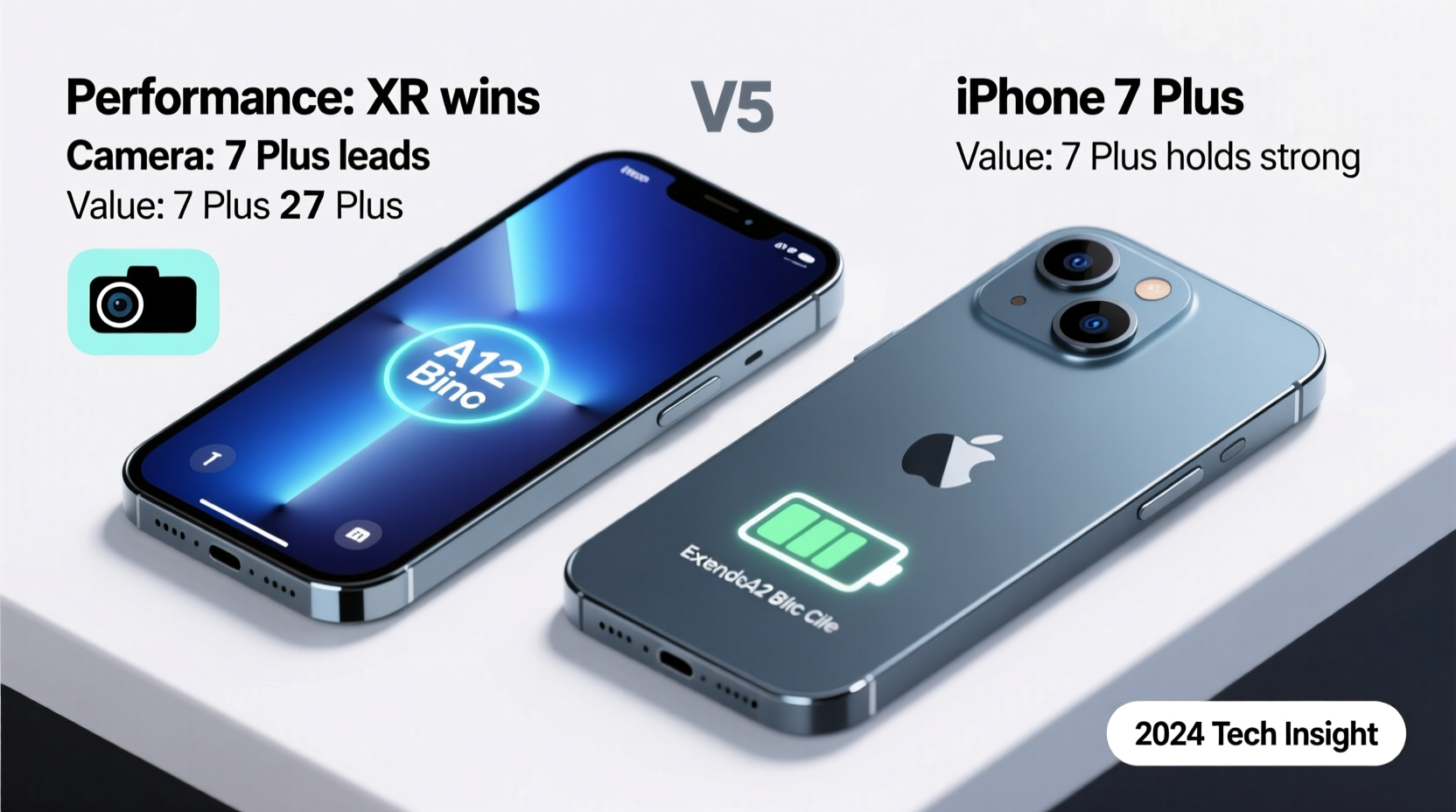
The iPhone 7 Plus features a classic aluminum body with physical Home button and Touch ID. It’s slightly heavier and thicker than the XR but feels sturdy in hand. Its 5.5-inch display uses LCD technology with a 1334x750 resolution, resulting in lower pixel density compared to newer models.
In contrast, the iPhone XR ditches the Home button for Face ID and introduces Apple’s “edge-to-edge” Liquid Retina display—a 6.1-inch LCD with a 1792x828 resolution. While not OLED, the screen offers better brightness, color accuracy, and overall immersion. The glass back enables wireless charging, a feature absent on the 7 Plus.
Performance and Software Longevity
Under the hood, the iPhone XR runs on the A12 Bionic chip, which outperforms the 7 Plus’s A10 Fusion by a wide margin. In everyday tasks like app switching, photo editing, and multitasking, the difference is noticeable. More importantly, software support favors the XR.
Apple typically supports iPhones for five to six years with iOS updates. The iPhone 7 Plus received its last major update with iOS 16, while the XR continues to run iOS 17 and is expected to get iOS 18. This extended support means better security, access to new features, and longer compatibility with apps.
“Even if your phone feels fast today, outdated hardware eventually hits a wall with new operating systems.” — David Kim, Mobile Analyst at TechPulse Insights
Camera Comparison: Portrait Mode and Low Light
Both phones have dual rear cameras, but their capabilities differ significantly. The 7 Plus introduced portrait mode using two 12MP sensors (wide and telephoto), allowing 2x optical zoom. However, edge detection in portrait mode was often inconsistent, especially around hair or glasses.
The iPhone XR, despite having only one 12MP wide lens, uses advanced software processing to simulate depth for portrait mode. Thanks to the A12’s Neural Engine, it delivers more accurate subject separation and better low-light performance. Its Smart HDR feature enhances dynamic range, preserving highlights and shadows in challenging lighting.
Front-facing cameras also favor the XR. Its 7MP TrueDepth camera enables Animoji, Memoji, and superior facial recognition, while the 7 Plus’s 7MP front shooter lacks depth sensing entirely.
Battery Life and Charging Options
Battery longevity is where the 7 Plus still earns respect. Despite its age, many units maintain strong battery health due to less aggressive background processes in older iOS versions. Real-world usage shows the 7 Plus lasting a full day with moderate use—even after several years.
The iPhone XR improves on this with larger capacity and optimized power management. Apple claims up to 16 hours of video playback, compared to the 7 Plus’s 13 hours. More importantly, the XR supports faster charging (with a compatible adapter) and wireless charging—two conveniences that enhance daily usability.
| Feature | iPhone 7 Plus | iPhone XR |
|---|---|---|
| Processor | A10 Fusion | A12 Bionic |
| Rear Cameras | Dual 12MP (Wide + Telephoto) | Single 12MP (Wide) with computational depth |
| Display | 5.5\" LCD (1334x750) | 6.1\" Liquid Retina LCD (1792x828) |
| Fingerprint/Face ID | Touch ID | Face ID |
| Charging | Lightsaber only | Wired + Wireless |
| iOS Support (as of 2024) | Up to iOS 16 | Supports iOS 17, likely iOS 18 |
| Battery Life (Video Playback) | Up to 13 hours | Up to 16 hours |
Real-World Example: Sarah’s Upgrade Dilemma
Sarah has used her iPhone 7 Plus since 2017. She takes photos of her kids, manages emails, and occasionally edits videos for her small bakery’s Instagram. Her phone works fine, but she’s noticed slower app launches and occasional crashes in newer versions of Instagram and TikTok.
She considered buying a used iPhone XR for $220. After testing one at a local reseller, she found the larger screen made video editing easier, Face ID worked reliably at home, and the camera produced noticeably brighter photos indoors. Most crucially, the phone ran iOS 17 without lag.
She upgraded—and hasn’t looked back. “It felt like my old phone had been running underwater,” she said. “The XR just *responds*.”
Step-by-Step: Should You Upgrade?
Follow this decision timeline if you're on the fence:
- Evaluate current performance: Are apps slow to open? Does the camera struggle in dim light? Do updates fail or cause instability?
- Check battery health: Go to Settings > Battery > Battery Health. If maximum capacity is below 80%, replacement cost may justify an upgrade.
- Test iOS compatibility: Can your device run the latest iOS version? If not, security and app functionality will degrade over time.
- Compare prices: Used iPhone XRs start around $180–$250. If your 7 Plus needs a battery ($49–$69), factor that into the total cost.
- Try before you buy: Visit a carrier store or resale shop to handle an XR. Test Face ID, screen size, and weight.
Is the 7 Plus Secretly Better?
In specific scenarios, yes. Users who prioritize physical buttons, dislike Face ID, or want the best possible battery replacement value may find the 7 Plus sufficient. Its headphone jack remains a bonus for wired earbud lovers, and the dual-lens system offers genuine optical zoom—a feature even some newer budget iPhones lack.
However, calling the 7 Plus \"better\" overlooks critical trade-offs. The absence of wireless charging, inferior water resistance (IP67 vs IP67 but improved sealing), and limited future-proofing make it a diminishing return investment. By 2025, many apps will likely drop support for devices unable to run iOS 17 or later.
FAQ
Can the iPhone 7 Plus still get security updates?
No. As of late 2023, Apple stopped signing security patches for iOS 16 on the 7 Plus. Devices no longer receiving updates are vulnerable to emerging threats.
Is the iPhone XR camera better than the 7 Plus in daylight?
Yes. While both capture good daylight photos, the XR’s Smart HDR produces more balanced exposures, especially in high-contrast scenes like beachfronts or sunlit windows.
Does the iPhone XR feel much bigger than the 7 Plus?
Marginally. Though the XR has a larger screen, its compact bezels make it nearly the same height as the 7 Plus. Many users adapt within a few days.
Conclusion: Time to Move Forward
The iPhone 7 Plus was a landmark device—one of Apple’s longest-serving flagships. But technology moves forward, and so should your expectations. The iPhone XR isn't just a modest upgrade; it's a meaningful leap in performance, software support, camera intelligence, and convenience features like wireless charging.
If your 7 Plus is showing signs of slowdown or battery decay, upgrading to an XR (or newer model) isn’t indulgence—it’s practical maintenance. For under $250, you gain years of smoother operation, better photos, and continued access to the latest apps and security updates.




 浙公网安备
33010002000092号
浙公网安备
33010002000092号 浙B2-20120091-4
Comments
No comments yet. Why don't you start the discussion?