
When choosing between the iPhone XR and the iPhone 8 Plus, buyers often face a dilemma rooted in trade-offs: modern design versus proven durability, newer processor versus larger screen, Face ID versus Touch ID. Both phones were released within a year of each other—iPhone 8 Plus in 2017, iPhone XR in 2018—but they represent two different philosophies in Apple’s smartphone evolution. Today, both are available at discounted prices, making them attractive options for budget-conscious consumers. But which one offers better long-term value in 2024?
The answer depends on what you prioritize: raw performance and software longevity, or physical convenience and familiarity. Let’s break down the key differences to determine whether the iPhone XR still holds its ground or if the iPhone 8 Plus remains the more practical choice.
Design and Display: Modern Minimalism vs Classic Functionality
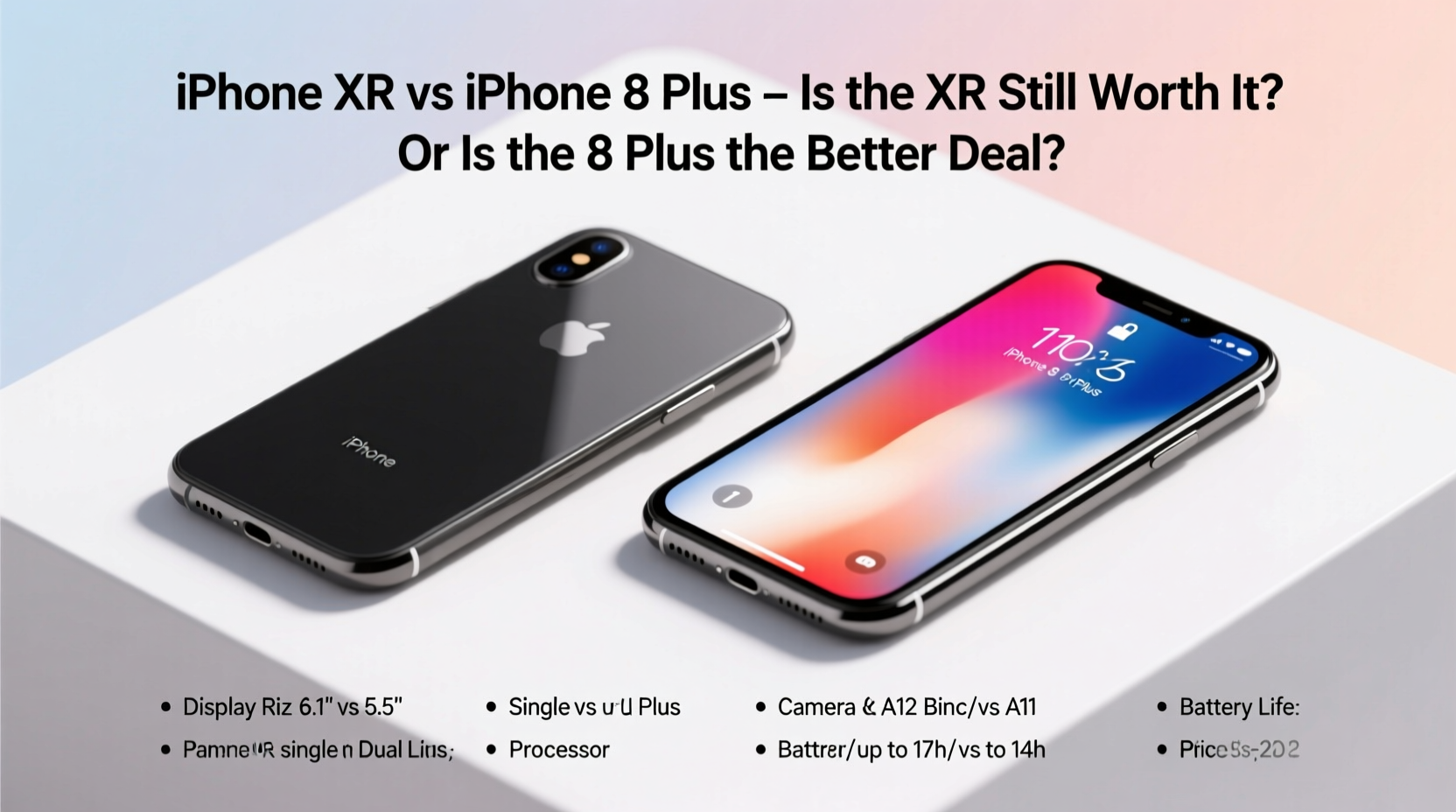
The most immediate difference lies in their design language. The iPhone XR features a nearly bezel-less 6.1-inch Liquid Retina LCD display with an edge-to-edge layout and Face ID integration. It embraces Apple’s post-Home-button era, offering a sleeker, more compact form despite its large screen. The aluminum frame and glass back give it a premium feel, though it's less rugged than the 8 Plus.
In contrast, the iPhone 8 Plus sticks with the traditional design introduced in 2014: thick top and bottom bezels, a physical Home button with Touch ID, and a slightly taller but wider body. Its 5.5-inch Retina HD display is smaller but uses a higher-resolution IPS LCD panel. While not as immersive, it remains sharp and color-accurate.
The XR’s design supports modern gestures—swipe up to go home, swipe down from the top-right for Control Center—which some users adapt to quickly, while others find disruptive. Meanwhile, the 8 Plus retains tactile feedback via the Home button, appealing to those who dislike facial recognition or wear masks frequently.
Performance and Software Longevity
This is where the iPhone XR pulls significantly ahead. Equipped with the A12 Bionic chip—the first 7nm processor in any smartphone at the time—it outperforms the iPhone 8 Plus’s A11 Bionic by roughly 15–20% in CPU tasks and up to 50% in graphics. More importantly, the A12 ensures longer software support.
As of 2024, both devices run iOS 17, but future updates are uncertain. Historically, iPhones receive about 5–6 years of OS updates. The iPhone 8 Plus (2017) is nearing the end of its lifecycle, while the iPhone XR (2018) has already surpassed that mark but continues to perform well under current system demands. Real-world usage shows the XR handles multitasking, AR apps, and modern games more smoothly.
“Even three years after release, the A12 Bionic remained competitive with mid-tier Android chips of its time.” — David Liu, Mobile Hardware Analyst at TechPulse Weekly
If you plan to keep your phone beyond 2025, the XR is far more likely to support iOS 18 or 19, assuming Apple follows its update pattern. For long-term ownership, this makes the XR the safer bet.
Camera Comparison: Single Lens vs Dual Cameras
The iPhone 8 Plus features a dual 12MP rear camera system: wide and telephoto lenses. This enables true 2x optical zoom and Portrait mode with depth control—a feature absent on the base iPhone XR at launch. However, the XR received Portrait Mode via software updates using its single 12MP wide lens and advanced machine learning.
In daylight, both cameras produce excellent results with accurate colors and dynamic range. The 8 Plus wins in versatility due to zoom capability, while the XR matches it in low-light performance thanks to Smart HDR and improved noise reduction algorithms enabled by the A12 chip.
For selfies, the XR’s TrueDepth front camera (7MP) supports Portrait Mode and Animoji, whereas the 8 Plus has a basic 7MP front shooter without depth-sensing capabilities.
| Feature | iPhone XR | iPhone 8 Plus |
|---|---|---|
| Rear Cameras | Single 12MP (Wide) | Dual 12MP (Wide + Telephoto) |
| Optical Zoom | No | 2x |
| Portrait Mode (Rear) | Yes (Software-based) | Yes (Dual-lens) |
| Front Camera | 7MP with Portrait Mode | 7MP, no Portrait Mode |
| Smart HDR | Yes | No |
While the 8 Plus technically has superior hardware flexibility, the XR leverages computational photography to close the gap. For most casual photographers, the difference is negligible unless zoom is essential.
Battery Life and Charging
Apple rated the iPhone XR with up to 1.5 hours more video playback than the 8 Plus. In real-world tests, the XR consistently lasts longer—around 11–13 hours of mixed use compared to 9–11 for the 8 Plus. This advantage comes from the efficiency of the A12 chip and slightly larger battery capacity (2942 mAh vs 2691 mAh).
Both phones support fast charging (with a compatible adapter), but neither includes one in the box. They also support Qi wireless charging, a feature absent in earlier iPhone models. If you use wireless charging pads or want maximum uptime between charges, the XR delivers better endurance.
Real-World Example: Choosing for Daily Use
Consider Maria, a teacher who needs a reliable phone for scanning documents, taking student photos, and staying connected during school hours. She values battery life and ease of use. Initially drawn to the 8 Plus for its larger buttons and Touch ID (which works even with gloves), she tested both models. After trying the XR, she appreciated the longer battery life and smoother app performance when editing videos for her classroom. Though she missed the physical Home button at first, she adapted within a week. Ultimately, she chose the XR for its modern interface and confidence in receiving future updates.
Her experience reflects a broader trend: users willing to adapt to gesture navigation often find the XR’s benefits outweigh the loss of Touch ID.
Checklist: Which iPhone Should You Buy?
- Choose the iPhone XR if:
- You want longer software support (iOS updates through 2025+)
- Better battery life is a priority
- You prefer Face ID and modern iOS gestures
- You take lots of selfies or use Animoji
- You play mobile games or use AR apps
- Choose the iPhone 8 Plus if:
- You prefer Touch ID over Face ID
- You need optical zoom for photography
- You're used to the older iOS navigation
- You find larger screens cumbersome but still want good visibility
- You’re buying secondhand and find a significantly lower price
Frequently Asked Questions
Can the iPhone XR last until 2026?
Possibly, but it depends on usage. With moderate use and iOS optimization, the XR can remain functional through 2025. Performance may degrade with heavier apps or future iOS versions, but for calls, messaging, and light browsing, it should suffice.
Is Touch ID better than Face ID?
It depends on context. Touch ID works with masks, gloves, and in bright sunlight. Face ID is faster in ideal conditions and enables features like Attention-aware Wake and Animoji. Security levels are comparable, but personal preference plays a big role.
Which phone has better resale value?
Currently, the iPhone XR holds slightly better resale value due to its newer chipset and longer expected support. However, both are depreciated significantly since release, so the difference is minimal unless the device is in pristine condition.
Final Verdict: Is the XR Still Worth It?
Yes—the iPhone XR remains the better overall choice in 2024. Despite lacking a second rear camera, its superior processor, longer battery life, and extended software support make it more future-proof. The transition to Face ID and gesture navigation may require adjustment, but these represent the direction of iOS going forward.
The iPhone 8 Plus still holds appeal for specific users—especially those who prioritize Touch ID or optical zoom—but its aging hardware limits longevity. Unless you find it at a dramatically lower price or have strong preferences for the classic design, the XR offers better value for money.
Technology evolves quickly, but smart choices endure. Whether you’re upgrading from an older iPhone or entering the ecosystem for the first time, prioritizing performance and update lifespan will serve you better than clinging to outdated conveniences.




 浙公网安备
33010002000092号
浙公网安备
33010002000092号 浙B2-20120091-4
Comments
No comments yet. Why don't you start the discussion?