
The iPhone 8 Plus and iPhone XS Max were released just a year apart—2017 and 2018—but they represent two distinct eras in Apple’s smartphone evolution. For users still holding onto an iPhone 8 Plus in 2024, the question isn’t just about nostalgia; it’s practical. Is upgrading to the XS Max—or even considering it over newer models—still a smart move today? The answer depends on your priorities: longevity, performance, camera quality, and software support.
While both devices are now several generations behind Apple’s latest lineup, many people continue using them daily. This analysis cuts through marketing hype and examines real-world value, helping you decide whether making the switch now makes sense—or if it's better to skip ahead to a newer model entirely.
Design and Display: A Shift in Philosophy
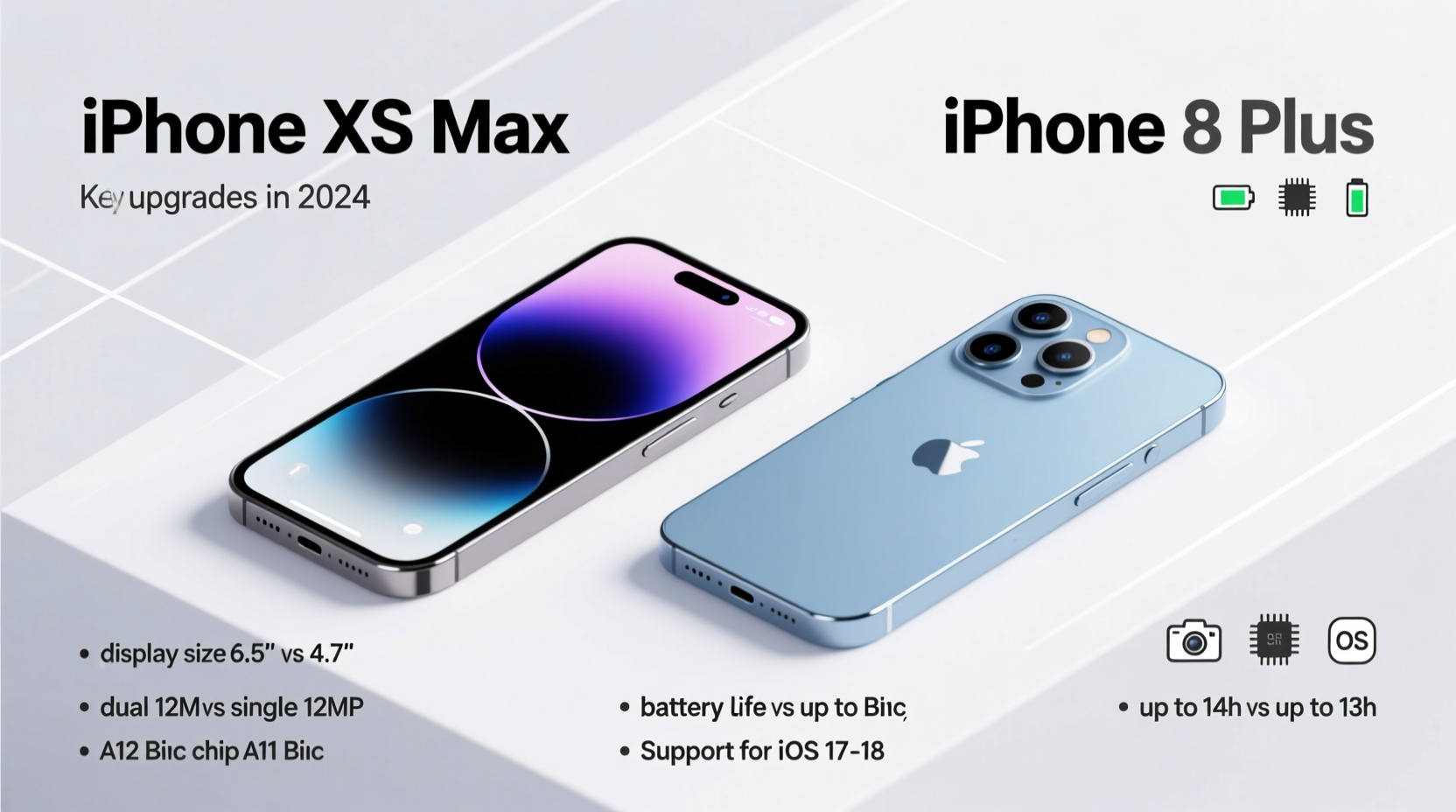
The most immediate difference between the iPhone 8 Plus and XS Max lies in their design language. The 8 Plus sticks with Apple’s pre-2018 formula: a thick bezel-heavy body, Touch ID home button, and a 5.5-inch LCD screen. In contrast, the XS Max introduced the modern iPhone look—edge-to-edge OLED display, Face ID, and slimmer profile—all in a larger 6.5-inch form factor.
The shift from LCD to OLED brings tangible benefits: deeper blacks, higher contrast ratios, and improved color accuracy. For media consumption or reading in low light, the XS Max’s display is objectively superior. Its resolution (2688×1242) also surpasses the 8 Plus (1920×1080), delivering sharper text and crisper images.
However, the removal of the home button means adapting to Face ID. While generally reliable, Face ID can struggle in low-light environments or when wearing masks—something not an issue with the tactile reliability of Touch ID on the 8 Plus.
Performance and Software Longevity
Under the hood, the gap widens significantly. The iPhone 8 Plus runs on the A11 Bionic chip, while the XS Max features the A12 Bionic—Apple’s first 7nm processor. Though only one generation apart, the A12 delivers roughly 15–20% faster CPU performance and up to 50% better graphics efficiency.
This difference becomes apparent in multitasking, app launch speed, and gaming. More importantly, software support favors the XS Max. Apple typically supports iPhones for five to six years post-release. The 8 Plus, released in September 2017, reached its last major iOS update with iOS 16 (with minor security updates continuing). The XS Max, launched in 2018, received updates up to iOS 17 and may see limited patches into 2025.
“Even small generational leaps in Apple’s silicon translate to extended usability. An extra year of iOS updates can be the difference between a usable phone and a sluggish one.” — David Lin, Mobile Technology Analyst at TechPulse Insights
If staying current with apps and security is important, the XS Max holds a clear edge. Most modern apps are optimized for devices with at least A12-level performance, meaning the 8 Plus may increasingly struggle with future updates.
Camera Comparison: Evolution Over Revolution
Both phones feature dual 12MP rear cameras (wide + telephoto), but the XS Max improves upon nearly every aspect of photography.
| Feature | iPhone 8 Plus | iPhone XS Max |
|---|---|---|
| Sensor Size | Smaller | Larger, improved light capture |
| Smart HDR | No | Yes – better dynamic range |
| Portrait Mode | People only | Enhanced depth control, works on objects |
| Low-Light Performance | Moderate noise | Cleaner, brighter night shots |
| Front Camera | 7MP | 7MP with Portrait Mode & better skin tones |
In real-world use, the XS Max produces more consistent results. Smart HDR balances highlights and shadows effectively, reducing blown-out skies or shadowy faces. Night mode, though officially absent on the XS Max, benefits from software enhancements that improve low-light clarity compared to the 8 Plus.
For casual photographers, the difference might seem subtle. But for those who share photos regularly or value image fidelity, the XS Max delivers visibly better output—especially in challenging lighting.
Real-World Example: Sarah’s Upgrade Dilemma
Sarah has used her iPhone 8 Plus since 2018. By 2023, she noticed apps like Instagram and Google Maps started crashing more often. Battery life dropped below 5 hours of screen time, and charging took longer due to wear. She considered upgrading but hesitated—was moving to the XS Max worth it?
After testing a used XS Max for a week, she found the larger screen made web browsing easier, Face ID worked well in most situations, and her favorite apps ran smoothly. Most importantly, iOS 17 felt responsive, whereas her 8 Plus struggled with iOS 16. She decided the upgrade was justified—not because the XS Max is cutting-edge, but because it restored reliability.
Sarah’s case reflects a common scenario: upgrading from an aging device isn’t about chasing innovation, but regaining functionality.
Battery Life and Charging: Practical Considerations
Despite having a smaller battery (3,174 mAh vs. 2,691 mAh), the XS Max often matches or exceeds the 8 Plus in real-world usage thanks to the power-efficient A12 chip and OLED display (which uses less power for dark content).
Additionally, the XS Max supports faster wired charging (with a compatible adapter) and Qi wireless charging at up to 7.5W—same as the 8 Plus. However, neither includes fast charging in the box, requiring a separate purchase of a USB-C adapter and cable.
- The 8 Plus charges fully in ~2 hours with standard 5W charger.
- The XS Max can reach 50% in 30 minutes with an 18W+ adapter (sold separately).
- Both degrade similarly after 2+ years of heavy use.
Is Upgrading Still Worth It in 2024?
The short answer: yes, but conditionally.
If you're currently using an iPhone 8 Plus and want a smoother experience with better display quality, camera performance, and another year or two of iOS updates, stepping up to a well-maintained XS Max is a logical move. It represents a meaningful improvement without jumping into the premium pricing of current Pro models.
However, consider this: the XS Max starts at around $200–$250 on the used market in 2024. For just $100–$150 more, you could get an iPhone 12 or 13, which offer 5G, significantly faster chips (A14/A15), MagSafe, and three to four years of guaranteed updates. These provide much better long-term value.
Upgrade Checklist: What to Evaluate Before Deciding
- Current Device Condition: Does your 8 Plus have battery issues, screen cracks, or frequent crashes?
- iOS Support Needs: Do you rely on up-to-date apps and security patches?
- Budget: Can you stretch to a newer model, or is sub-$250 your limit?
- Preference for Features: Do you want Face ID, larger screen, or better cameras?
- Future Plans: Will you upgrade again within 1–2 years?
If most answers lean toward needing reliability and modern performance, skipping the XS Max and aiming for an iPhone 11 or later may be smarter. But if budget is tight and you need *something* better than the 8 Plus, the XS Max remains a competent, albeit aging, option.
Frequently Asked Questions
Can the iPhone XS Max run iOS 17 smoothly?
Yes. While not as fast as newer models, the XS Max handles iOS 17 well for everyday tasks like messaging, browsing, and social media. Heavy multitasking or intensive games may show slight lag.
Is the iPhone 8 Plus obsolete in 2024?
Not entirely. It still functions for calls, texts, and basic apps. However, lack of recent updates, declining app compatibility, and degraded batteries make it impractical as a primary device for most users.
Should I buy the XS Max or save for a newer iPhone?
If you can wait and save, go for an iPhone 12 or newer. You’ll gain years of support, better performance, and modern features. But if you need a capable phone immediately on a tight budget, a refurbished XS Max is a reasonable stopgap.
Final Thoughts
The iPhone XS Max was a transitional flagship—a bridge between the home-button era and today’s all-screen designs. For someone still using an 8 Plus, upgrading to it in 2024 offers real improvements: a superior display, better camera, and extended software life. But it’s not a future-proof investment.
Technology moves fast, and Apple’s ecosystem rewards staying relatively current. If your goal is simply to escape the limitations of the 8 Plus, the XS Max will deliver. But if you’re looking to maximize value and avoid another upgrade soon, putting in a little extra effort—and budget—toward a newer model will serve you far better in the long run.




 浙公网安备
33010002000092号
浙公网安备
33010002000092号 浙B2-20120091-4
Comments
No comments yet. Why don't you start the discussion?