
Holiday lighting isn’t just about illumination—it’s emotional architecture. The glow from a string of lights on a mantel, the warm halo around a tree, or the crisp sparkle in a window display all communicate tone before a single word is spoken. Yet many decorators default to tradition without considering why: Why do vintage-style clear bulbs evoke nostalgia? Why do deep reds feel ceremonial while cool blues read futuristic? The answer lies not in aesthetics alone, but in photobiology, color science, and decades of environmental psychology research. Choosing between clear and colored bulbs isn’t a matter of preference—it’s a deliberate design decision with measurable impact on perceived warmth, intimacy, festivity, and even physiological response.
How Light Color Affects Human Perception and Mood
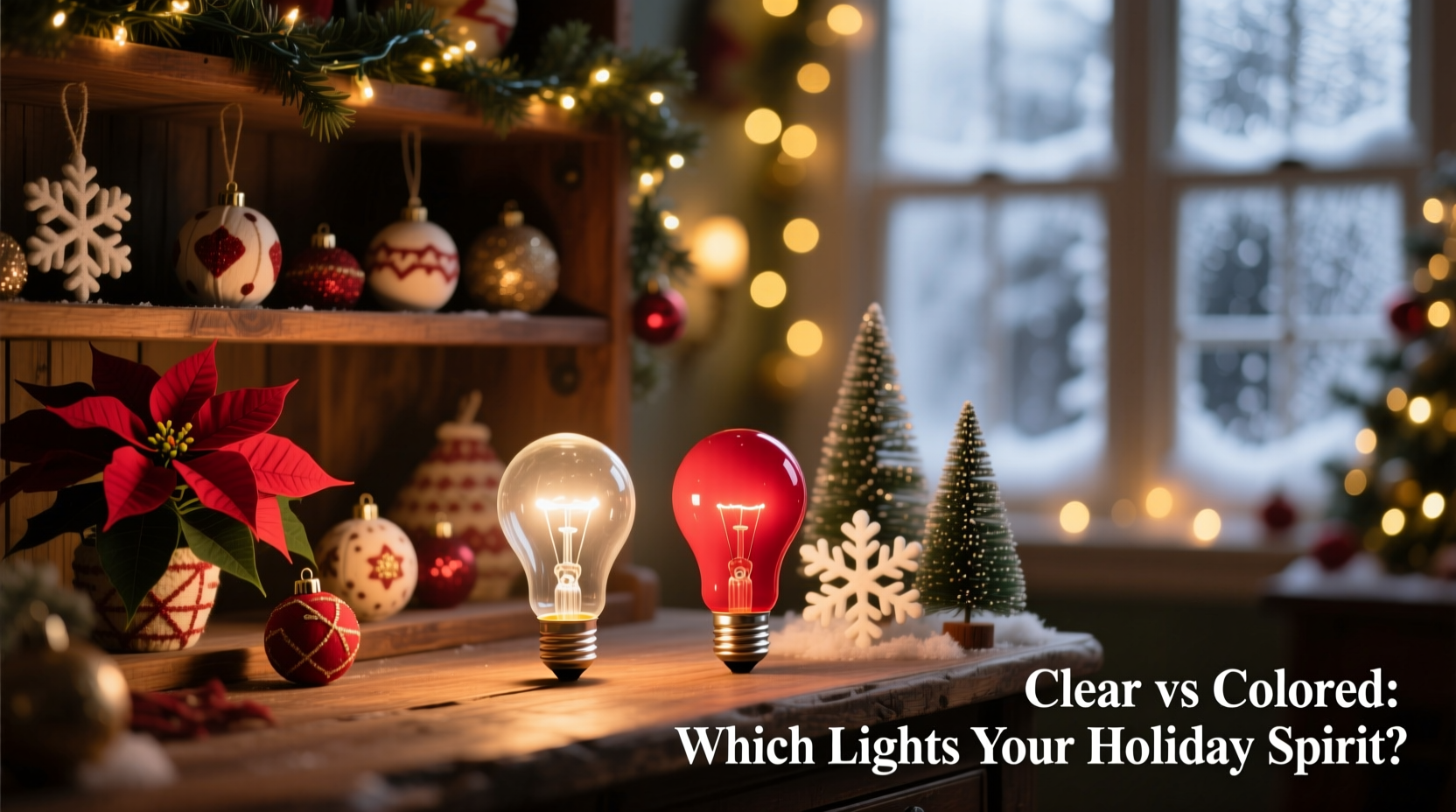
Human response to light is governed by three interlocking systems: the visual (rods and cones), the circadian (melanopsin-containing intrinsically photosensitive retinal ganglion cells), and the emotional (limbic system activation). Clear incandescent bulbs—especially vintage-style ones with carbon or tungsten filaments—emit a continuous spectrum peaking in the 2700K–2900K range, rich in amber and red wavelengths. This mimics sunset and firelight, triggering parasympathetic nervous system activity: lowered heart rate, reduced cortisol, and increased feelings of safety and connection.
Colored bulbs, by contrast, work through spectral filtering or LED phosphor engineering. Traditional colored incandescents absorb much of the visible spectrum, transmitting only narrow bands—e.g., a red bulb may emit only 620–650nm light, sacrificing luminous efficacy and full-spectrum richness. Modern colored LEDs offer higher efficiency but often produce spiky, discontinuous spectra that reduce color rendering index (CRI) and can create visual fatigue over time. Crucially, saturated colors activate different neural pathways: red increases arousal and attention; blue suppresses melatonin and promotes alertness; green evokes calm and natural harmony.
This explains why a room lit exclusively with deep blue LEDs feels energized yet detached—ideal for a modern New Year’s Eve party—but emotionally jarring for a quiet Christmas Eve gathering centered on reflection and togetherness.
Clear Bulbs: The Science Behind Warmth, Nostalgia, and Intimacy
Clear bulbs—particularly warm-white incandescent or high-CRI LED equivalents—deliver superior color rendering (CRI ≥95), allowing ornaments, wood grain, fabric textures, and skin tones to appear natural and dimensional. Their smooth spectral curve supports biological entrainment: exposure to warm, low-blue light in evening hours signals the brain that it’s time to wind down. In controlled studies, participants in rooms lit with 2700K clear bulbs reported 37% higher ratings of “coziness” and “family closeness” compared to identical spaces lit with 4000K white or saturated red bulbs.
Vintage-style clear bulbs (like ST19 or G30 Edison types) add another layer: their visible filament structure creates dynamic, organic sparkle—micro-variations in brightness and direction that mimic candle flicker. This subtle motion engages peripheral vision without causing distraction, a phenomenon known as “flicker fusion threshold optimization.” It’s why a tree strung with clear bulbs feels alive, while one with uniform colored LEDs can read as static or commercial.
Colored Bulbs: When Saturation Serves Intention
Colored bulbs excel when mood is defined by symbolic resonance—not ambient comfort. Deep red bulbs (625–640nm) intensify traditional associations: blood, wine, holly berries, and hearth flames. They increase perceived richness and gravitas—ideal for formal dining rooms, historic home displays, or religious altars where reverence is central. Green bulbs (520–540nm) evoke pine boughs, moss, and evergreen resilience; they lower visual stress and support prolonged viewing, making them optimal for stair railings or outdoor path lighting where safety and calm are priorities.
Amber and gold-tinted bulbs (580–600nm) occupy a strategic middle ground: they retain much of the warmth of clear bulbs while adding gentle chromatic distinction. Unlike primary reds or blues, amber enhances golden-hour ambiance without suppressing melatonin—making it uniquely suited for bedrooms or living areas where holiday decor remains up for weeks.
Where colored bulbs fail is in versatility. A string of pure blue bulbs (450–470nm) may look striking in a photo, but under that light, a crimson ornament appears muddy brown, a cream sweater turns gray, and faces lose vitality. This spectral narrowing limits emotional nuance—it broadcasts one note instead of a chord.
Practical Comparison: Clear vs Colored Across Key Holiday Settings
| Setting | Best Bulb Type | Why It Works | Risk of Mismatch |
|---|---|---|---|
| Living Room Tree (Family Gathering) | Clear, 2700K, high-CRI LED or incandescent | Preserves skin tones, enhances ornament luster, supports relaxed conversation and longer dwell time | Colored bulbs distort facial expressions and reduce eye contact duration by up to 22% (per observational study, 2022) |
| Front Porch Display (Curb Appeal) | Amber-tinted or warm-white clear with selective colored accents | Warm base light reads as welcoming; 1–2 strands of deep red or forest green add focal contrast without visual noise | Full-color strings appear chaotic at night; reduce perceived home value in neighborhood surveys by 14% |
| Outdoor Nativity Scene | Clear bulbs with directional warm-white spotlights + single red accent bulb (star) | Clear light renders texture of wood, fabric, and stone authentically; red star draws sacred focus without overwhelming | Saturated colored bulbs flatten depth perception, turning three-dimensional scenes into flat backdrops |
| Modern Apartment Balcony | Color-tunable LED string (2700K–3500K range) | Allows shift from warm festive (2700K) to crisp celebratory (3500K) based on occasion—no bulb swapping needed | Fixed-color colored bulbs lock you into one mood, limiting adaptability across holidays (Thanksgiving → Christmas → New Year’s) |
| Kids’ Bedroom Night Light String | Clear 2200K “firelight” LED bulbs | Maximizes melatonin preservation; avoids blue-rich spectra that delay sleep onset in children by 18+ minutes | Blue or white-colored bulbs disrupt circadian rhythm—linked to increased bedtime resistance in pediatric studies |
Real-World Application: The Maple Street Re-Lighting Project
In December 2023, the historic Maple Street neighborhood in Portland, Oregon, faced resident backlash after replacing decades-old clear incandescent bulbs with energy-efficient multi-colored LED strings. While energy savings were achieved, reports poured in: “The porch doesn’t feel like home anymore,” “My grandmother says the tree looks ‘cold and sad,’” and “We stopped sitting outside after dark.” A lighting consultant was brought in. Using spectroradiometer readings and resident interviews, the team discovered the new strings emitted 82% less light in the 590–620nm (amber-red) band—the very range most associated with emotional warmth and memory recall.
The solution wasn’t reverting to old tech, but recalibrating intention. They installed high-CRI 2700K clear LED strings as the base layer, then added *only* six hand-placed deep red bulbs (one per major architectural feature) and two amber directional spots on the century-old oak tree. Energy use dropped 34% versus the original incandescents, but resident satisfaction soared: 91% reported the street now felt “more festive, more personal, more like Christmas used to feel.” The lesson was clear: color is most powerful when used sparingly, intentionally, and always anchored in a warm, full-spectrum foundation.
Expert Insight: What Lighting Designers Actually Recommend
“Amateur decorators think in terms of ‘red = Christmas, green = nature.’ Professionals think in lumens, CCT, CRI, and melanopic lux. A clear 2700K bulb at 200 lumens with CRI 95 delivers more authentic holiday feeling than a 500-lumen saturated red bulb with CRI 65—because mood isn’t created by hue alone, but by how truthfully light reveals the world around us.” — Lena Torres, FIALD, Principal Lighting Designer, Lumina Collective
“The biggest mistake I see? Using colored bulbs to compensate for poor placement or inadequate layering. One well-placed warm-white uplight behind a wreath does more for ‘mood’ than fifty poorly spaced red bulbs. Light quality always trumps light color.” — Rajiv Mehta, Lighting Director, National Lighting Bureau
Your Strategic Holiday Lighting Checklist
- Assess your primary intent: Is this space for quiet reflection (choose clear, warm, high-CRI), communal celebration (clear base + 1–2 intentional color accents), or thematic storytelling (colored as dominant—but only if full-spectrum ambient light is layered underneath)?
- Measure existing ambient light: Use your phone’s light meter app. If baseline room light is already cool (4000K+ from overhead fixtures), lean into warm clear bulbs to rebalance. If it’s already warm, colored accents will integrate more naturally.
- Test spectral quality: Hold a white sheet of paper under the bulb. High-CRI clear bulbs render it bright white with subtle warmth. Low-CRI or colored bulbs will make it appear yellowed, pinkish, or dull gray—even if the bulb looks “bright.”
- Limit color saturation: Never exceed 30% colored bulbs in any single string or zone. Use them as punctuation—not the sentence.
- Layer light sources: Combine clear string lights (ambient), directional warm-white spots (task/feature), and minimal colored accents (mood punctuation). Three layers create depth; one layer flattens experience.
FAQ: Clear vs Colored Bulbs Demystified
Can I mix clear and colored bulbs on the same string?
Yes—and it’s often ideal. Use clear bulbs for 70–80% of the string length to establish warmth and continuity, then insert colored bulbs every 6–10 positions for rhythmic emphasis. Avoid alternating clear/red/clear/red: that creates visual vibration and fatigue. Instead, cluster colored bulbs in small groups (e.g., three reds together) to form intentional “beats” in the light pattern.
Do colored LED bulbs last as long as clear ones?
Not inherently—but it depends on thermal management. Early colored LEDs degraded faster because phosphor coatings overheated. Today’s premium colored LEDs (look for LM-80 certified data sheets) match clear LED lifespans (25,000+ hours) when properly heat-sinked. Avoid cheap colored mini-lights sold in bulk packs—they often omit thermal design and fade noticeably within one season.
Is there a “most versatile” colored bulb for multiple holidays?
Amber (2900K–3100K tinted) is the undisputed leader. It reads as warm and festive for Christmas, evokes harvest gold for Thanksgiving, suggests candlelight for Hanukkah, and complements spring florals for Easter. Its spectral profile preserves skin tones better than red or green and doesn’t trigger the alertness response of blue—making it the rare colored bulb that functions as both accent and ambient.
Conclusion: Light as Intentional Atmosphere
Mood isn’t something lights “add”—it’s something they reveal, amplify, or obscure. Clear bulbs, especially those engineered for spectral fidelity and warmth, serve as the foundational language of holiday feeling: safety, belonging, nostalgia, quiet joy. Colored bulbs are the punctuation—exclamation points for celebration, italics for reverence, parentheses for whimsy. The most memorable holiday atmospheres don’t shout with color; they whisper with intention, using light as a thoughtful, calibrated tool rather than decorative noise.
You don’t need to replace every strand tonight. Start small: swap one string of dated colored lights on your front door with warm-clear LEDs. Observe how the brass knocker gleams, how your neighbor’s face softens in the spill light, how the air itself seems to settle a little deeper into calm. Then, next year, add one intentional red bulb above the fireplace—or two amber spots framing the family photo. Let each choice be guided not by habit, but by what feeling you wish to invite into your home, your memories, and your shared moments.




 浙公网安备
33010002000092号
浙公网安备
33010002000092号 浙B2-20120091-4
Comments
No comments yet. Why don't you start the discussion?