
When it comes to artificial Christmas trees, one of the most important decisions isn’t just about height or fullness—it’s about how the tree goes together and comes apart. At the heart of this decision lies the base: fixed or detachable. While both types have their loyal users, an increasing number of homeowners are turning to models with detachable bases for greater convenience. But is the switch truly worth it? The answer depends on your space, lifestyle, and long-term holiday plans. This article breaks down the real-world differences between detachable and fixed tree bases, examining ease of storage, setup time, durability, and overall user experience.
Understanding Tree Base Types
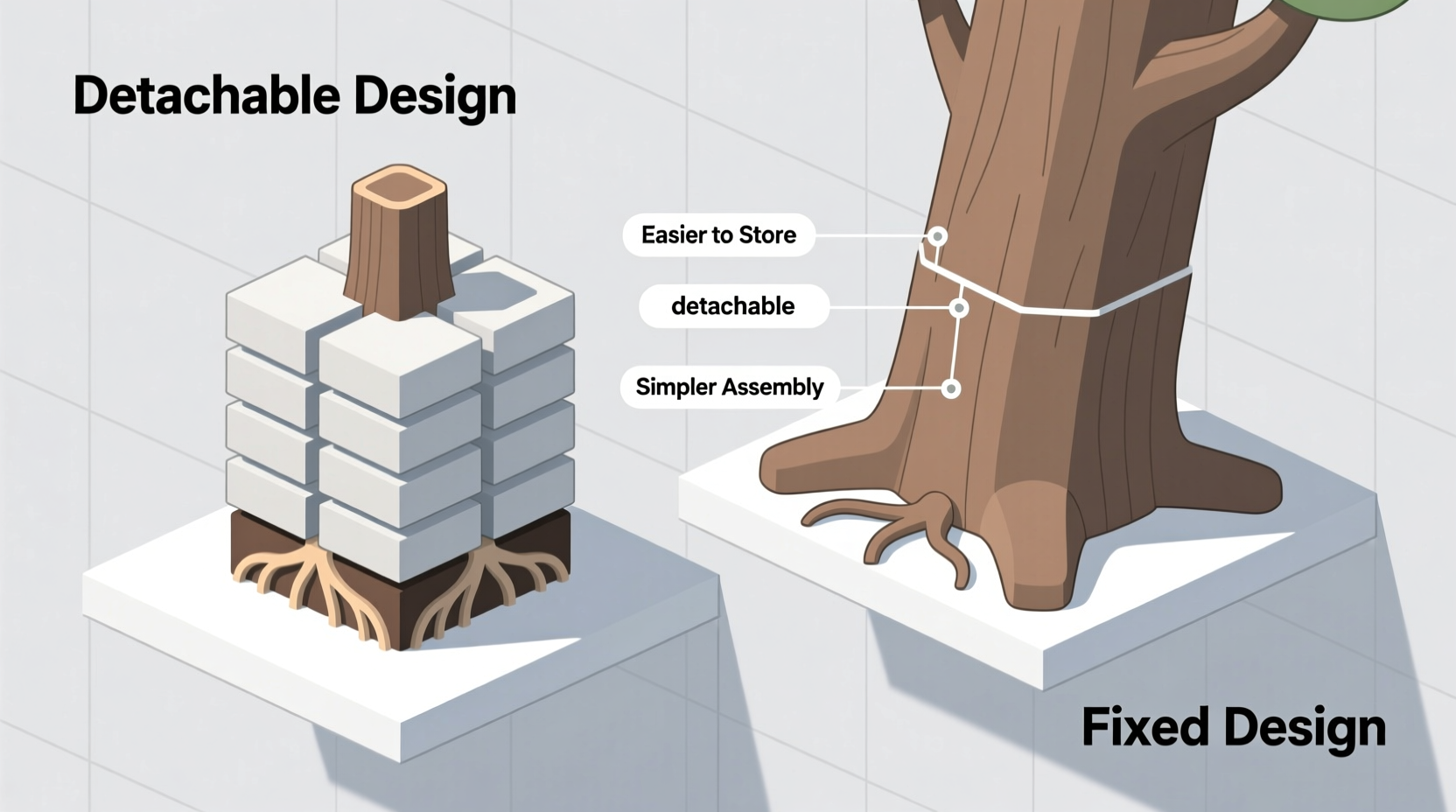
The base of an artificial Christmas tree serves two primary functions: stability and structural support. Fixed bases are permanently attached to the central pole of the tree and cannot be removed without tools or modification. Detachable bases, as the name suggests, can be unscrewed, unclamped, or otherwise separated from the trunk section after use.
Fixed models typically feature a single-piece construction where the stand and center pole are fused. These are common in lower-priced trees and often found in pre-lit designs. Detachable versions usually involve a threaded rod or quick-release pin system that allows the base to be disengaged once the tree is disassembled.
The choice between them affects more than just initial setup—it influences how you store the tree, how much space it consumes off-season, and how quickly you can decorate year after year.
Storage Efficiency: Space-Saving Advantages of Detachable Bases
One of the most compelling arguments for choosing a detachable base is its impact on storage. Artificial trees already require substantial space when broken down into sections, but adding a bulky fixed base increases the footprint—sometimes by up to 30%.
A fixed base remains part of the longest component—the center pole—which must be stored horizontally. In contrast, a detachable base can be stored separately, often vertically or stacked inside another container, freeing up valuable closet, attic, or garage space.
Consider a typical 7.5-foot tree with a 21-inch diameter metal base. When attached, the pole-and-base unit may measure over 8 feet long including hardware. Removing the base shortens the main pole by nearly a foot, making it easier to fit into standard tree bags or upright storage bins.
“Homeowners with limited vertical storage benefit most from modular components. Separating the base cuts down on awkward lengths and improves stacking efficiency.” — Laura Nguyen, Home Organization Consultant
Real-World Example: Urban Apartment Living
Take Sarah, a resident of a Chicago high-rise with only a narrow hall closet available for seasonal items. Each year, her old 8-foot tree with a fixed base required disassembly into three large sections. The longest piece—the pole with attached stand—wouldn’t fit in any of her existing storage bins. She ended up wrapping it in a blanket and leaning it behind the couch until next season, risking damage and dust buildup.
Last year, she upgraded to a model with a detachable base. After removing the stand, the center pole fit neatly into a slim, upright tree bag designed for tight spaces. The base itself was stored under her bed in a flat plastic tote alongside ornaments. Total setup and takedown time dropped by half, and she no longer worried about scratching walls during transport.
Assembly and Disassembly: Speed and Simplicity Compared
While all artificial trees require some level of reassembly each holiday season, the type of base plays a key role in determining how smooth—or frustrating—that process will be.
With fixed bases, the entire structure stands upright from the start. You begin by placing the bottom tree section onto the pole already secured in the stand. Then, you stack upper sections and secure branches. However, because the base is heavy and unwieldy, positioning the tree precisely where you want it before loading sections can be difficult—especially on carpet or uneven flooring.
Detachable systems reverse this logic. First, you assemble the tree sections off the base. Once the full trunk is connected and stabilized, you attach the base last. Some modern models use twist-lock mechanisms that take seconds to engage. Others rely on simple wingnuts or threaded bolts.
This method offers several advantages:
- Better control during placement: You can position the empty base exactly where needed before lifting the tree onto it.
- Reduced strain: Lifting a lightweight pole onto a stationary base is easier than hoisting a top-heavy tree onto a stand.
- Faster teardown: At season’s end, simply unscrew the base and separate components immediately—no need to remove sections while balancing the whole structure.
Step-by-Step: Assembling a Tree with a Detachable Base
- Unpack all tree sections and lay them out in order. Identify the center pole segments and confirm threading compatibility.
- Assemble the center pole by connecting each segment securely. Ensure locking pins or screws are fully engaged.
- Insert the bottom of the pole into the detached base and fasten using the manufacturer’s mechanism (e.g., hand-tightened bolt).
- Attach the lowest branch section to the pole, aligning clips or hooks evenly around the circumference.
- Stack upper sections one at a time, rotating slightly with each layer to create a natural, full silhouette.
- Fluff branches thoroughly, starting from the bottom and working upward.
- Secure the tree with optional wall anchors if necessary, especially in homes with pets or small children.
Disassembly follows the reverse path, allowing you to remove sections cleanly and detach the base early—eliminating the risk of dropping heavy parts during breakdown.
Durability and Long-Term Reliability
Critics of detachable bases often raise concerns about structural integrity. They argue that repeated attachment and detachment could wear down threads or loosen connections over time, potentially compromising stability—especially for tall or wide trees.
In practice, however, well-designed detachable systems are engineered for hundreds of cycles. High-end models use reinforced steel couplings, corrosion-resistant finishes, and precision-machined fittings that maintain tight tolerances even after years of use.
Fixed bases avoid mechanical wear but introduce other risks. Because they remain attached year-round, they’re more prone to accidental damage during storage. A bent leg or cracked hub can render the entire pole unusable, forcing replacement of the whole core structure—even if the branches are intact.
Conversely, a damaged detachable base can often be replaced independently. Many manufacturers sell replacement stands separately, reducing long-term costs and waste.
| Feature | Fixed Base | Detachable Base |
|---|---|---|
| Storage Footprint | Larger (base adds length) | Smaller (components stored separately) |
| Setup Time | Moderate to high (heavy lifting involved) | Lower (modular, lighter handling) |
| Durability Risk | High (damage affects entire pole) | Low (replaceable parts) |
| Mobility | Poor (awkward shape) | Excellent (breaks into compact units) |
| Cost | Generally lower | Slightly higher (engineering complexity) |
| Repairability | Limited | High (individual component replacement) |
Who Benefits Most From a Detachable Base?
Not every household needs a detachable base, but certain lifestyles make it almost essential. Consider upgrading if:
- You live in a small apartment or condo with limited storage.
- You travel with your tree (e.g., between vacation homes or shared custody arrangements).
- You have physical limitations that make lifting heavy objects difficult.
- You value speed and consistency in annual setup.
- You own multiple trees and rotate them seasonally.
Families who keep their tree up for extended periods—from Thanksgiving through New Year’s—also appreciate the ability to fine-tune placement before final assembly. With a detachable system, you can adjust the base position on hardwood or tile floors without dragging the entire tree.
Common Misconceptions About Detachable Bases
Despite growing popularity, several myths persist:
Myth 1: “They’re less stable than fixed bases.”
Reality: Stability depends on proper assembly and base design—not whether it's removable. A well-built detachable base with a wide footprint and secure lock performs identically to a fixed version.
Myth 2: “You’ll lose the connector piece.”
Reality: Most modern kits include tethered bolts or storage compartments within the base housing. Keeping spare parts in a labeled zipper pouch with your ornament kit eliminates this issue.
Myth 3: “Only cheap trees have detachable bases.”
Reality: Premium brands like National Tree Company, Balsam Hill, and Fraser Hill Farm offer advanced detachable systems on high-end models featuring hinged branches, LED lighting, and realistic foliage.
Checklist: Choosing the Right Tree Base for Your Needs
Before purchasing your next artificial tree, ask yourself these questions:
- Do I have enough horizontal space to store a long pole-plus-base unit?
- Will I be moving the tree frequently between locations?
- Am I willing to spend extra upfront for better long-term convenience?
- Do I struggle with heavy lifting or joint pain?
- Is repairability or part replacement important to me?
- Do I want faster setup and teardown each year?
- Will the tree be placed on a delicate floor surface (e.g., polished wood)?
If you answered “yes” to three or more, a detachable base is likely the smarter investment.
Frequently Asked Questions
Can I convert a fixed base tree to a detachable system?
Technically, yes—but not safely or practically. Aftermarket conversion kits exist but often compromise structural integrity. They may void warranties and increase tipping risk. It’s better to replace the entire tree with a purpose-built detachable model.
Are detachable bases compatible across brands?
No. Thread size, pole diameter, and locking mechanisms vary widely between manufacturers. Always use the original base designed for your specific tree. Some companies do offer exact replacement parts through customer service.
Do detachable bases work with pre-lit trees?
Yes, many do. Wires are routed internally through the pole and connect via insulated junctions at each segment. The electrical continuity remains intact as long as the pole sections are properly aligned and secured. Look for models with built-in wire management to prevent tangling.
Final Verdict: Is a Detachable Base Easier?
For most modern households, the answer is a clear yes. A detachable tree base offers superior flexibility in both storage and assembly. It reduces physical strain, saves space, speeds up seasonal transitions, and enhances long-term usability. While fixed bases still serve budget-conscious buyers or those with ample storage, they represent an older design paradigm increasingly outpaced by modular innovation.
The initial cost difference—typically $10 to $30 more for a detachable model—is quickly offset by time saved, reduced wear on floors and furniture, and fewer frustrations over tangled branches or misaligned stands.
“The future of artificial trees is modularity. Just like flat-pack furniture changed home storage, detachable components are transforming holiday prep.” — Mark Ellison, Senior Product Designer at Evergreen Living Co.
Conclusion
Choosing a Christmas tree isn’t just about aesthetics—it’s about logistics, longevity, and peace of mind. A detachable base may seem like a minor feature, but its impact on your annual routine is significant. Whether you're decorating a cozy studio or managing a multi-home holiday rotation, the freedom to store smarter and assemble faster makes a tangible difference.
If you’ve been wrestling with a cumbersome fixed-base tree for years, now might be the perfect time to upgrade. Prioritize function as much as form, and you’ll find that the holidays become a little easier—and a lot more joyful—with every passing season.




 浙公网安备
33010002000092号
浙公网安备
33010002000092号 浙B2-20120091-4
Comments
No comments yet. Why don't you start the discussion?