
When it comes to staying cool during warmer months, fans remain one of the most energy-efficient and accessible solutions. Among modern options, Dyson fans have gained widespread attention for their sleek design, bladeless technology, and premium price tag. But do they deliver noticeably better cooling than traditional fans—or are they simply quieter and more stylish? To answer this, we need to look beyond marketing claims and examine how these devices move air, influence perceived temperature, and perform in real environments.
How Fans Cool: The Science Behind Air Movement
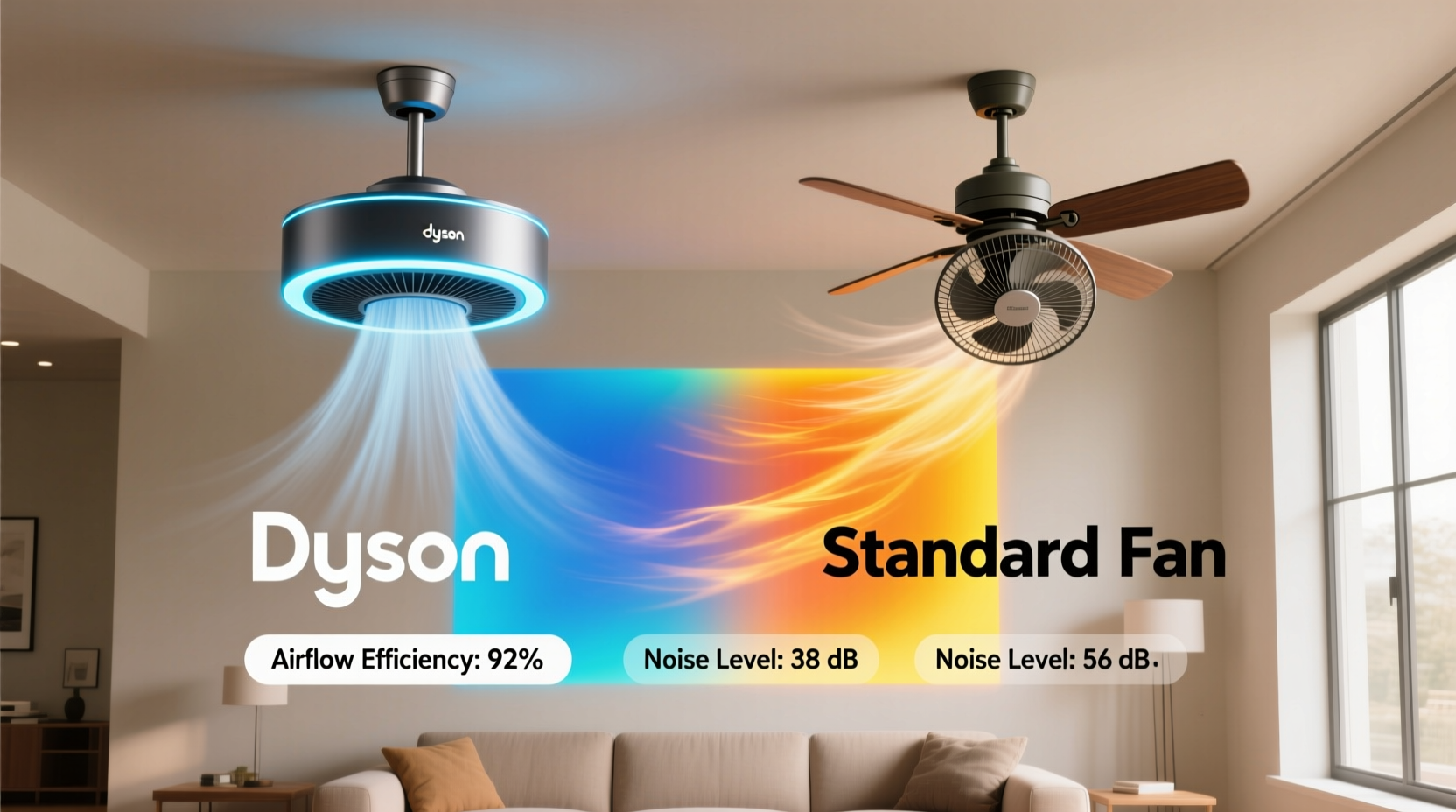
Fans don’t lower room temperature like air conditioners. Instead, they enhance evaporative cooling by moving air across the skin, accelerating the evaporation of sweat. This process creates a wind-chill effect, making you feel cooler even if the ambient temperature remains unchanged. The effectiveness of a fan depends on two key factors: airflow volume (measured in cubic feet per minute, or CFM) and airflow velocity (how fast that air reaches you).
Traditional oscillating fans typically use angled blades to push air forward, creating turbulent but directional airflow. In contrast, Dyson’s Air Multiplier™ technology draws air into the base and amplifies it through a circular aperture, producing a smooth, continuous stream. While both types increase air circulation, the delivery method differs significantly.
“Airflow consistency and distribution matter more than raw power when evaluating comfort.” — Dr. Lena Patel, Environmental Engineer at MIT
Airflow Performance: Dyson vs. Traditional Fans
Dyson markets its fans as delivering “powerful, uninterrupted airflow,” but how does that translate in practice? Independent tests show that high-end Dyson models like the AM09 or Pure Cool series can produce airflow comparable to strong tower or pedestal fans—sometimes exceeding them at close range due to focused projection. However, their maximum CFM output is often similar to or slightly less than high-performance conventional fans priced far below.
The key difference lies in airflow quality. Traditional fans generate gusty, pulsating bursts due to blade rotation, which some users find disruptive. Dyson fans produce a steadier, laminar flow that feels more consistent and less jarring. This smoother delivery may not cool more effectively overall, but it enhances user comfort, especially in quiet spaces like bedrooms or offices.
Comparative Airflow Features
| Feature | Dyson Fan | Traditional Oscillating Fan |
|---|---|---|
| Airflow Type | Smooth, continuous stream | Pulsating, blade-driven bursts |
| Max Air Projection | Up to 7–8 feet (focused) | 5–7 feet (dispersed) |
| CFM Range (Avg.) | 150–220 CFM | 100–300+ CFM (high-end models) |
| Oscillation Coverage | Full room sweep (180°–350°) | Typically 90°–120° |
| Noise at High Speed | 45–55 dB | 55–65 dB |
| Energy Use (Watts) | 35–55 W | 40–100 W |
While Dyson units offer excellent airflow control and diffusion, they rarely outperform industrial-grade box fans or high-CFM tower fans in raw cooling capacity. Their advantage is refinement, not brute force.
Noise Levels: Why Quiet Matters for Comfort
One area where Dyson consistently outperforms traditional fans is noise. Because there are no exposed blades chopping through the air, the sound profile is significantly smoother. Most Dyson models operate between 45 and 55 decibels on medium to high settings—comparable to a quiet conversation. In contrast, many conventional fans exceed 60 dB, producing a noticeable hum or whooshing that can disrupt sleep or concentration.
This reduction in auditory disturbance contributes to a perception of comfort that goes beyond physical cooling. A quieter environment allows for better relaxation, deeper sleep, and fewer distractions. In settings like nurseries, home offices, or bedrooms, this benefit alone can justify the higher cost for some buyers.
Additionally, Dyson fans often include features like night mode, which reduces both speed and noise further while maintaining gentle airflow. Some models also feature acoustic engineering with insulated motor housings and optimized airflow channels to minimize turbulence-induced sound.
Perceived Cooling vs. Actual Temperature Change
It’s important to distinguish between actual temperature reduction and perceived cooling. No standard fan—Dyson or otherwise—lowers the room’s temperature. But perception plays a major role in comfort. Factors like airflow consistency, directionality, and personal sensitivity all influence how “cool” a fan feels.
Dyson fans excel in creating a sensation of even, enveloping airflow. Their ability to project air precisely and maintain steady output makes the cooling feel more uniform. Many users report feeling cooler at lower speeds compared to traditional fans, likely due to reduced air turbulence and better targeting.
However, in large or poorly insulated rooms, neither type of fan will compensate for excessive heat. In such cases, pairing any fan with other strategies—like closing blinds during the day, using ceiling fans, or placing a bowl of ice in front of the unit—can amplify the cooling effect regardless of brand.
“The psychology of airflow matters. A smooth, predictable breeze feels more comfortable than erratic gusts—even if both move the same volume of air.” — Dr. Rajiv Mehta, Human Thermal Comfort Researcher
Real-World Example: Office vs. Living Room Use
Consider Sarah, a remote worker using a Dyson Pure Cool TP04 in her home office. She replaced a noisy pedestal fan that disrupted video calls and caused headaches from uneven airflow. With the Dyson, she noticed immediate improvements: fewer distractions, less fatigue, and a consistent cooling effect even at medium speed. Though the room temperature didn’t drop, she felt more alert and comfortable throughout the day.
In contrast, her living room uses a powerful box fan during evening gatherings. It moves more air and cools a larger group quickly, but the noise level makes conversation difficult. Here, raw airflow wins over refinement. This illustrates that “better cooling” depends on context—personal preference, room size, and usage patterns all shape what works best.
Additional Features That Influence Value
Beyond airflow and noise, Dyson fans often include added functionalities that traditional fans lack. These don’t directly make the fan “cooler,” but they enhance usability and convenience:
- Air Purification: Models like the Pure Cool series include HEPA and carbon filters that capture dust, pollen, and odors—ideal for allergy sufferers.
- Smart Controls: Wi-Fi connectivity allows app-based scheduling, voice commands via Alexa or Google Assistant, and integration with smart home systems.
- Indoor Air Quality Monitoring: Real-time PM2.5 and VOC sensors provide feedback on air cleanliness, displayed on the device or app.
- Heating Function (in HP Series): Dual-purpose units offer heating in winter, increasing year-round utility.
These extras add value but come at a steep premium. A basic Dyson fan starts around $300, while comparable traditional fans cost $40–$100. Whether these features justify the price depends on individual needs. For someone prioritizing clean air and smart automation, the investment may be worthwhile. For others seeking simple cooling, it’s likely overkill.
Checklist: Choosing the Right Fan for Your Needs
- Assess your primary goal: maximum airflow, quiet operation, or air purification?
- Measure room size—larger spaces may require multiple or higher-CFM fans.
- Consider placement—will it be near a bed, desk, or open living area?
- Evaluate noise tolerance—do you need whisper-quiet performance?
- Determine budget—can you justify advanced features or should you opt for simplicity?
- Check for extra needs—remote control, timer, oscillation, or smart features?
- Look at energy efficiency—lower wattage saves on long-term electricity costs.
Frequently Asked Questions
Do Dyson fans cool better than regular fans?
Not necessarily in terms of lowering temperature. Dyson fans provide smoother, more consistent airflow, which many people find more comfortable. However, high-powered traditional fans can move more air and may cool larger areas more effectively. The choice depends on your priorities: refined airflow and quietness (Dyson) versus raw power and affordability (traditional).
Are Dyson fans safer than blade fans?
Yes, particularly for homes with children or pets. The bladeless design eliminates exposed rotating parts, reducing the risk of injury. The grills are also smaller and harder to penetrate than those on many traditional fans, adding an extra layer of safety.
Can I use a regular fan with ice to match Dyson’s cooling?
You can enhance any fan’s cooling effect by placing a bowl of ice or a damp cloth in front of it. As air passes over the cold surface, it picks up a slight chill, creating a makeshift air cooler. While this won’t match true AC, it can improve perceived coolness and is a cost-effective trick—especially with conventional fans.
Making the Right Choice: Practical Recommendations
If your main concern is staying cool, start by optimizing airflow and placement before investing in high-end models. Ensure your fan is positioned to draw in cooler air (e.g., near a window at night) and direct it toward occupied areas. Clean blades or air intakes regularly to maintain efficiency.
For light, personal use in bedrooms or offices where noise matters, a Dyson fan offers tangible benefits in comfort and aesthetics. Its quiet operation and smooth airflow create a premium experience that many users appreciate daily.
For whole-room cooling, garages, workshops, or budget-conscious households, a high-quality traditional fan—especially a tower or box model with adjustable speeds and wide oscillation—delivers excellent performance at a fraction of the cost.
Conclusion: Cooling Perception vs. Reality
So, is a Dyson fan actually cooler than a regular fan? Objectively, no—not in terms of measurable temperature reduction. But subjectively, many users feel cooler due to the fan’s consistent, quiet, and targeted airflow. It’s not magic; it’s engineering refinement. Dyson excels at minimizing discomforts—noise, turbulence, safety concerns—that detract from the cooling experience.
Ultimately, the best fan is the one that meets your specific needs. If you value silence, safety, smart features, and elegant design, a Dyson may be worth the investment. If you want maximum airflow and value, a well-chosen traditional fan will serve you just as well—and leave money in your pocket.




 浙公网安备
33010002000092号
浙公网安备
33010002000092号 浙B2-20120091-4
Comments
No comments yet. Why don't you start the discussion?