
Back pain affects millions of people worldwide, and one of the most overlooked contributors is poor sleep support. A growing number of consumers turn to memory foam mattresses in search of relief, drawn by their reputation for contouring comfort and pressure relief. But while many report improved spinal alignment and reduced discomfort, others worry about long-term durability—specifically, whether these mattresses sag prematurely. The truth lies somewhere between marketing claims and real-world performance.
Memory foam can be an excellent choice for back pain sufferers when selected wisely, but not all models perform equally. Equally important is understanding how material quality, density, and construction influence both therapeutic benefits and longevity. This article breaks down the science behind memory foam’s support, evaluates its tendency to sag, and offers practical guidance for making a durable, pain-relieving investment.
How Memory Foam Supports Spinal Alignment
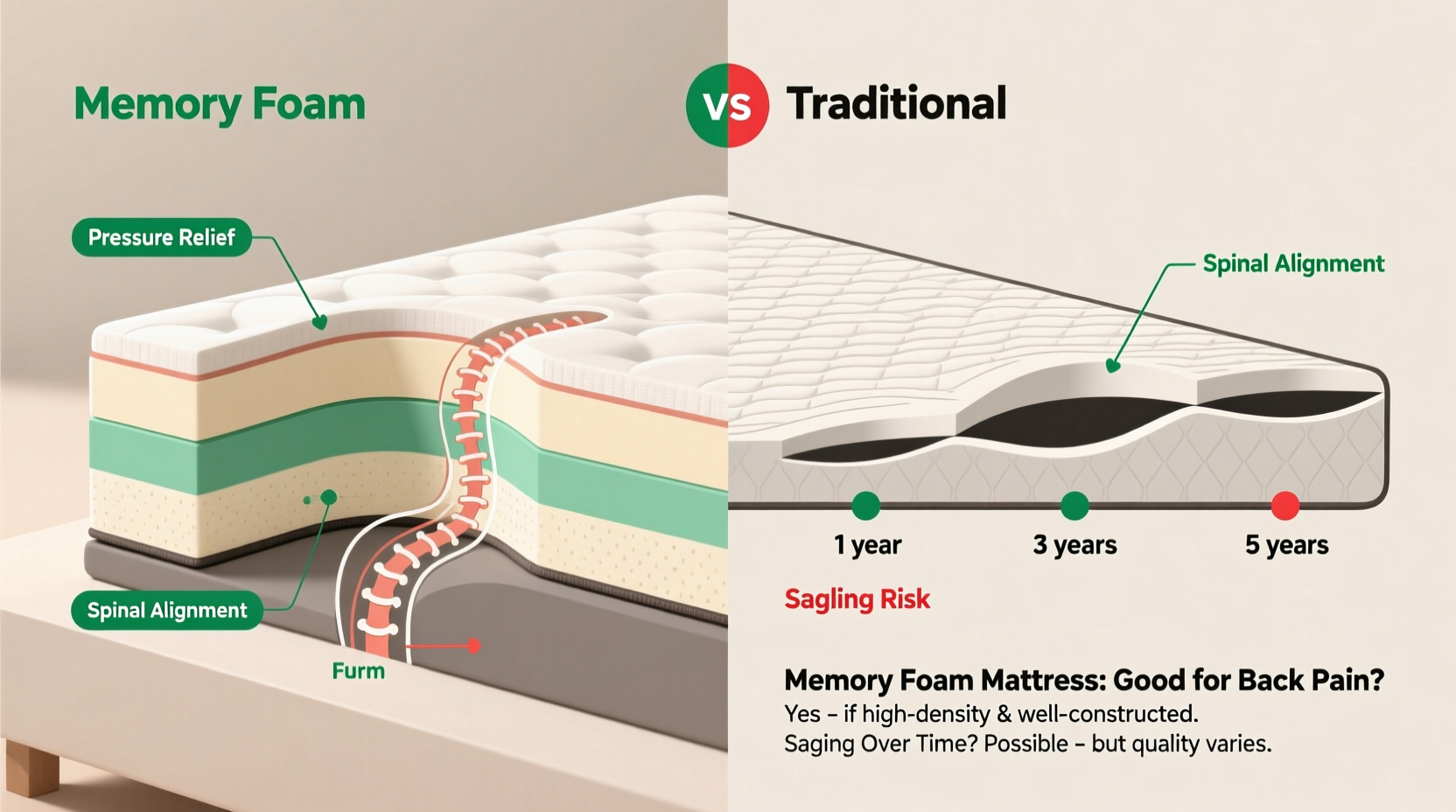
Traditional innerspring mattresses rely on coils for support, which can create uneven pressure points, especially for side sleepers or those with chronic back issues. Memory foam, originally developed by NASA in the 1970s, responds to body heat and weight by conforming closely to the sleeper’s shape. This adaptive quality helps distribute weight evenly, reducing pressure on sensitive areas like the lower back, hips, and shoulders.
When properly designed, a memory foam mattress supports the natural curvature of the spine. For individuals with mild to moderate lower back pain, this alignment can reduce muscle tension and nerve compression during sleep. Unlike firmer surfaces that may feel supportive but fail to cushion joints, memory foam balances softness with structural integrity—provided the core layers are dense enough.
The key lies in the foam’s density, measured in pounds per cubic foot (PCF). High-density foams (4.0 PCF and above) offer superior durability and support, while low-density options (below 3.0 PCF) tend to compress quickly and lose their restorative qualities.
“Proper spinal alignment during sleep is critical for managing chronic back pain. Memory foam can help if it provides balanced support—not too soft, not too rigid.” — Dr. Lena Patel, Chiropractic Specialist
Do Memory Foam Mattresses Sag Over Time?
All mattresses degrade with use, but memory foam has a mixed reputation when it comes to sagging. Early versions from the 2000s were notorious for developing body impressions within two years. Today’s formulations have improved significantly, yet concerns remain—especially with budget-friendly models.
Sagging occurs when the foam cells break down under repeated pressure, losing their ability to rebound. This results in permanent indentations, often near the center where hips and shoulders press nightly. While some indentation (up to 1.5 inches) is considered normal wear, deeper sags compromise support and can worsen back pain.
Several factors determine whether a memory foam mattress will sag prematurely:
- Foam Density: Higher-density foams resist compression longer. Look for at least 4.0 PCF in the comfort layer and 1.8+ PCF in the base support layer.
- Layer Construction: Mattresses with a single layer of thin foam over polyfoam cores are more prone to failure. Multi-layer designs with transitional and high-resilience base foams last longer.
- Body Weight: Heavier individuals (over 230 lbs) place greater stress on foam, accelerating wear. They benefit from hybrid models or extra-dense foams.
- Temperature Sensitivity: Traditional memory foam softens in heat, which can increase sinkage in warm rooms. Gel-infused or open-cell variants mitigate this issue.
Comparing Mattress Types: Support vs. Longevity
| Mattress Type | Back Pain Relief | Likelihood of Sagging | Average Lifespan |
|---|---|---|---|
| Low-Density Memory Foam | Moderate (may sink too much) | High | 5–6 years |
| High-Density Memory Foam | High (excellent contouring) | Low to Moderate | 7–9 years |
| Gel-Infused Memory Foam | High (cooling + support) | Moderate | 7–8 years |
| Hybrid (Foam + Coils) | Very High (balanced support) | Low | 8–10 years |
| Innerspring | Low to Moderate (firm but less contouring) | Moderate (coil fatigue) | 6–8 years |
This comparison shows that high-density and hybrid memory foam options outperform cheaper alternatives in both pain relief and durability. While traditional memory foam excels in pressure relief, combining it with pocketed coils enhances edge support and reduces long-term deformation.
Real-World Example: Sarah’s Experience with Chronic Back Pain
Sarah, a 42-year-old office worker, struggled with lower back pain for years. After trying multiple firm innerspring mattresses with little improvement, she switched to a 12-inch all-foam mattress with a 4.5 PCF memory foam top layer. Within three weeks, she reported waking up with less stiffness and improved mobility.
“I used to dread getting out of bed,” she said. “Now I actually feel rested. The mattress hugs my hips just enough without letting me sink too far.”
However, after five years, Sarah noticed a persistent dip forming under her waist. She weighed 190 lbs and slept primarily on her side—two factors contributing to accelerated wear. When she contacted the manufacturer, her warranty covered partial replacement due to a 2-inch sag, confirming that even quality foams degrade over time under consistent load.
Her case illustrates a common reality: memory foam can deliver meaningful pain relief, but longevity depends on user profile and product quality.
Choosing a Memory Foam Mattress That Lasts
Selecting the right memory foam mattress involves more than reading customer reviews. It requires evaluating materials, certifications, and structural design. Follow this checklist to avoid premature sagging and maximize back support:
Buying Checklist for Durable, Pain-Relieving Memory Foam
- ✅ Choose a comfort layer with at least 3 inches of memory foam at 4.0+ PCF density.
- ✅ Ensure the support core is made of high-resilience polyfoam (1.8+ PCF), not low-grade filler.
- ✅ Opt for gel-infused or open-cell foam if you sleep hot or live in a warm climate.
- ✅ Consider hybrid models if you weigh over 200 lbs or want enhanced airflow and edge stability.
- ✅ Verify the warranty covers body impressions of 1 inch or more (standard is 1.5 inches).
- ✅ Look for CertiPUR-US® certification to ensure low VOC emissions and absence of harmful chemicals.
- ✅ Test the mattress in-home for at least 30 nights; pain relief may take time to assess accurately.
Avoid overly soft models marketed as “plush” or “cloud-like,” especially if you have back issues. Excessive sinkage misaligns the spine, particularly for stomach and back sleepers. Medium-firm to firm feels (rated 6–7 on a 10-point scale) typically offer the best balance.
Step-by-Step Guide to Extending Your Mattress Life
To get the most out of your memory foam investment and delay sagging, follow this maintenance routine:
- Use a Proper Foundation: Always pair your mattress with a solid platform, slatted base (slats no more than 3 inches apart), or adjustable bed frame. Avoid box springs unless specified by the manufacturer.
- Rotate Periodically: If the mattress is flippable or rotatable, turn it head-to-foot every 3–6 months to distribute wear evenly.
- Protect with a Cover: Use a breathable, waterproof protector to guard against spills, sweat, and dust mites without trapping heat.
- Avoid Jumping or Sitting on Edges: These actions compress foam beyond design limits, leading to early breakdown.
- Control Room Temperature: Keep the bedroom cool (60–68°F) to prevent foam from overheating and softening excessively.
- Inspect Annually: Check for visible dips, loss of bounce, or squeaking (in hybrids). Address minor sags early with a mattress topper if needed.
Frequently Asked Questions
Can a memory foam mattress cause back pain?
Yes—if it's too soft or too firm for your sleeping position. A mattress that doesn’t align the spine properly can strain muscles and ligaments. Side sleepers often need softer pressure relief, while back and stomach sleepers benefit from firmer support. Personal preference and body type matter greatly.
How do I know if my memory foam is sagging too much?
If you notice a visible dip deeper than 1.5 inches, feel the support weakening, or wake up with more pain than before, your mattress may be failing. Try placing a level across the surface; any gap between the level and mattress indicates uneven wear.
Are memory foam toppers a good fix for a sagging mattress?
They can help temporarily by adding cushioning and smoothing minor indentations, but they won’t restore lost structural integrity. For sags over 2 inches, replacement is usually the better option.
Final Thoughts: Balancing Comfort, Support, and Durability
Memory foam mattresses can be highly effective for back pain when chosen with care. Their ability to cradle the body and maintain spinal alignment makes them a strong contender among sleep solutions. However, their long-term value hinges on material quality. Low-cost models may offer short-term comfort but often fail within a few years, potentially worsening pain due to inadequate support.
Investing in a high-density or hybrid memory foam mattress pays off in both health and cost-efficiency. With proper care, these beds can provide lasting relief and resist sagging far longer than their predecessors. Don’t be swayed by flashy marketing—focus on density ratings, layer composition, and verified warranties.




 浙公网安备
33010002000092号
浙公网安备
33010002000092号 浙B2-20120091-4
Comments
No comments yet. Why don't you start the discussion?