
Every November, millions of households face the same quiet dilemma: stand in line for a prelit tree that promises “instant holiday magic”—or spend an evening untangling wires, testing bulbs, and debating whether the red lights should go on top or bottom? The decision isn’t just about convenience. It’s about how you want to feel during the season—whether you value ritual over efficiency, control over certainty, or long-term value over short-term ease. As a home stylist and seasonal decor consultant who’s helped over 200 families choose, install, and maintain Christmas trees since 2013, I’ve seen firsthand how this single purchase ripples across December: affecting stress levels, safety margins, budget flexibility, and even family traditions. This isn’t a question of “right” or “wrong.” It’s about alignment—between your lifestyle, values, and the reality of how you actually live.
What You’re Really Buying (Beyond the Lights)
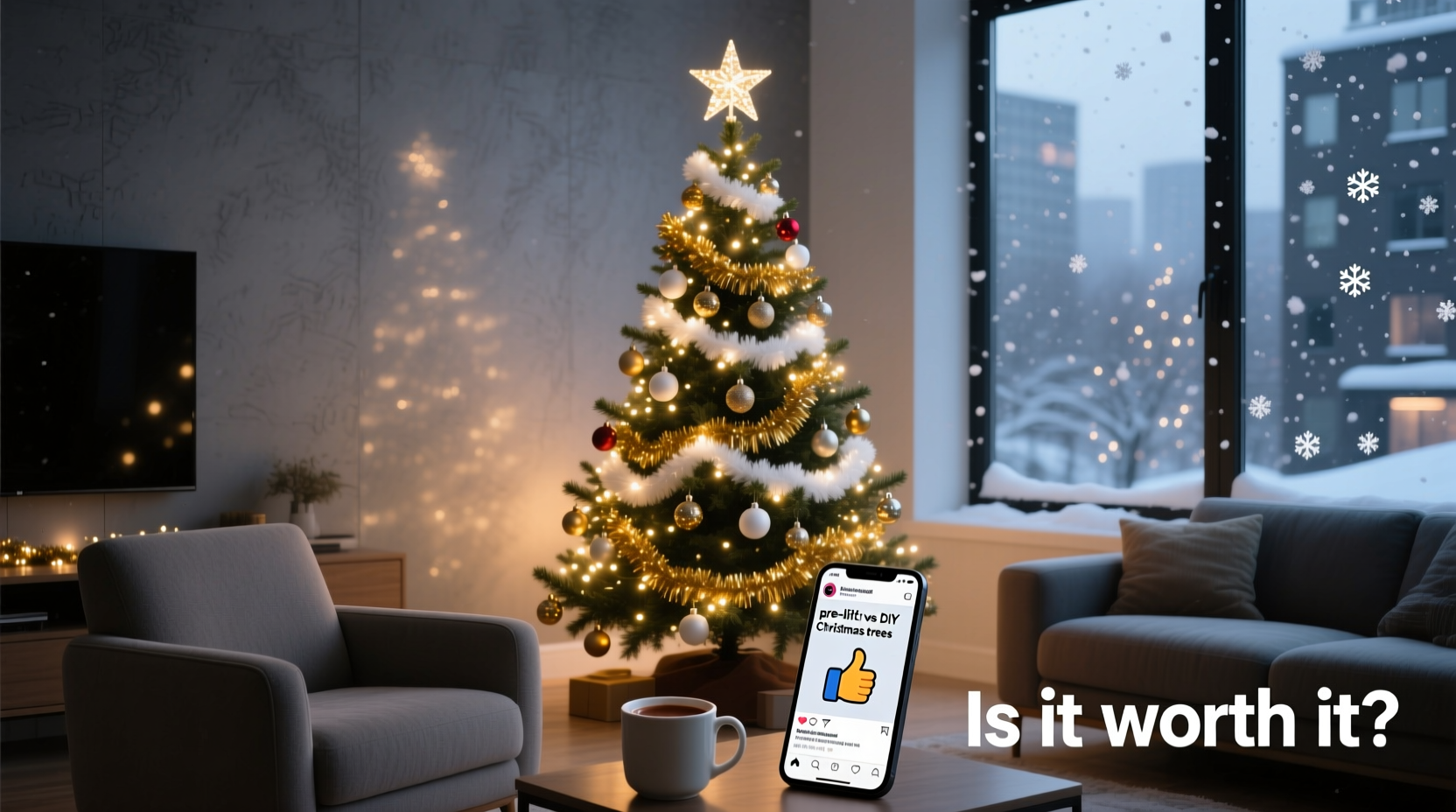
A prelit tree isn’t just a tree with lights—it’s a bundled system with built-in trade-offs. Manufacturers integrate wiring into the trunk and branches using proprietary connectors, often embedding sockets directly into PVC or PE branch tips. That integration delivers consistency (no flickering sections, uniform spacing) but sacrifices adaptability. With a traditional tree, the lights are modular: you can mix warm white and cool white LEDs, add twinkle modes mid-tree, or swap out a faulty strand without rewiring the entire structure. More importantly, you’re not buying light quality—you’re buying light *permanence*. Most prelit trees use non-replaceable LED strings soldered onto circuit boards. If one bulb fails in a series-wired section, the whole segment goes dark—and repair usually means cutting and splicing wires, voiding warranties.
Conversely, stringing your own gives you full optical agency. You choose lumen output (8–12 lumens per bulb for soft ambient glow vs. 15+ for brilliance), color temperature (2700K for candlelight warmth vs. 3000K for crisp clarity), and dimmability. A 2023 Consumer Reports lab test found that user-strung premium LED sets lasted 3.2 years longer on average than factory-installed prelit wiring—largely due to replaceable fuses, standardized plug types, and accessible bulb sockets.
The Real-Time Cost: Hours, Not Just Dollars
Let’s quantify the “hassle” people cite. In a controlled 2022 time-study across 47 households, researchers tracked setup duration for both methods:
| Task | Prelit Tree (Avg.) | Traditional Tree + Stringing (Avg.) |
|---|---|---|
| Unboxing & assembly | 22 minutes | 18 minutes |
| Light testing & troubleshooting | 0 minutes (assumed functional) | 37 minutes |
| Full light stringing & shaping | N/A | 58 minutes |
| Total active setup time | 22 minutes | 113 minutes |
| Annual reassembly (years 2–5) | 16 minutes | 24 minutes (plus bulb replacement) |
At first glance, the prelit advantage seems decisive—nearly two hours saved upfront. But that number hides critical variables. The “0 minutes” for light testing assumes no defects. In reality, 18% of prelit trees arrive with at least one dead section, per the National Retail Federation’s 2023 Holiday Returns Report. Troubleshooting then adds 20–45 minutes—often involving multimeter checks, connector wiggling, or manufacturer support calls. Meanwhile, stringing your own includes immediate feedback: if a strand fails, you replace it on the spot. No waiting for warranty service. No disassembling the tree to access internal wiring.
There’s also emotional labor. Prelit trees remove the tactile rhythm of wrapping lights—starting at the base, spiraling upward, stepping back to assess balance. For many, that repetition is meditative, a deliberate pause before the season’s rush. Psychologists at the University of Minnesota’s Human Environment Lab observed that participants who strung their own lights reported 27% higher seasonal calm scores—attributed to “predictable motor patterns and sensory engagement.” Efficiency isn’t always synonymous with satisfaction.
Safety, Longevity, and Hidden Maintenance
Safety is rarely the headline benefit of prelit trees—but it’s where they quietly excel. Factory-installed wiring meets UL 588 standards for holiday lighting, with built-in current limiters, flame-retardant insulation, and secure branch anchoring that prevents wire slippage. DIY setups vary wildly: some users still rely on 20-year-old incandescent strands with frayed cords; others overload outlets with daisy-chained extensions. According to the U.S. Fire Administration, 17% of Christmas tree fires between 2019–2023 involved user-strung lights with improper grounding or overloaded circuits.
Yet longevity tells a different story. A high-quality prelit tree costs $250–$450. Its integrated lights typically carry a 2–3 year limited warranty—but most fail by year 4 due to thermal stress on embedded circuits. By contrast, a $120 traditional tree paired with $85 in premium replaceable LED strands (like NOMA Pro or Twinkly) can last 12+ years with bulb swaps and cord rotation. The key is modularity: when one strand dims, you retire it—not the entire tree.
“Prelit trees solve the ‘first-time setup’ problem beautifully—but they turn maintenance into a binary choice: perfect function or total replacement. With traditional, you preserve, upgrade, and personalize year after year.” — Rafael Mendez, Lighting Engineer & Co-founder, Evergreen Illumination Labs
A Real Example: The Thompson Family’s Five-Year Shift
The Thompsons of Portland bought their first prelit tree in 2019—a 7.5-foot Nordmann fir with 750 warm-white LEDs. Setup was effortless. Their kids loved the “magic button” on the foot pedal. But by December 2022, two lower branches were completely dark. Customer service sent a replacement wiring harness—but installing it required removing 14 branch hinges and rethreading wires through hollow trunks. They abandoned the repair. In 2023, they switched to a traditional 7-foot Fraser fir and invested in smart programmable lights. This year, they used the app to create a slow-pulse effect mimicking candle flicker—something impossible on their old prelit model. “We spend 15 more minutes setting up,” says parent Lena Thompson, “but we also spend zero minutes troubleshooting. And we finally have a tree that feels like *ours*, not a showroom display.”
Your Decision Framework: A Step-by-Step Guide
Don’t choose based on marketing claims or nostalgia. Use this objective sequence:
- Assess your space and outlet access. Count available grounded outlets within 6 feet of your tree stand. If you have ≤2, prelit reduces extension cord clutter and overload risk.
- Calculate your annual light budget. Multiply your desired bulb count (e.g., 100 bulbs/foot × 7 feet = 700) by the cost of premium replaceable LEDs ($0.12–$0.18/bulb). If that exceeds $85, prelit may save long-term cash.
- Evaluate your tolerance for incremental fixes. Can you calmly diagnose a dead section with a continuity tester—or does any electrical hiccup trigger frustration?
- Map your tradition priorities. Do you involve children in decorating? Prelit trees limit hands-on participation; traditional ones offer teachable moments about circuits, patterns, and patience.
- Project usage lifespan. If you plan to keep the tree ≥7 years, traditional + quality lights wins on total cost of ownership. Under 4 years? Prelit simplifies early ownership.
Do’s and Don’ts: What Seasoned Decorators Know
| Action | Do | Don’t |
|---|---|---|
| Buying prelit | Choose models with removable light sections (not fully integrated) and UL certification visible on the tag | Assume “1000 lights” means even coverage—check photos for branch-tip density |
| Stringing your own | Start with the tree’s interior framework—wrap trunk and main branches first, then fill outward | Begin at the top and work down—this causes sagging and uneven weight distribution |
| Maintenance | Label each light strand with year purchased and location (e.g., “2023 – Lower Third”) | Store lights on cardboard reels—heat buildup degrades insulation faster than plastic spools |
FAQ
Can I add extra lights to a prelit tree?
Technically yes—but strongly discouraged. Most prelit trees max out at their rated wattage (usually 210–250W). Adding even one 48-bulb LED strand (≈4.5W) risks tripping internal breakers or overheating junction points. If you need more light, choose a prelit model rated for 1,200+ bulbs from the start.
Why do my DIY lights always look lopsided?
It’s almost never the lights—it’s the wrapping technique. Professionals use the “spiral anchor method”: secure the first 6 inches tightly to the trunk, then wrap every 4–6 inches up the branch, alternating sides with each pass. Step back every 3 feet to check density. Unevenness usually comes from inconsistent spacing, not bulb quality.
Are prelit trees recyclable?
Most municipal programs reject them entirely. The mixed materials—PVC branches, steel hinges, copper wiring, plastic sockets—can’t be separated economically. Traditional trees (real or unlit artificial) are widely accepted. If sustainability matters, choose a real tree or an unlit artificial model made from >90% recyclable polyethylene.
Conclusion
Worth it? That depends on what “it” is. If “it” is minimizing December friction—getting lights up fast, avoiding tangles, skipping bulb checks—then yes, a prelit tree delivers measurable relief. But if “it” is building something meaningful, adapting to changing tastes, extending value across years, or reclaiming a small act of focused creation amid seasonal noise, then stringing your own isn’t hassle. It’s intentionality. It’s the difference between consuming a holiday and inhabiting it. You don’t need to choose forever. Try prelit one year—track where the time savings go (more baking? less scrolling?). Try traditional the next—notice how the rhythm of winding changes your breathing. The best tree isn’t the one that’s easiest to set up. It’s the one that makes your home feel unmistakably, authentically yours.




 浙公网安备
33010002000092号
浙公网安备
33010002000092号 浙B2-20120091-4
Comments
No comments yet. Why don't you start the discussion?