
Every November, millions of households face the same quiet dilemma: do you flip the switch manually—or invest in a programmable timer? It’s easy to dismiss the decision as trivial. After all, Christmas lights run for just six weeks. But that “small” choice ripples across safety, electricity bills, seasonal consistency, and even neighborly goodwill. A manual switch demands daily discipline—forgetting once means lights blaze through dawn, wasting energy and drawing unwanted attention. A programmable timer, meanwhile, operates silently and precisely—but not all models deliver equal reliability or ease of use. This isn’t about gadgetry for its own sake. It’s about designing holiday routines that serve your time, your budget, and your peace of mind.
Energy Efficiency: Where Minutes Add Up to Dollars
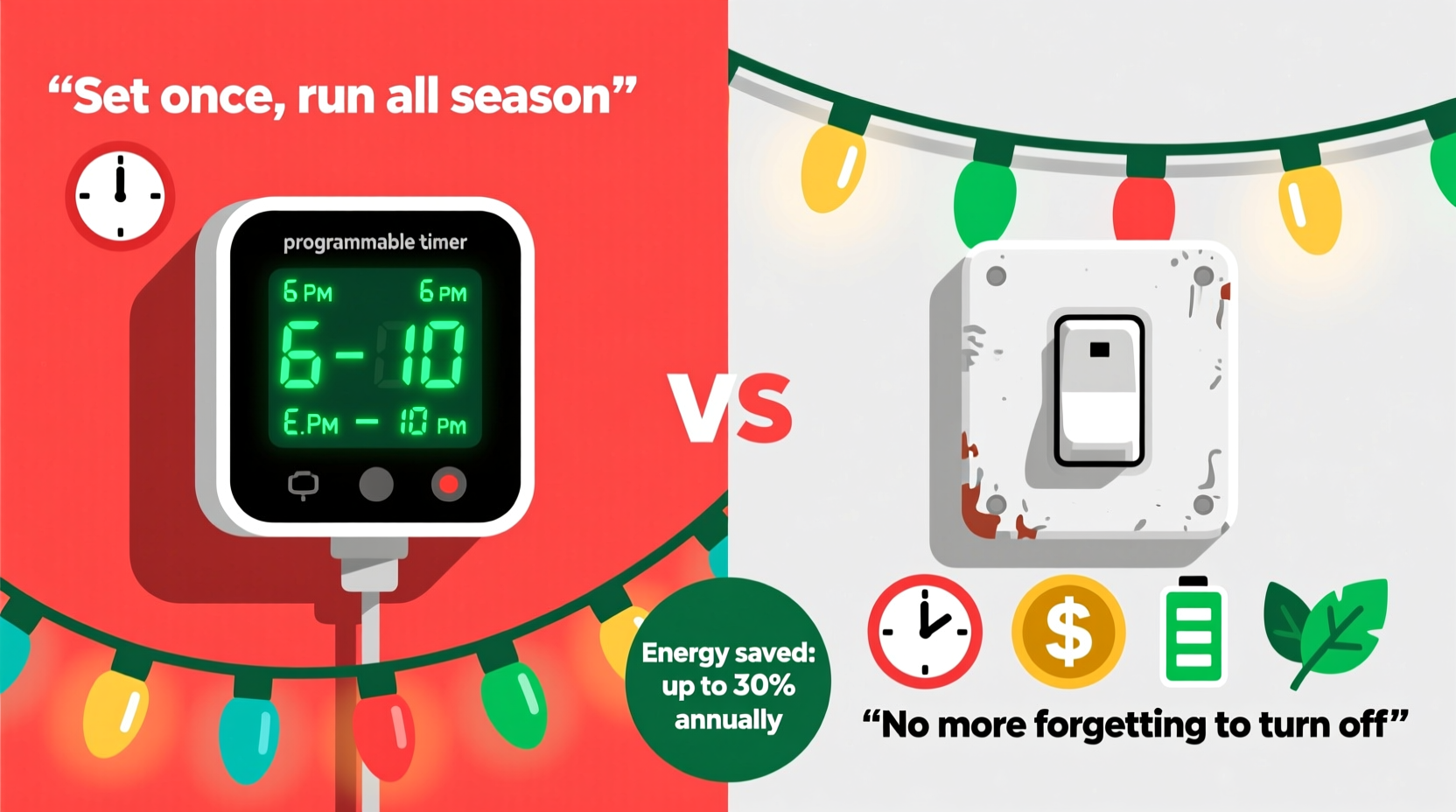
Christmas lights are deceptively power-hungry. A typical 100-bulb string of incandescent mini-lights draws 40–60 watts; LED equivalents use 4–7 watts—but many homes deploy dozens of strings. Over six weeks, a single 50-watt string left on from 5 p.m. to midnight (7 hours × 42 days) consumes 14.7 kWh. At the U.S. national average residential rate of $0.16/kWh, that’s $2.35 per string. Multiply by five strings—and add the cost of forgetting to turn them off at sunrise—and annual waste climbs to $20–$40 without a timer.
Programmable timers eliminate human error. They can be set to activate only during usable evening hours—say, 5:30 p.m. to 11:00 p.m.—and automatically cut power before daylight. Advanced models with photocell integration adjust for seasonal shifts in sunset time, maintaining consistent lighting duration year after year. In contrast, a manual switch relies entirely on memory, routine, and physical presence. Studies by the U.S. Department of Energy show households using programmable controls for seasonal lighting reduce related energy consumption by 32–47% compared to manual operation.
Safety and Risk Mitigation: Beyond Convenience
A manual switch introduces two persistent safety concerns: over-illumination and fire risk. Lights left on unattended overnight—especially older incandescent sets or those strung near dry pine boughs, curtains, or wooden railings—can elevate surface temperatures significantly. The National Fire Protection Association reports that between 2018–2022, an average of 790 home fires per year were caused by decorative lighting, with 40% involving electrical distribution or lighting equipment. Most occurred between Thanksgiving and New Year’s Day—and nearly half happened while residents were asleep or away.
A programmable timer acts as a fail-safe. Even if you travel, host guests, or simply fall asleep early, the timer enforces a hard cutoff. High-quality timers include built-in overload protection (typically rated for 15 amps/1800 watts), thermal cutoffs, and surge suppression—features absent in standard wall switches. As electrical safety consultant Marcus Lin notes:
“A timer isn’t just a convenience device—it’s a passive guardian. When you’re not there to monitor, it becomes the most reliable member of your holiday safety team.” — Marcus Lin, NFPA-Certified Electrical Safety Advisor
Convenience, Consistency, and the Psychology of Routine
Holiday fatigue is real. Between shopping, cooking, hosting, and school events, adding “turn lights on/off” to your daily checklist creates cognitive load. Research from the University of California, Berkeley shows that micro-tasks requiring repeated decision-making—even simple ones like flipping a switch—deplete executive function over time, contributing to seasonal stress. A programmable timer removes that friction entirely.
But convenience goes deeper than automation. It’s about predictability—for you and others. Neighbors appreciate consistent lighting windows. Municipalities often enforce “light curfews” (e.g., no exterior lighting after 11 p.m.) to reduce light pollution. And children thrive on ritual: knowing lights come on at the same time each evening builds anticipation and structure. Manual operation rarely sustains that consistency beyond the first week. By Week 3, lights may flicker on at 6:45 p.m. one night and 9:15 p.m. the next—or remain dark altogether.
Reliability Comparison: What Really Breaks Down
Not all timers are created equal—and neither are manual switches. To make an informed decision, it helps to compare failure points, lifespan, and real-world performance.
| Feature | Manual Wall Switch | Basic Mechanical Timer | Digital Programmable Timer | Smart Wi-Fi Timer |
|---|---|---|---|---|
| Average Lifespan | 20+ years (if undisturbed) | 3–5 years (mechanical wear) | 7–10 years (electronic components) | 4–6 years (firmware, connectivity) |
| Power Outage Recovery | None needed—always works | Loses time; requires reset | Most retain settings; some auto-sync via internal clock | Auto-resyncs on reboot; cloud backup available |
| Seasonal Sunset Adjustment | None—requires daily re-timing | None—fixed schedule | Yes (with GPS or manual date input) | Yes (automatic geolocation + weather API) |
| Remote Control | No | No | No (unless paired with smart plug) | Yes—via app, voice assistant, or geofencing |
| Cost Range (per unit) | $2–$8 | $12–$25 | $20–$45 | $35–$80 |
The table reveals a key truth: longevity alone doesn’t define value. A manual switch may last decades—but its utility diminishes the moment your schedule changes or memory falters. Conversely, a $40 digital timer pays for itself in energy savings within two seasons—if you’re running 10+ strings—and delivers measurable gains in safety and routine stability.
Real-World Case Study: The Henderson Family, Portland, OR
The Hendersons installed 22 strings of LED lights across their roofline, porch, and front yard in 2021. For two years, they used a manual switch mounted inside their garage. “We’d remind each other at dinner,” says Sarah Henderson, “but holidays got chaotic—especially when my mom visited from out of state. One snowy December morning, our neighbor knocked on the door to say our lights were still blazing at 7:15 a.m. We’d forgotten entirely.”
That incident prompted research. They chose a digital programmable timer with sunset tracking and a 15-amp rating. Setup took 12 minutes. Since installation in November 2023, the lights have activated precisely at sunset (ranging from 4:32 p.m. in early December to 4:58 p.m. in late December) and powered down at 11:00 p.m. every night—without a single missed or extended cycle. Their December electric bill dropped 8.2% year-over-year, despite adding three new light strings. More importantly, Sarah says: “We stopped dreading the ‘lights check’ at bedtime. That small relief made our holidays feel lighter.”
Step-by-Step: Choosing and Installing the Right Timer
- Evaluate your load: Add up the total wattage of all lights on the circuit. Ensure it stays under 80% of the timer’s rated capacity (e.g., max 1440W on a 15-amp/1800W timer).
- Choose the right type: For simplicity and reliability, start with a digital timer (not mechanical). Avoid plug-in models rated below 10 amps unless powering only 1–2 strings.
- Check compatibility: Verify the timer supports outdoor-rated GFCI outlets if installed outside. Indoor timers must never be exposed to moisture.
- Set and verify: Program start/end times *before* plugging in lights. Test for one full day—including a simulated power outage—to confirm memory retention.
- Label and document: Use waterproof tape to label the timer with its schedule and year of installation. Store the manual digitally—many brands offer QR-code access to setup videos and troubleshooting.
FAQ: Practical Questions Answered
Can I use a programmable timer with smart lights like Philips Hue?
Yes—but it’s usually redundant. Smart lights have built-in scheduling via app or voice assistant, and their native software handles sunset/sunrise adjustments more precisely. Reserve timers for non-smart LED or incandescent strings, or use them as a hardware-level backup in case your Wi-Fi fails.
Do timers work with extension cords and power strips?
Yes, but with critical caveats. Never daisy-chain multiple power strips behind a timer. Always plug the timer directly into a grounded outlet, then connect *one* heavy-duty (14-gauge) outdoor-rated power strip rated for the total load. Overloading downstream strips is the leading cause of timer-related failures.
What if I want different schedules for weekdays vs. weekends?
Most mid-tier and premium digital timers support 7-day programming. Look for models explicitly labeled “7-day programmable” or “weekdays/weekends separate.” Avoid “dual program” timers that only allow two fixed schedules—they lack flexibility for varied holiday plans.
Conclusion: Automating Joy, Not Just Light
A programmable timer isn’t about replacing human intention—it’s about honoring it. It honors your desire for festive beauty without demanding constant vigilance. It honors your commitment to safety without requiring round-the-clock awareness. And it honors your values—conserving energy, reducing waste, and protecting what matters most in your home.
The upfront cost of a quality timer is modest. Its return isn’t measured only in kilowatt-hours saved, but in quieter evenings, fewer forgotten moments, and the deep satisfaction of a tradition that runs smoothly—because you designed it to. You don’t need to overhaul your entire lighting setup this year. Start with one circuit—the front porch, the tree, the stair railing. Set it, test it, trust it. Then notice how much mental space opens up when one small, repetitive task simply… disappears.




 浙公网安备
33010002000092号
浙公网安备
33010002000092号 浙B2-20120091-4
Comments
No comments yet. Why don't you start the discussion?