
For city apartment dwellers, studio renters, dorm residents, and anyone living in under-500-square-foot spaces, the traditional floor-standing Christmas tree often feels like an impossible luxury. It demands floor space, ceiling height, stability, and storage capacity most small homes simply lack. Enter the tabletop Christmas tree with integrated lights: compact by design, plug-and-play by function, and festive by intention. But practicality isn’t just about size—it’s about safety, energy use, longevity, visual impact, and daily livability. This article cuts through marketing hype to assess tabletop trees not as decorative novelties, but as intentional spatial solutions—grounded in real constraints, verified user experiences, and interior design best practices.
Why “Practical” Means More Than Just “Small”
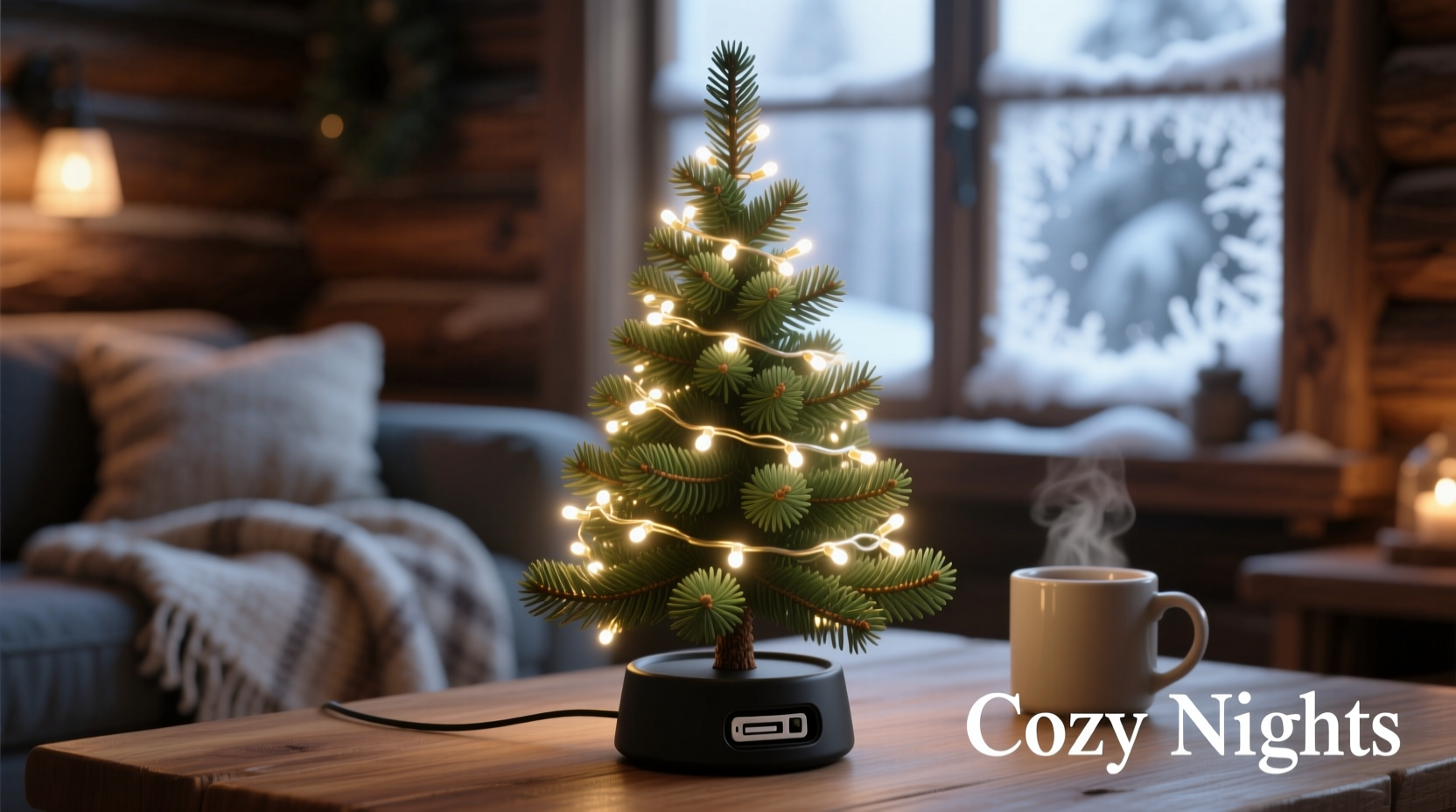
Calling something “practical” for small spaces requires evaluating five interlocking dimensions: spatial footprint, installation effort, energy and safety profile, aesthetic versatility, and long-term usability. A 16-inch tree that wobbles on a bookshelf, draws 40 watts, overheats after two hours, clashes with your existing decor, and sheds plastic needles every time you walk past it isn’t practical—it’s inconvenient. True practicality emerges when a product aligns with how people actually live—not how catalogs stage it.
Interior designer Lena Torres, who specializes in micro-apartment styling across New York and Toronto, confirms this nuanced view:
“Clients don’t need ‘a tree’—they need a focal point that works *with* their lifestyle, not against it. A well-chosen tabletop tree does more than occupy space; it anchors a mood, defines a zone, and signals celebration without demanding sacrifice. That’s functional design.” — Lena Torres, Founder of Compact Living Studio
Measuring Real-World Space Efficiency
Tabletop trees typically range from 12 to 24 inches tall and 8 to 16 inches wide at the base. To contextualize that footprint, consider these comparisons:
| Item | Typical Footprint (in²) | Notes |
|---|---|---|
| Standard 6-ft floor tree (with stand) | ~314–452 | Requires 12–18\" clearance on all sides for safety and access |
| 18-inch tabletop tree (on 12\"x12\" shelf) | ~45–90 | Fits comfortably on a nightstand, desk, kitchen counter, or floating shelf |
| Medium-sized laptop + keyboard | ~70 | Same surface area as many tabletop trees—proving minimal intrusion |
| Standard coffee table book stack | ~30–50 | Many trees occupy less space than a curated reading pile |
Crucially, tabletop trees eliminate three spatial penalties common with full-size trees: no dedicated floor zone, no overhead clearance concerns (no risk of touching ceilings or smoke detectors), and no doorway obstruction during setup or takedown. In a studio where the “living room” doubles as the bedroom and dining area, that flexibility is non-negotiable.
Energy Use, Safety, and Plug-In Realities
One overlooked practical advantage is energy efficiency. Most LED-equipped tabletop trees consume between 2–8 watts—comparable to a single LED nightlight. Running one for 8 hours daily over 30 days uses less than 2 kWh total. By contrast, a midsize pre-lit floor tree averages 25–40 watts, consuming 6–9.6 kWh over the same period.
Safety is equally critical in tight quarters. Tabletop trees eliminate tripping hazards associated with cords running across floors and reduce fire risk by keeping lights elevated away from rugs, curtains, and upholstered furniture. UL-certified models include built-in thermal cutoffs and low-voltage DC adapters—features increasingly standard in reputable brands like National Tree Company, Balsam Hill’s Mini Collection, and IKEA’s JULESNIS series.
Aesthetic Integration: Beyond “Cute” to Cohesive
Practicality fails if the tree feels like a visual compromise. The strongest tabletop trees succeed because they’re designed as interior objects—not miniature replicas. Key integration strategies include:
- Material intentionality: Faux-fir trees with matte PVC tips read as modern sculpture; metallic or birch-wood trunk variants blend into Scandinavian or industrial schemes.
- Lighting sophistication: Warm-white LEDs (2700K–3000K) mimic candlelight and avoid the clinical glare of cool-white bulbs—critical in bedrooms or home offices.
- Proportional layering: Pairing a 16-inch tree with matching mini ornaments (under 1.5\") and a coordinating base (e.g., a ceramic planter or woven basket) creates intentionality, not clutter.
- Strategic placement: Nestling the tree into a bookshelf “vignette,” centering it on a console behind a sofa, or mounting it on a wall-mounted shelf with integrated lighting avoids visual competition while maximizing presence.
This approach transforms the tree from seasonal decoration to year-round design element—many users keep the bare branch structure displayed with dried citrus slices or eucalyptus garlands in January and February.
Mini Case Study: Maya’s 320-Sq-Ft Downtown Loft
Maya Chen, a graphic designer in Portland, lives in a converted warehouse loft with 9-foot ceilings, exposed brick, and zero closet space. Her previous solution? A 4-foot artificial tree stored in vacuum bags under her platform bed—requiring 45 minutes to assemble each November and causing repeated back strain. Last year, she switched to an 18-inch pre-lit birch-trunk tabletop tree with warm-white micro-LEDs.
She placed it on a reclaimed oak floating shelf above her Murphy bed—positioned so it’s visible from her work desk and kitchen nook. She added three handmade felt ornaments and wrapped the base in natural jute twine. Total setup time: 90 seconds. Storage now takes one 10\"x10\"x8\" box that fits inside her under-bed storage bin alongside her holiday cards. Crucially, Maya reports the tree “feels like part of the room—not an imposition.” Her neighbors, initially skeptical, now ask where she sourced it. “It doesn’t shout ‘Christmas,’” she says. “It whispers ‘cozy.’ And in a space this small, whispering is everything.”
What to Prioritize When Choosing (and What to Skip)
Selecting the right tabletop tree isn’t about finding the smallest option—it’s about matching features to your physical environment and usage patterns. Use this checklist before purchasing:
✓ Verify exact dimensions—including base width and cord length (many are only 3–4 feet long)
✓ Confirm light type: Warm-white LEDs (not multicolor or cool-white) for ambient harmony
✓ Check for a stable, weighted base—avoid flimsy plastic stands prone to tipping
✓ Ensure the power adapter is compact and wall-wart style (not bulky transformer boxes)
✓ Look for removable branches or fold-flat design if storage space is extremely limited
✓ Read reviews specifically mentioning “stability on narrow shelves” or “low heat emission”
Avoid these common pitfalls:
- Overly dense foliage—creates visual weight and traps dust, making cleaning difficult in tight quarters.
- Non-detachable lights—if one bulb fails, the entire string may go dark; opt for replaceable LED modules or battery-operated alternatives for true modularity.
- Unrealistic color temperature—cool-white LEDs (5000K+) create harsh contrast against warm-toned walls or wood furniture, undermining calm ambiance.
- No cord management—a dangling 6-foot cord on a 12-inch shelf defeats neatness. Prioritize models with integrated cord wraps or recessed ports.
Step-by-Step: Setting Up & Maintaining Your Tabletop Tree Year After Year
A practical solution must endure beyond December. Follow this proven sequence to maximize lifespan and minimize seasonal friction:
- Measure twice, place once: Use painter’s tape to outline the tree’s footprint on your intended surface. Live with the taped shape for 24 hours—observe traffic flow, sightlines, and ambient light.
- Prep the surface: Wipe down the shelf or desk. Place a thin, non-slip liner (like a silicone baking mat cut to size) beneath the base to prevent sliding and protect finishes.
- Plug in strategically: Route the cord along the back edge of the shelf and secure with adhesive cord clips—never drape over front edges where it can snag.
- Style intentionally: Hang no more than 8–12 ornaments (prioritizing texture over quantity). Add a single ribbon loop at the top instead of a bulky star—reduces visual top-heaviness.
- Post-holiday reset: Unplug, gently wipe branches with a dry microfiber cloth, detach lights if modular, and store upright in original box or a rigid garment box with acid-free tissue paper.
Well-maintained tabletop trees retain structural integrity and lighting performance for 6–8 years—significantly longer than floor models subjected to annual disassembly stress.
FAQ
Can I safely leave my tabletop tree lit overnight?
Yes—if it uses UL/ETL-certified LED lights and a properly rated power adapter. Modern low-wattage LEDs generate negligible heat and include automatic shut-off timers (often 6–8 hours) or manual on/off switches. Never leave non-certified or older incandescent-mini-light trees unattended.
Will a tabletop tree feel “too small” or “inauthentic”?
Perception depends entirely on context. In a studio apartment, a 20-inch tree centered on a dining nook table creates proportionate scale and intimacy. Authenticity comes from personal meaning—not size. Many users report stronger emotional connection to smaller trees because they’re touched, styled, and lived with daily—not relegated to a corner.
Do tabletop trees work in rooms with low ceilings or sloped walls?
Exceptionally well. Their vertical profile avoids ceiling proximity issues, and lightweight bases adapt easily to angled surfaces like dormer shelves or loft mezzanines. For sloped walls, use a wall-mounted bracket system (designed for small planters or clocks) to secure the base—eliminating tip risk entirely.
Conclusion
A tabletop Christmas tree with lights isn’t a consolation prize for those without space—it’s a deliberate, intelligent response to evolving urban lifestyles, minimalist values, and thoughtful interior design. Its practicality lies in measurable efficiencies: watts saved, square inches reclaimed, setup minutes eliminated, and visual noise reduced. It respects the reality of small-space living—not as a limitation, but as a design constraint that invites creativity, intentionality, and presence. When chosen with attention to proportion, light quality, material honesty, and daily usability, it becomes more than decoration. It becomes ritual made tangible. More than ever, celebration shouldn’t require expansion—it should invite refinement.




 浙公网安备
33010002000092号
浙公网安备
33010002000092号 浙B2-20120091-4
Comments
No comments yet. Why don't you start the discussion?