
Every December, millions of cat owners brace themselves—not for holiday stress, but for the annual ritual: the sudden pounce, the frantic scrambling up tinsel-draped branches, the inevitable crash as ornaments shatter and lights blink out. It’s not mischief. It’s not spite. It’s biology, instinct, and environmental mismatch colliding under a strand of LED lights. Understanding why your cat targets the tree—rather than just reacting to the chaos—is the first step toward a calmer, safer, and genuinely joyful holiday season.
The Instincts Behind the Assault
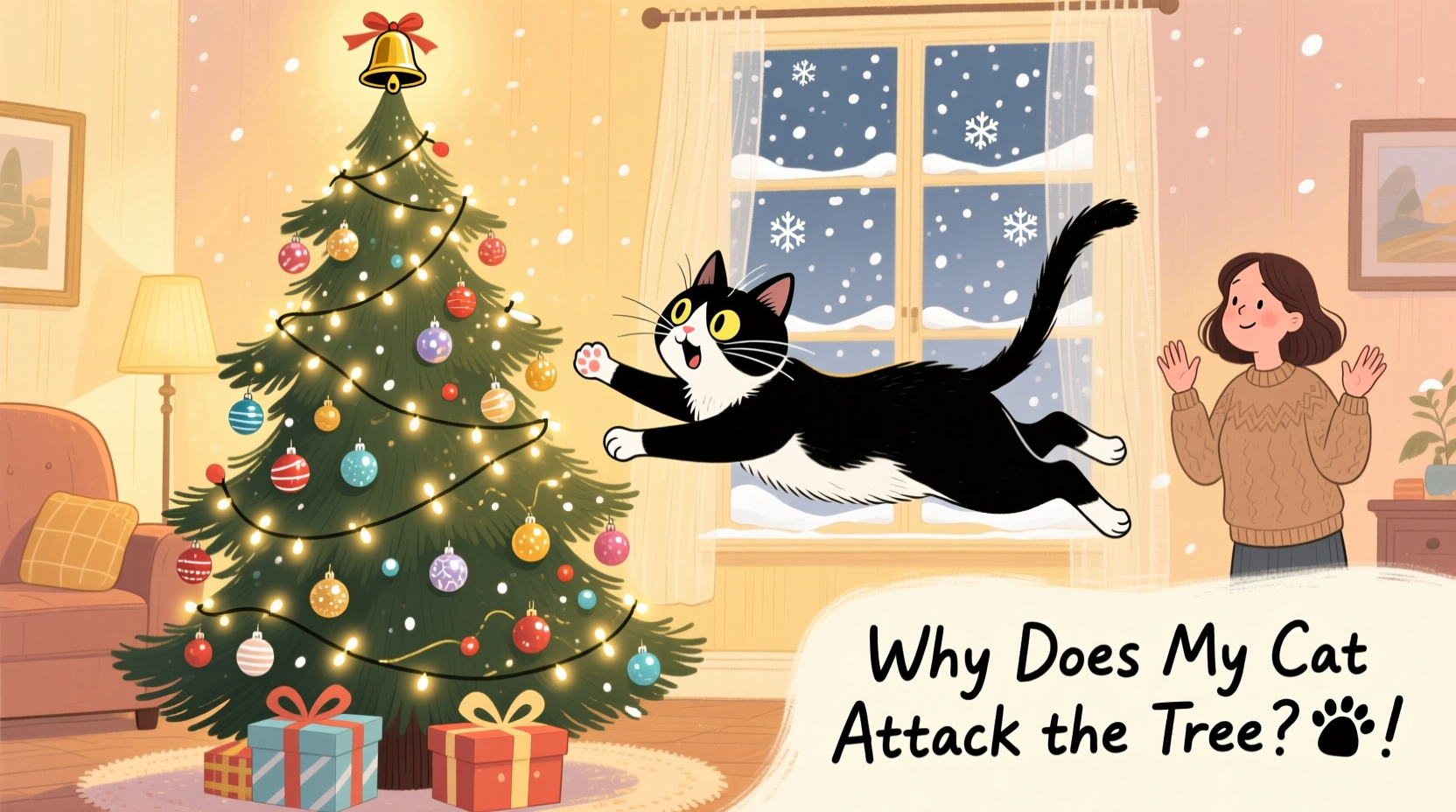
Cats don’t view your Christmas tree as festive décor. To them, it’s a multisensory anomaly that triggers deeply wired survival and play behaviors. Three core instincts explain the annual assault:
- Hunting drive: The tree’s swaying boughs, dangling ornaments, and flickering lights mimic prey movement—especially when air currents or household activity set branches in motion. A 2022 study in Applied Animal Behaviour Science found that vertical, unpredictable motion increases predatory attention in domestic cats by over 70% compared to static objects.
- Vertical territory assertion: In multi-cat homes—or even in single-cat households with windows overlooking birds or squirrels—the tree becomes an elevated vantage point. Cats instinctively seek height to monitor their domain. A 6–7 foot tree offers both security and surveillance—making it irresistible.
- Sensory novelty overload: Pine scent (especially from real trees), textured bark, crinkly tinsel, reflective glass, and unfamiliar scents from ornaments or garlands create a novel stimulus field. For indoor cats with limited environmental enrichment, the tree is the most dynamic object in the house—a living puzzle box demanding investigation.
This isn’t “bad behavior.” It’s normal feline cognition misaligned with human tradition. As Dr. Sarah Wooten, DVM and certified feline behavior specialist, explains:
“Cats don’t understand ‘holiday decor.’ They understand movement, scent, texture, and spatial opportunity. When we place a tall, shiny, moving object in their territory—especially one that smells like the outdoors—we’re essentially building a playground designed to trigger every instinct they’ve evolved over 10,000 years.” — Dr. Sarah Wooten, DVM, CVJ, Fear Free Certified Professional
What *Not* to Do (And Why It Backfires)
Many well-intentioned interventions worsen the problem—either by increasing stress, reinforcing attention-seeking, or creating new hazards. Avoid these common missteps:
| Action | Why It Fails | Better Alternative |
|---|---|---|
| Spraying water or shouting “no” | Startles the cat, elevates stress hormones, and associates the tree with fear—not boundaries. Often leads to redirected aggression or nighttime attacks when unsupervised. | Redirect energy *before* escalation using interactive toys away from the tree. |
| Using citrus sprays or bitter apple on the trunk | May deter some cats short-term, but risks respiratory irritation (especially with pine oils) and doesn’t address the root motivation. Many cats simply avoid the trunk but climb higher into branches where sprays don’t reach. | Use physical barriers + environmental enrichment instead. |
| Tying the cat’s collar to the tree stand | Extremely dangerous. Risk of strangulation, panic-induced injury, or entanglement with lights/ornaments. Veterinarians report multiple ER cases each December from this practice. | Never restrict mobility near electrical cords or breakables. Use supervised play sessions instead. |
| Removing all ornaments and lights “to make it boring” | Doesn’t remove the tree’s height, scent, or novelty. May even increase curiosity—leading to more persistent exploration once decorations are added later. | Introduce decorations gradually while pairing with positive reinforcement (see Step-by-Step Guide). |
A Proven 5-Step Prevention Protocol
Effective prevention isn’t about punishment—it’s about redirecting instinct, managing access, and enriching alternatives. Follow this sequence starting two weeks before you bring the tree indoors:
- Pre-Tree Enrichment Boost (Days 14–7): Double daily interactive play sessions (15 minutes twice daily) using wand toys that mimic birds or rodents. End each session with a food puzzle or treat-dispensing toy to simulate the “hunt-eat-rest” cycle. This reduces pent-up predatory energy.
- Designated “Tree Zone” Setup (Day 7): Place a sturdy cat tree or shelf 3–4 feet away from where the Christmas tree will stand. Cover it with soft fleece and add a few safe, non-breakable ornaments (e.g., felt balls, jingle bells on string). Let your cat explore it freely—this establishes an alternative vertical outlet.
- Gradual Tree Introduction (Day 3–1): Set up the bare tree frame (no lights or ornaments) for 48 hours. Place treats or catnip on the lowest stable branch (not near the base where tipping risk exists). Observe reactions. If your cat investigates calmly, reward with praise and a treat. If anxious or overly excited, pause and extend this phase.
- Controlled Decoration (Day 0): Add lights last—only after ornaments are secured. Use only shatterproof, lightweight ornaments on lower branches (within 3 feet of floor). Hang heavier or fragile items above 4 feet. Secure all cords inside cord covers or behind furniture. Anchor the tree stand to a wall stud using a flexible, breakaway strap (tested for cat-safe tension).
- Daily Maintenance & Monitoring (Throughout Season): Spend 10 minutes each morning engaging your cat with a wand toy near the designated “tree zone”—not the real tree. Rotate toys weekly to maintain novelty. Check anchor straps daily. Remove any fallen tinsel, ribbon, or broken ornament fragments immediately.
Real-World Success: The Thompson Household Case Study
In Portland, Oregon, the Thompsons had battled Christmas tree destruction for seven years. Their 4-year-old Maine Coon, Juno, would scale the tree within minutes of setup, knocking over three to five ornaments daily. After two trees tipped (once onto a laptop, once onto a vintage speaker), they consulted a certified cat behaviorist.
The turning point wasn’t stronger anchoring—it was timing and substitution. They began daily 7 a.m. “sunbeam hunts” using a laser pointer along a sunlit hallway, followed by a meal in a slow-feeder bowl shaped like a pinecone. They installed a wall-mounted perch directly opposite the tree location—covered in Juno’s favorite silvervine—and placed a battery-operated, rotating feather toy on it (set to activate only during peak morning activity hours). Within three days of tree setup, Juno spent 80% of her vertical time on the perch. By Christmas Eve, she’d touched the real tree only twice—both times to sniff the base, then walk away. No ornaments were lost. No tree tipped. The Thompsons now refer to it as “The Year Juno Got Her Own Tree.”
Do’s and Don’ts: A Quick-Reference Checklist
- ✅ DO anchor your tree to a wall stud—even if it’s a “stable” weighted base.
- ✅ DO use only UL-listed, low-heat LED lights (cats’ paws can burn on older incandescent strings).
- ✅ DO provide at least one elevated perch or shelf elsewhere in the room—ideally with a window view.
- ✅ DO vacuum daily around the tree base to remove pine needles (which attract chewing) and shed fur (which can clog filters).
- ✅ DO rotate your cat’s toys weekly—including puzzle feeders, tunnels, and scent games (try hiding dried catnip or valerian root in cardboard boxes).
- ❌ DON’T use tinsel, ribbons, or plastic icicles—these cause intestinal blockages if ingested.
- ❌ DON’T hang anything scented with essential oils (e.g., cinnamon, clove, pine)—toxic to cats even in small amounts.
- ❌ DON’T rely solely on deterrent sprays or noise-based corrections—they erode trust and increase anxiety.
- ❌ DON’T leave the tree unattended for more than 2 hours during peak activity times (dawn and dusk).
- ❌ DON’T punish after the fact—even 30 seconds post-incident is too late for behavioral connection.
FAQ: Your Top Questions, Answered
Will getting a fake tree solve the problem?
Not necessarily. While fake trees lack pine scent and sap, many still sway, reflect light, and offer novel textures. Some cats prefer the firmer branches of artificial trees for scratching or climbing. The key isn’t the tree type—it’s how you manage access, enrichment, and safety. That said, PVC-free, non-toxic plastic trees with weighted bases and minimal “sway” do reduce risk.
My cat only attacks at night—can I just close the door?
Yes—if your home layout allows it safely. But be aware: restricting access overnight may increase daytime obsession. Instead, try installing a motion-activated deterrent (like the PetSafe SSSCAT spray) *pointed away from the tree*, triggered only when your cat approaches within 3 feet. Pair this with a cozy, elevated sleeping perch nearby—so the cat chooses rest over raiding.
Is it okay to use double-sided tape on the trunk?
Not recommended. While sticky tape deters some cats, it can transfer to paws, then to fur or bedding—causing grooming distress or skin irritation. Worse, determined climbers often ignore it entirely. Physical barriers (like a low, removable fence made of PVC pipe and mesh) or strategic placement of scratching posts around the base are safer, more reliable options.
Conclusion: Reclaim the Magic—Without the Mayhem
Your cat isn’t trying to ruin Christmas. They’re responding to ancient impulses in a world that rarely accommodates them. When you shift from seeing the tree as a decoration to be protected—and start seeing it as a behavioral catalyst to be understood—you unlock real solutions. Prevention isn’t about perfection; it’s about consistency, observation, and compassion. Anchor the tree, enrich the environment, redirect the drive, and respect the instinct. Do this thoughtfully, and what was once a source of dread becomes a quiet testament to how well you know your cat—and how deeply you care.
This holiday season, let the lights glow without worry. Let the ornaments sparkle without peril. And let your cat climb, explore, and play—just not on the Fraser fir. Because peace isn’t the absence of chaos. It’s the presence of understanding.




 浙公网安备
33010002000092号
浙公网安备
33010002000092号 浙B2-20120091-4
Comments
No comments yet. Why don't you start the discussion?