
In 2025, the line between mobile and console gaming continues to blur. Tablets have evolved from basic consumption devices into powerful handhelds capable of running graphically intensive games at high frame rates. Yet, despite significant advancements in hardware, software, and accessories, many gamers still question whether tablets offer a truly viable alternative to dedicated gaming platforms like consoles or PCs. The answer isn’t binary—it depends on what kind of gamer you are, how you play, and what compromises you’re willing to accept.
Today’s top-tier tablets rival mid-range laptops in processing power, support external controllers, and can stream AAA titles via cloud services. At the same time, they remain constrained by screen size, thermal throttling, and ecosystem limitations. This article examines the state of tablet gaming in 2025 across multiple dimensions: hardware capabilities, control schemes, game library depth, portability advantages, and real-world usability—ultimately answering whether it's now a legitimate platform or still a necessary compromise.
Hardware Power: Tablets Are Closer Than Ever
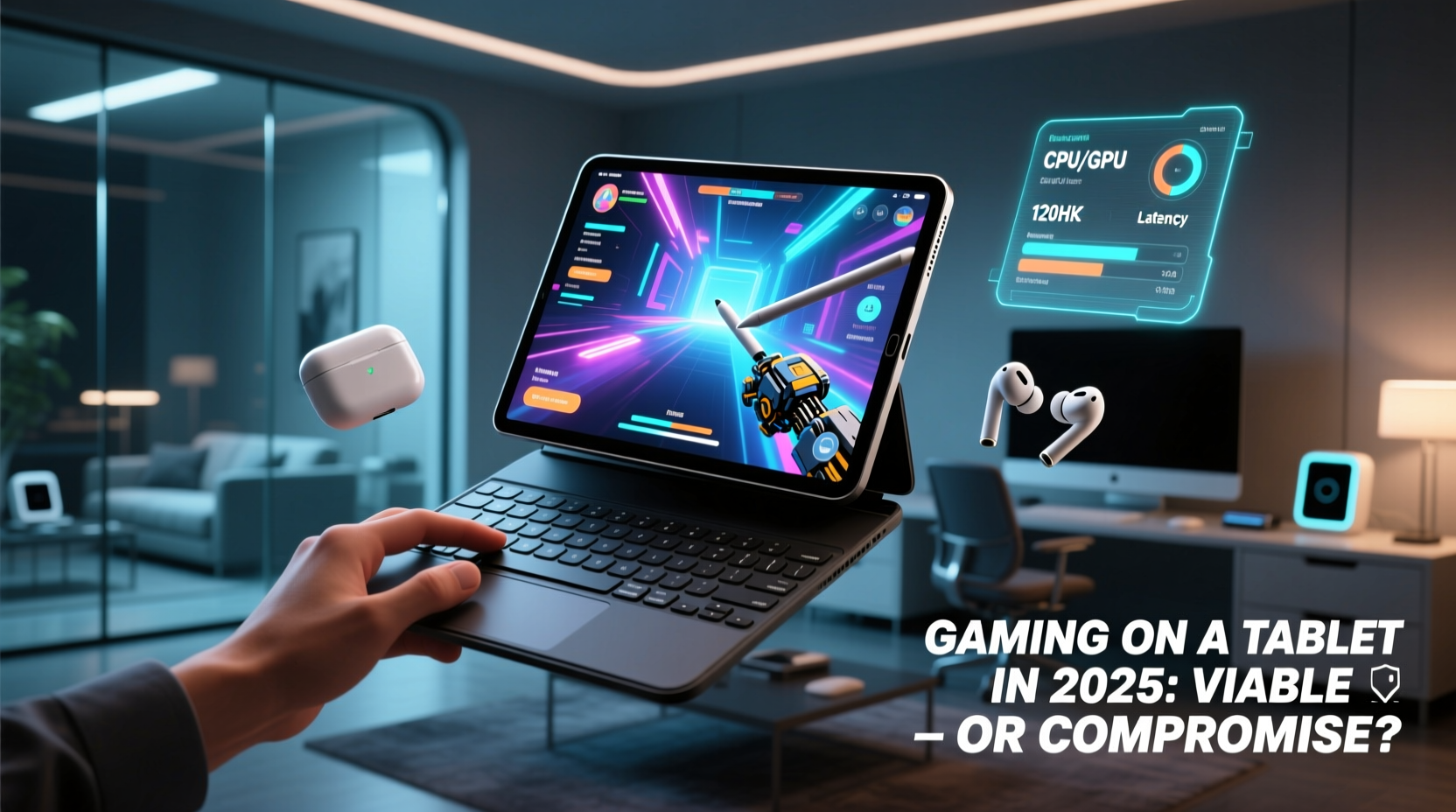
Modern flagship tablets—such as the Apple iPad Pro (M3), Samsung Galaxy Tab S10 Ultra, and Microsoft Surface Pro 10 with Snapdragon X Elite—are powered by desktop-class chips. These processors deliver sustained performance that was unthinkable on mobile just five years ago. For example, Apple’s M3 chip enables console-level rendering, supports hardware-accelerated ray tracing, and handles complex physics simulations with ease. Similarly, Qualcomm’s latest Oryon CPU architecture in premium Android tablets offers multi-threaded performance competitive with entry-level gaming laptops.
RAM capacity has also increased, with 16GB now available on high-end models, allowing for smoother multitasking and better background app retention during long gaming sessions. Storage options up to 2TB mean players can install dozens of large games without constant management.
However, thermal constraints remain a limiting factor. Unlike consoles or laptops, tablets lack active cooling systems. Prolonged gameplay leads to thermal throttling, especially in graphically intense titles. While manufacturers have improved heat dissipation through vapor chambers and advanced materials, sustained peak performance remains elusive compared to fan-cooled devices.
Control Options: Bridging the Gap Between Touch and Precision
One of the most persistent criticisms of tablet gaming is input precision. Touchscreens work well for casual games like puzzles or match-3 titles but fall short in genres requiring fine motor control—first-person shooters, real-time strategy, or fast-paced platformers.
The solution lies in peripherals. In 2025, Bluetooth controller support is nearly universal across iOS and Android tablets. Devices like the Xbox Wireless Controller, PlayStation DualSense Edge, and Razer Kishi V2 provide console-grade ergonomics and responsiveness. Some tablets even support mouse and keyboard input via USB-C or wireless protocols, opening the door to MOBAs and battle royales traditionally reserved for PC.
Apple’s Game Controller framework and Google’s updated Android Game Dashboard ensure low-latency input handling and standardized button mapping. Additionally, cloud gaming apps like Xbox Cloud Gaming, NVIDIA GeForce NOW, and Amazon Luna now optimize their interfaces specifically for controller use on tablets.
Despite these advances, touch remains the default—and often only—option for many users. Casual gamers may never invest in extra gear, which keeps tablet gaming perceptionally tied to simplicity rather than seriousness.
“Tablets will never replace consoles for hardcore players, but they’ve become serious contenders for immersive, portable experiences—especially with a good controller.” — Lena Park, Senior Analyst at MobileTech Insights
Game Library: Quality vs. Quantity
A platform is only as strong as its games. In 2025, the tablet gaming ecosystem is more diverse than ever—but not necessarily deeper.
iOS leads in quality, with optimized ports of major titles like *Resident Evil Village*, *Death Stranding Director’s Cut*, and *No More Heroes III*. Thanks to Apple’s MetalFX upscaling and close developer partnerships, these games run impressively on M-series iPads, often matching Switch OLED performance while exceeding it in resolution and texture fidelity.
Android lags slightly behind due to fragmentation. High-end Samsung and Lenovo tablets can run demanding games like *PUBG Mobile*, *Diablo Immortal*, and native versions of *Call of Duty: Mobile* at maximum settings. However, compatibility varies widely across brands and chipsets, making consistent experiences harder to guarantee.
Cloud gaming fills some gaps. Services like Xbox Cloud Gaming allow access to over 100 console-quality titles directly through a browser or app, effectively turning any capable tablet into an Xbox Series S/X endpoint. With 5G and Wi-Fi 6E becoming standard, latency issues have decreased significantly, though connection stability remains critical.
Still, exclusives are rare. Most tablet games are either mobile-first (free-to-play, ad-supported) or scaled-down ports. True AAA development natively built for tablets remains limited, suggesting publishers still view them as secondary devices.
Comparison: Tablet Gaming Ecosystems in 2025
| Platform | Native AAA Support | Cloud Gaming Readiness | Controller Compatibility | Ecosystem Strength |
|---|---|---|---|---|
| iOS (iPad) | High (M-series optimized) | Excellent (Xbox, GeForce NOW) | Full (MFi certified) | ★★★★★ |
| Android (Premium) | Moderate (Samsung, Lenovo) | Very Good | Wide (Bluetooth HID) | ★★★★☆ |
| Windows on ARM | Good (emulated x64) | Excellent | Full (native drivers) | ★★★★☆ |
| ChromeOS | Low | Good (browser-based) | Limited | ★★★☆☆ |
Portability and Lifestyle Integration
Where tablets shine brightest is convenience. A 12-inch iPad Pro weighs under 500 grams—less than half the weight of a laptop and far more compact than a console setup. It fits in small spaces, boots instantly, and runs for 8–10 hours on a charge, depending on workload.
This makes tablets ideal for travel, commuting, or gaming in environments where setting up a full rig isn’t feasible. Parents playing during naptime, students squeezing in sessions between classes, or professionals unwinding on flights all benefit from the immediacy and discretion of tablet gaming.
Beyond pure portability, tablets integrate seamlessly into daily digital life. You can switch from gaming to checking email, watching videos, or video calling without rebooting or switching devices. No other gaming platform offers this level of lifestyle fluidity.
Moreover, split-screen and picture-in-picture features allow multitasking—watching a walkthrough on YouTube while playing, for instance. This hybrid functionality enhances accessibility and learning curves for new games.
Mini Case Study: Sarah, the Commuter Gamer
Sarah works in downtown Toronto and commutes two hours daily on public transit. She used to skip gaming entirely due to space and noise constraints. In early 2025, she bought an iPad Air with a clip-on Bluetooth controller. Now, she plays turn-based RPGs like *Genshin Impact* and *Civilization VI* during her commute. Using headphones, she avoids disturbing others, and the tablet’s battery lasts her entire round trip. “It’s not the biggest screen,” she says, “but I get real gameplay in without carrying a backpack full of gear.” Her experience reflects a growing trend: tablet gaming as a pragmatic extension of urban lifestyles.
Step-by-Step Guide: Building a Viable Tablet Gaming Setup in 2025
If you're considering transitioning to tablet-based gaming, follow this practical guide to maximize your experience:
- Choose the Right Device: Prioritize tablets with flagship processors (Apple M-series, Snapdragon 8 Gen 3 or newer, or Windows on ARM). Avoid budget models for anything beyond casual titles.
- Invest in a Controller: Purchase a reliable Bluetooth controller. The Backbone One (iOS/Android), Razer Kishi, or Xbox Wireless Controller paired with a protective case ensures comfort and durability.
- Optimize Connectivity: Use Wi-Fi 6 or 5G with low latency. Test your internet speed; aim for at least 25 Mbps download and under 50ms ping for cloud gaming.
- Subscribe to Cloud Services: Sign up for Xbox Game Pass Ultimate (includes cloud), GeForce NOW Priority or RTX 3080 tier, or PS Plus Premium if remote play suits your needs.
- Manage Storage Wisely: Install games selectively. Use external SSDs (via USB-C) for additional storage if supported.
- Use Accessories: Consider a foldable stand, passive cooling pad, or matte screen protector to enhance ergonomics and reduce glare.
- Adjust Settings: Lower graphics presets slightly to extend battery life and reduce heat buildup during extended sessions.
Frequently Asked Questions
Can a tablet replace my console or gaming PC?
For most people, no—not entirely. Tablets excel in portability and accessibility but lack the raw power, expandability, and exclusive libraries of dedicated systems. They can complement your setup, especially for on-the-go play, but won’t fully substitute a home rig for 4K gaming, modding, or VR.
Are touchscreen controls improving?
Yes, but slowly. Haptic feedback, adaptive virtual sticks, and AI-assisted aiming (like in *Call of Duty: Mobile*) help bridge the gap. However, physical controls remain superior for precision. Touch should be seen as a fallback, not a primary method for serious gaming.
Will native AAA game development grow on tablets?
Potential exists, particularly on iPadOS with Apple’s push for pro workflows. If developers see sustained demand and fair revenue models (moving away from freemium traps), we could see more native AAA investments by 2026–2027. Until then, cloud and ports dominate.
Final Verdict: A Compromise Narrowly Avoided
In 2025, gaming on a tablet is no longer inherently a compromise—if you approach it with realistic expectations and the right tools. It doesn’t replicate the full fidelity or depth of a gaming PC or console, but it delivers something unique: a seamless blend of high-performance gaming and everyday usability in one sleek device.
For casual and mid-core gamers, those with limited space, or anyone seeking flexible play sessions throughout the day, tablets offer unmatched value. With a good controller and cloud subscription, you can enjoy hundreds of quality titles anywhere, anytime. The hardware is capable, the ecosystem is maturing, and the user experience is increasingly polished.
Yet, compromises do linger. Thermal limits cap sustained performance. Native AAA titles remain scarce. And without accessories, the experience defaults back to touch-centric mechanics unsuited for many genres. So while the gap has narrowed dramatically, calling tablets “equal” to traditional platforms would be premature.
The truth is, tablet gaming has evolved from a last resort to a strategic choice. Whether it’s viable for you depends less on technology and more on how you define “gaming.” If immersion, convenience, and mobility matter more than maxed-out settings and surround sound, then yes—tablet gaming isn’t just viable in 2025. It’s quietly revolutionary.




 浙公网安备
33010002000092号
浙公网安备
33010002000092号 浙B2-20120091-4
Comments
No comments yet. Why don't you start the discussion?