
A freshly cut Christmas tree brings warmth, fragrance, and tradition into the home each holiday season. But once it’s standing in the corner, adorned with lights and ornaments, its lifespan depends heavily on how well it’s hydrated. The central question many families face: Is it more effective to water the tree manually every day, or should you invest in an automated hydration system? The answer isn’t always straightforward—it depends on tree type, household routine, and environmental conditions.
Understanding how trees absorb water, what factors accelerate drying, and which methods deliver consistent moisture can make the difference between a lush, needle-retaining centerpiece and a brittle, fire-prone hazard by New Year’s Eve.
The Science of Tree Hydration
When a Christmas tree is cut, it loses its root system but retains the ability to draw water through capillary action in the trunk’s xylem tissue. This process works best when the cut surface is clean, unsealed, and submerged in water within hours of cutting. Once the end dries or sap seals the pores, water uptake drops significantly—sometimes by over 70%.
Needle retention, scent strength, and overall freshness are directly linked to moisture levels. A study by the National Christmas Tree Association found that properly hydrated trees lose fewer than 5% of their needles over four weeks, while neglected ones can shed up to 30% in half that time.
Indoor conditions worsen dehydration. Heat from radiators, HVAC systems, and holiday lighting increases transpiration, pulling moisture from branches faster than it can be replaced. In dry winter air (often below 30% humidity), a tree can consume a quart of water per day—or more during peak heat usage.
“Water uptake isn’t linear—it peaks in the first 48 hours after setup. After that, consistent replenishment matters more than volume.” — Dr. Laura Simmons, Horticultural Scientist, University of Vermont Extension
Daily Manual Watering: Pros and Challenges
Manually watering your Christmas tree daily is the traditional approach and remains effective—if done correctly. It requires vigilance, especially in the first week, when water consumption is highest.
The process typically involves checking the reservoir each morning and refilling it before levels drop below the base of the trunk. Most standard stands hold between one and three gallons, though larger trees may require more frequent top-offs.
Advantages of Daily Watering
- Low cost: No additional equipment beyond a quality stand with a reservoir.
- Full control: You observe the tree daily, allowing early detection of browning, pests, or mold.
- Immediate response: If water runs low, you can refill immediately without relying on technology.
Drawbacks of Manual Watering
- Human error: Forgetting even one day—especially during busy holiday gatherings—can begin irreversible drying.
- Inconsistent timing: Refilling at irregular times may lead to periods of stress, particularly if the base becomes exposed.
- Limited scalability: Homes with multiple trees or tall specimens (over 8 feet) may struggle to maintain all manually.
Automated Hydration Systems: How They Work
Tree hydration systems are engineered solutions designed to eliminate human dependency in watering. These range from simple drip-feed reservoirs to smart devices with sensors and Wi-Fi connectivity.
Most common types include:
- Gravity-fed reservoirs: A large external tank connected via tubing to the tree stand, using elevation to feed water gradually.
- Pump-based systems: Electric pumps cycle water from a distant source (like a bucket) into the stand as levels drop.
- Sensor-equipped smart stands: Devices like the “TreeHuggar” monitor water levels and send smartphone alerts when refills are needed.
These systems aim to provide uninterrupted hydration, reduce maintenance, and extend tree life by ensuring the cut end never dries out.
Benefits of Automated Systems
- Consistency: Delivers steady water flow regardless of household activity.
- Convenience: Ideal for travelers, elderly individuals, or those hosting large events who may overlook daily checks.
- Capacity: Some systems support multi-gallon reserves, reducing refill frequency to once a week or less.
Limitations to Consider
- Cost: Smart systems can cost $50–$150, compared to $20–$40 for basic stands.
- Mechanical failure: Clogs, power outages, or tubing kinks can disrupt delivery silently.
- Over-reliance: Users may stop visually inspecting the tree, missing early signs of decay or fire risk.
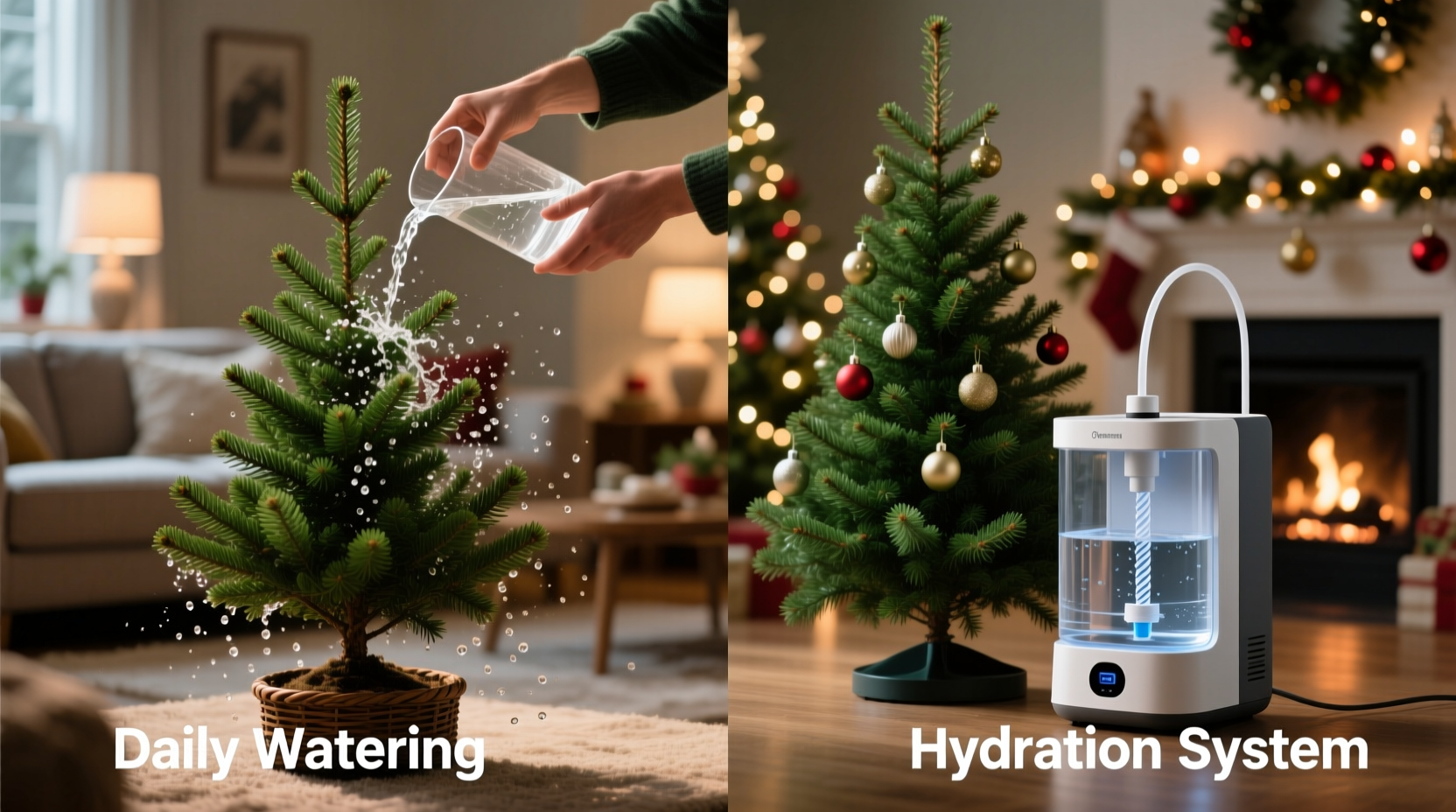
Comparative Analysis: Daily Watering vs. Hydration System
| Factor | Daily Manual Watering | Hydration System |
|---|---|---|
| Initial Cost | $ – $$ (stand only) | $$ – $$$ (device + possible installation) |
| Effectiveness (when maintained) | High | Very High |
| Reliability | Dependent on user discipline | Dependent on device function |
| Maintenance Frequency | Daily check required | Weekly refill typical; monitoring automated |
| Best For | Small households, budget-conscious users, single-tree homes | Large trees, busy families, tech-savvy users, multiple trees |
| Risk of Drying Out | Moderate to high if forgotten | Low, unless system fails unnoticed |
The data suggests that both methods can succeed—but success hinges on execution. A diligent homeowner with a daily routine may outperform someone relying on faulty automation. Conversely, a forgetful family benefits greatly from a fail-safe system.
Step-by-Step Guide to Optimal Tree Hydration
Regardless of method chosen, follow this timeline to maximize freshness:
- Make a fresh cut: Before placing the tree in the stand, trim ½ to 1 inch off the base. Do this within 4–6 hours of purchase to prevent sealing.
- Fill immediately: Submerge the cut end in room-temperature water right away. Use distilled or filtered water if tap water is highly chlorinated.
- Choose the right stand: Ensure the stand holds at least one gallon per inch of trunk diameter. Test stability before decorating.
- Set up your method: Install the hydration system or mark a daily reminder on your calendar or phone.
- Monitor the first week: Check water twice daily for the first 72 hours—this is peak absorption time.
- Maintain humidity: Use a nearby humidifier or place bowls of water around the tree to slow needle drying.
- Inspect regularly: Look for browning, musty smells, or sticky sap—signs of decay or pest infestation.
- Remove safely: Once water uptake stops completely and needles shed easily, take the tree down to avoid fire hazards.
Real-World Example: The Thompson Family Experiment
The Thompsons of Minneapolis decided to test both methods side-by-side during the 2023 holiday season. They purchased two Fraser firs of identical size (7.5 feet) and placed them in matching rooms with similar temperatures.
Tree A was watered manually each morning by the parents. Tree B used a gravity-fed hydration system with a five-gallon reservoir.
Results after 28 days:
- Tree A lost approximately 12% of its needles. One incident occurred where the stand ran dry overnight during a dinner party—leading to a noticeable dip in moisture recovery.
- Tree B retained nearly all needles (under 6% loss) and showed stronger scent retention. However, on day 20, a kink in the tubing reduced flow unnoticed for 36 hours until a visual check revealed slight wilting.
Their conclusion? Automation provided superior consistency, but only because they still performed weekly inspections. Without that check, Tree B might have declined rapidly.
Expert Recommendations and Best Practices
Industry experts agree that the goal isn’t necessarily choosing one method over the other—it’s ensuring continuous hydration through redundancy and awareness.
“The best system is the one that never lets the water run out. That could be a disciplined person or a reliable machine—but ideally, both.” — Greg Nelson, Executive Director, National Christmas Tree Growers Alliance
Here are key practices endorsed by arborists and holiday safety organizations:
- Never let the stand go dry: Even a few hours of exposure can form an embolism (air lock) in the xylem, blocking future uptake.
- Additives are optional: Commercial tree preservatives, sugar, or aspirin show minimal benefit in peer-reviewed studies. Plain water performs just as well.
- Keep away from heat sources: Maintain at least a 3-foot distance from fireplaces, radiators, and TV sets.
- Use LED lights: They emit less heat than incandescent bulbs, reducing moisture loss.
Essential Checklist for a Fresh Tree All Season
- ☐ Trim the trunk base before placing in stand
- ☐ Fill stand with water within 30 minutes of cutting
- ☐ Choose a stand with adequate capacity (minimum 1 gallon)
- ☐ Set daily alarm or install sensor alert system
- ☐ Check water level twice daily for first 72 hours
- ☐ Top off water every 24 hours or as needed
- ☐ Perform weekly inspection for mold, pests, and needle health
- ☐ Keep tree away from direct heat and sunlight
- ☐ Remove tree when water uptake ceases or needle loss exceeds 20%
Frequently Asked Questions
Can I rely solely on a hydration system without checking the tree?
No. Even advanced systems can fail due to clogs, power issues, or disconnections. Always perform visual checks at least once a week to confirm proper function and tree health.
How much water should my tree drink each day?
On average, a healthy tree consumes about one quart per inch of trunk diameter daily during the first week. A 4-inch trunk may drink a gallon per day initially, tapering off over time. Monitor your stand rather than assuming a fixed rate.
Is there a hybrid approach that combines both methods?
Yes—and it’s often the most effective. Use an automated system as your primary water source, but maintain a daily check habit. This creates redundancy: if the system fails, you’ll catch it quickly. Alternatively, use a smart stand that sends alerts while still requiring manual refills.
Final Verdict: Which Method Wins?
For most households, a hydration system offers measurable advantages in consistency and convenience, particularly during hectic holiday weeks. However, it should not replace human oversight—it should enhance it.
Daily manual watering remains a viable, cost-effective option for organized, attentive families. Its success depends entirely on routine adherence. Missed days equal dried trunks, accelerated needle drop, and increased fire risk.
The ideal solution lies in combining reliability with responsibility. Whether you choose technology or tradition, the core principle remains unchanged: continuous water contact with a freshly cut base is non-negotiable.
Take Action Today for a Healthier Holiday Tree
Your Christmas tree deserves more than decorative attention—it needs consistent care to stay safe, fragrant, and beautiful throughout the season. Evaluate your household’s habits, consider investing in a hydration aid if forgetfulness is a concern, and commit to a plan that ensures uninterrupted hydration.
Start tonight: inspect your stand, note your water level, and set a reminder. Whether you’re refilling by hand or trusting a smart sensor, the goal is the same—keeping nature’s holiday symbol alive and vibrant until the last gift is opened.




 浙公网安备
33010002000092号
浙公网安备
33010002000092号 浙B2-20120091-4
Comments
No comments yet. Why don't you start the discussion?